- Need-based procurement continues as mills anticipate further price corrections
- Supply transparency gains importance as uncertainty over billet origins persists
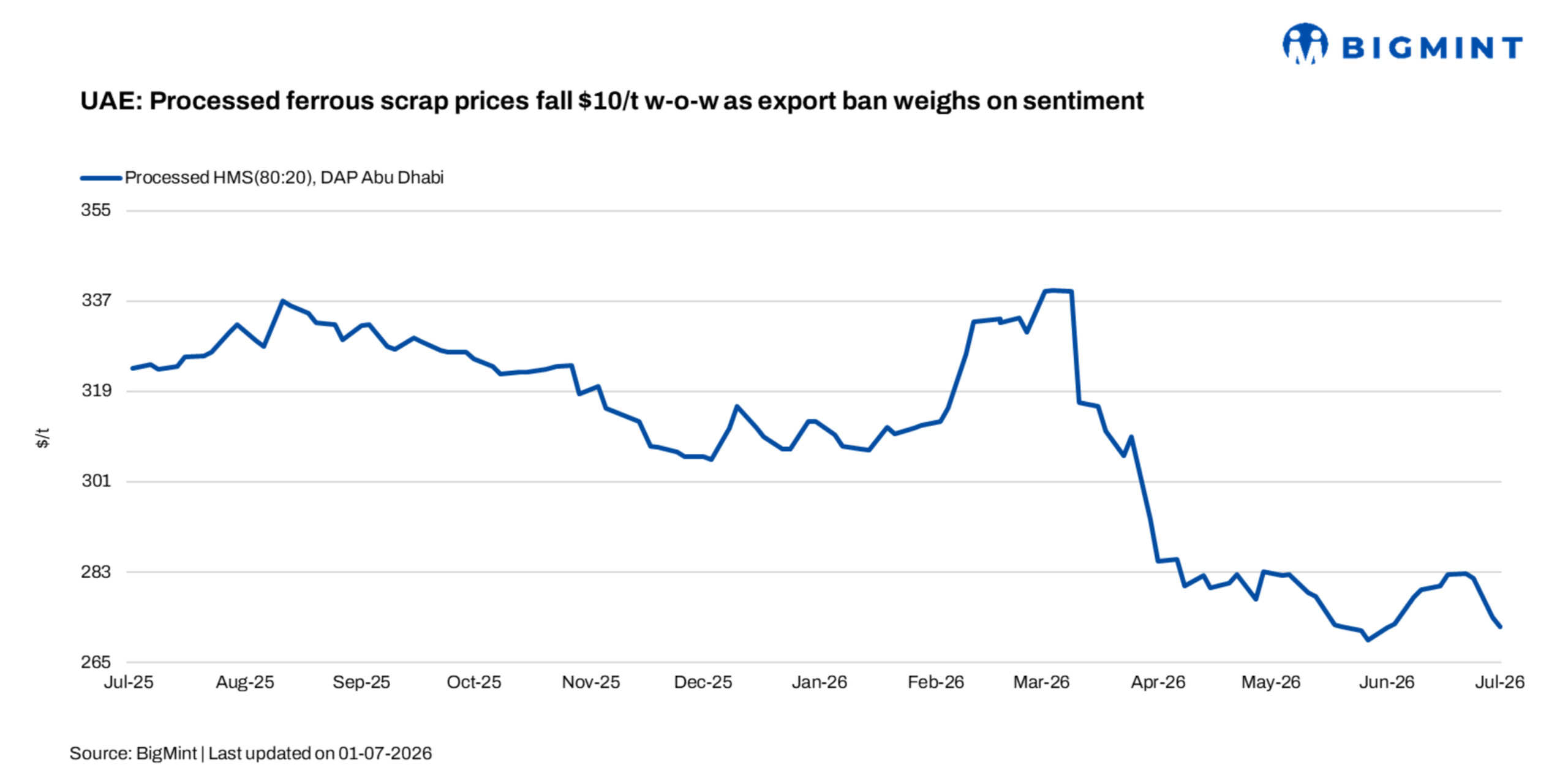
BigMint assessed processed HMS (80:20) scrap at AED 1,000/t ($272/t) DAP Abu Dhabi, down AED 35/t ($10/t) w-o-w, as trading activity remained subdued and buyers anticipated further price corrections following the UAE government’s temporary ban on exports of ferrous and Non-ferrous (Aluminium,Copper) scrap.
Most market participants adopted a wait-and-watch approach during the week ended on 3 July. Several mills were heard inquiring about HMS scrap at AED 900-950/t ($245-259/t) DAP last week, while the majority refrained from fresh bookings due to comfortable inventories and expectations of lower prices. Offers for processed HMS remained around AED 1,000/t ($272/t) DAP, although transactions were limited.
A UAE-based scrap processor told BigMint, “Most mills have sufficient inventories for now. Buyers expect domestic scrap availability to improve following the export ban, so they see little reason to rush into the market.”
Another trader added, “The export ban has affected market sentiment more than actual supply. Ferrous scrap exports from the UAE were already limited, but buyers believe additional domestic availability will put further pressure on local prices.”
While the export restriction is expected to have only a limited direct impact on the domestic ferrous scrap market, it reinforces expectations of improved local availability and has encouraged mills to delay procurement.
As per market insiders, the policy is expected to remain largely neutral for the ferrous scrap market, although it could provide longer-term support to regional scrap fundamentals by reducing export availability from the UAE.
Billet market faces supply transparency concerns
Alongside the softer scrap market, the UAE billet market continues to face procurement challenges despite improving regional logistics after the easing of Middle East tensions. Buyers are becoming increasingly focused on ECAS-certified billet availability, with certification compliance and supply transparency emerging as key procurement considerations alongside price.
Market participants said certified billet remains relatively tight, prompting buyers to diversify sourcing while carefully assessing the origin of imported material. Concerns have also resurfaced over the traceability of certain billet cargoes, with some traders questioning whether material declared from countries such as China, Oman or India may, in some cases, originate elsewhere through transshipment. Although these claims remain unverified, the uncertainty has made buyers more cautious when placing orders.
Industry sources also noted that some billet processed into rebar for export markets may not fall under the same ECAS certification requirements applicable to material intended for domestic UAE consumption. However, the implementation of these regulations remains unclear, adding another layer of uncertainty to procurement decisions.
Imported billet offers from China and Indonesia were heard around $520-530/t CFR UAE, but buying activity remained selective as mills prioritised supply security and certification over securing the lowest prices.
A regional billet trader told BigMint, “Price is no longer the only consideration. Buyers are increasingly asking where the billet comes from and whether it fully complies with ECAS requirements before committing to purchases.”
India’s billet exports to the UAE declined during the first two months of 2026. However, export activity picked up towards the end of the second quarter, with a few cargoes concluded to the Middle East, particularly Saudi Arabia, as weak domestic steel demand encouraged Indian mills to look for export opportunities. Despite lower direct shipments from India, market participants say billet remains readily available in the UAE, raising questions over alternative supply channels and the origin of some imported material. As a result, buyers have become increasingly cautious, placing greater emphasis on supply transparency and ECAS certification before committing to purchases.
Regional sentiment remains weak
In Pakistan, the UAE’s temporary scrap export ban added to market uncertainty, but weak domestic steel demand and sluggish construction activity remained the primary factors weighing on imported scrap prices. Mills continued to procure only on a need-based basis, delaying fresh bookings in anticipation of lower offers.
Outlook
The UAE processed ferrous scrap market is expected to remain under pressure in the coming weeks as mills continue need-based procurement and monitor the impact of the export ban on domestic availability. While prices may soften further in the short term, any sustained downside is likely to depend on domestic steel demand and inventory levels. In the billet market, certification compliance, supply transparency and traceability are expected to remain key purchasing criteria, with buyers likely to remain selective until greater clarity emerges regarding ECAS requirements and material origins.
Leave a Reply