- Prices tumble as steel demand weakens sharply
- Scrap to billet spread recovers slightly in June
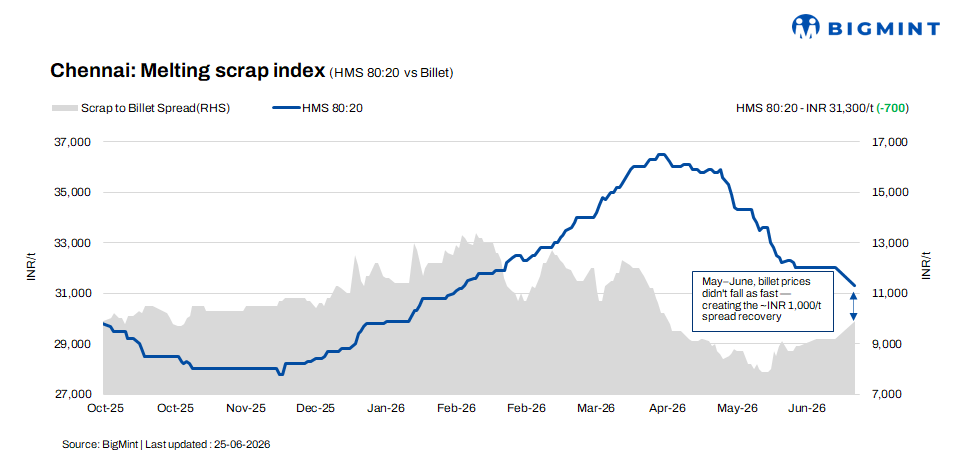
According to BigMints latest assessment, HMS (80:20) scrap prices in Chennai declined sharply by INR 700/t w-o-w to INR 31,300/t. In the semi-finished segment, billet prices remains unchanges since last two week and stand stable at INR 41,200/t,reflecting weak market sentiment.
Similarly, in the finished steel segment, rebar prices constant largily to INR 45,800/t. Market sources indicated that weak offtake from infrastructure and project segments continued to weigh on steel consumption, prompting mills to closely monitor production levels and inventories.
Scrap-to-billet spread recovers slightly in June
The scrap-to-billet spread in Chennai witnessed a modest recovery in June 2026, primarily driven by the recent correction in ferrous scrap prices while billet prices remained largely stable. The INR 700/t decline in HMS (80:20) scrap prices over the past week improved conversion margins for secondary steelmakers, providing some relief after margins had been under pressure in previous months. .
Imported and domestic price trends
Offer indications for Australia-origin shredded scrap were heard at $370-375/t CFR Chennai, while HMS 80:20 was quoted at $350-355/t CFR. Despite constrained domestic scrap availability, imported material attracted limited buying interest, as rupee depreciation increased landed costs and widened the price gap with domestic scrap. As a result, mills continued to rely primarily on local procurement, restricting import purchases to immediate requirements.

In the domestic market, HMS (80:20) scrap prices were quoted at INR 31,000-31,300/t for immediate payment deals, while credit-based transactions were concluded at slightly higher levels depending on payment terms and volumes.
Overall, trading activity remained concentrated within the INR 31,000-31,500/t range, reflecting stable supply-demand fundamentals. Variations in deal prices were primarily driven by payment terms, grade specifications, and mill-specific procurement requirements. Market participants continued to adopt a need-based purchasing strategy amid subdued finished steel demand.
Buyer-supplier sentiments
According to market participants, rebar inventories have increased to around 30-40 days as consumption from infrastructure and construction projects remains subdued. The accumulation of finished steel stocks has encouraged producers to prioritise inventory liquidation and operate at relatively lower utilisation rates, resulting in cautious and need-based scrap procurement.
Although billet prices have remained stable over the past two weeks, weak downstream steel demand has limited mills’ willingness to build raw material inventories. Improved domestic scrap availability and competitive offers from local suppliers further weighed on sentiment, exerting downward pressure on scrap prices.
Market sentiment remains cautious, with most mills procuring scrap only against immediate production requirements. Participants indicated that adequate domestic scrap availability and the absence of supportive demand-side drivers continue to limit buying interest.
Outlook
The Chennai ferrous scrap market is expected to remain under pressure through July unless demand from the construction and infrastructure sectors improves materially. While stable billet prices continue to support steelmakers’ conversion economics, elevated finished steel inventories and subdued steel consumption are likely to keep scrap procurement largely need-based. Adequate domestic scrap availability is also expected to cap any significant recovery in prices.

Leave a Reply