- Export curbs support domestic recycling ambitions
- Restriction effective from 10 June 2026
The UAE has imposed a temporary ban on the export of selected ferrous, copper and aluminium scrap, reinforcing its strategy to retain recyclable raw materials for domestic processing and support downstream manufacturing. While the move could tighten regional scrap availability, its immediate impact on India’s aluminium and copper scrap supply is expected to remain limited given the country’s diversified sourcing base.
The Government of the United Arab Emirates, through Dubai Customs Notice No. 13/2026, has announced a temporary prohibition on the export of specified industrial-use scrap, including ferrous, copper and aluminium scrap, effective 10 June 2026.
The restriction will remain in force for four months until 8 October 2026 and will be automatically renewed unless revoked through a subsequent Customs Notice.
The notification covers selected HS codes under:
- HS 7204 – Iron and steel waste and scrap
- HS 7404 – Copper waste and scrap
- HS 7602 – Aluminium waste and scrap

However, the Ministry of Foreign Trade may grant exemptions for shipments covered under international contracts signed before the ban or in cases considered to be in the public interest.
Part of broader UAE recycling strategy
The reported restriction appears to align with a broader shift in the UAE’s industrial policy towards treating recyclable materials as strategic resources rather than waste streams.
Over the past few years, the UAE has increasingly focused on building a circular economy by expanding domestic recycling capacity and downstream manufacturing. The country has also introduced measures to formalise the scrap sector, including the implementation of the Reverse Charge Mechanism (RCM) on scrap transactions from January 2026.
Historically, the UAE has moved away from outright export bans, instead relying on export duty mechanisms to balance domestic requirements with international trade. The latest notification signals a renewed emphasis on retaining recyclable materials within the country to support its growing recycling industry.
Industry estimates suggest that the UAE generates approximately 2-3 million tonnes (mnt) of ferrous scrap annually, nearly 50% of which is exported, primarily to South Asian countries such as Pakistan. The country is also estimated to generate around 1-2 mnt of aluminium scrap every year, although official production figures are not publicly available.
Retaining a larger share of this material domestically would strengthen feedstock availability for local recyclers and support the UAE’s ambitions to expand value-added aluminium production.
Limited impact on India’s aluminium scrap imports
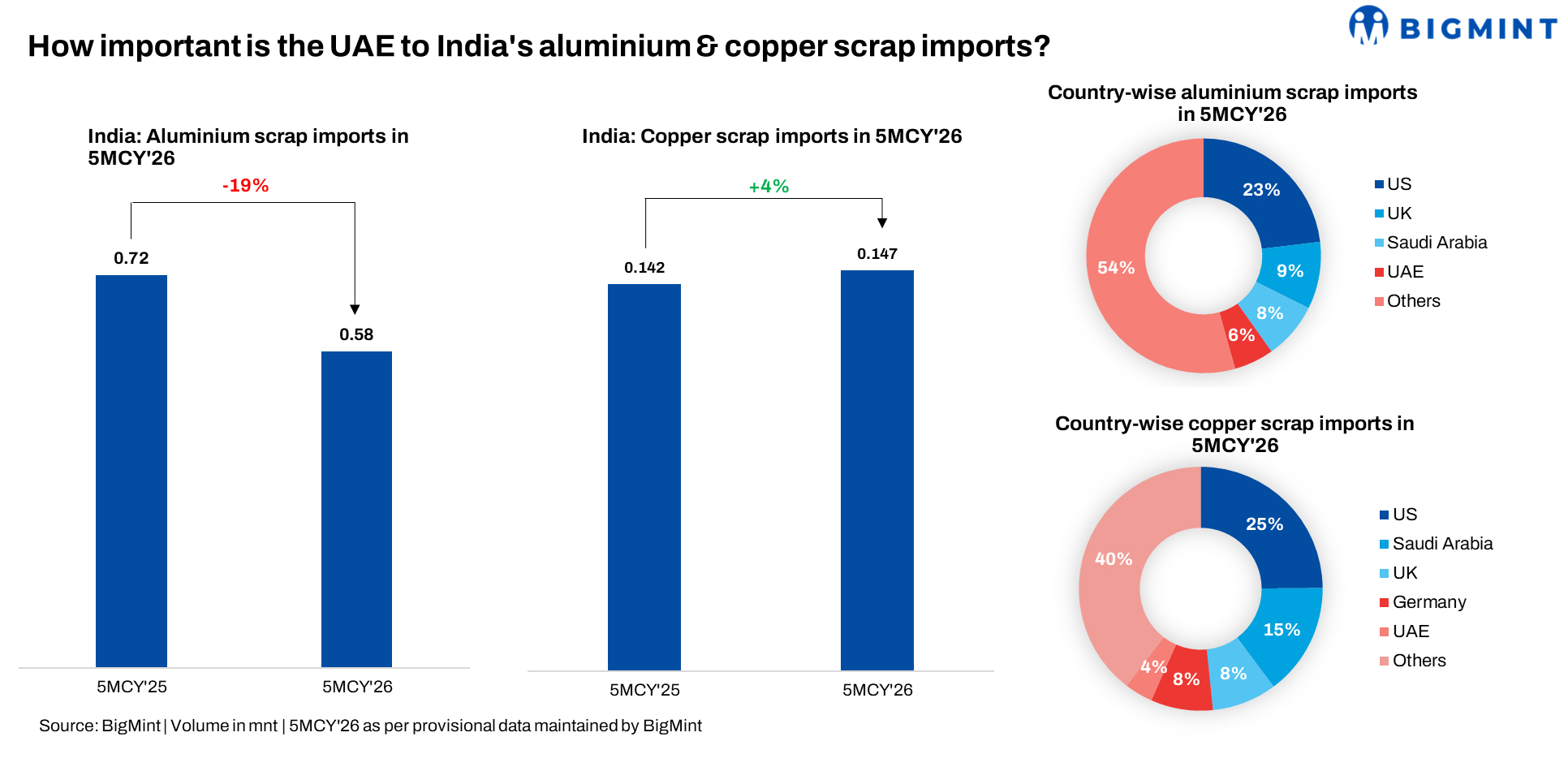
India imported 0.58 mnt of aluminium scrap during 5MCY’26, down 19% y-o-y from 0.72 mnt in the corresponding period last year.
Among all supplying countries, the UAE witnessed the sharpest decline. Aluminium scrap imports from the UAE fell 57% y-o-y to 32,176 tonnes during 5MCY’26, compared with 74,445 tonnes in 5MCY’25. Consequently, the UAE accounted for around 6% of India’s aluminium scrap imports during the period.
Despite the decline, the Middle East continues to remain an important regional supplier. In 2025, the region supplied approximately 381,154 tonnes of aluminium scrap to India, representing nearly 20% of the country’s total imports. Of this, the UAE alone contributed around 119,768 tonnes, accounting for approximately 8% of India’s overall aluminium scrap imports.
Although the UAE is not India’s largest supplier by volume, its strategic importance extends beyond market share. Shorter transit times, competitive freight costs and geographical proximity make UAE-origin material an attractive sourcing option for Indian secondary aluminium producers.
Overall, the temporary export restriction is unlikely to materially disrupt India’s aluminium scrap supply, given the country’s diversified sourcing base across North America, Europe and other Middle Eastern suppliers. However, prices of aluminium scrap grades that are predominantly sourced from the UAE could remain supported in the near term as reduced availability may tighten spot supply and increase procurement costs for Indian recyclers.
Copper scrap trade likely to remain largely unaffected
India imported 147,000 t of copper scrap during 5MCY’26, up 4% y-o-y from 142,000 tonnes a year earlier.
Of the total imports, only 5,529 t originated from the UAE, accounting for approximately 4% of India’s overall copper scrap imports.
Given the UAE’s relatively modest contribution and India’s diversified sourcing network across multiple exporting countries, the temporary export restriction is unlikely to materially affect copper scrap availability in the Indian market in the near term.
Outlook
While the immediate impact on India’s overall aluminium and copper scrap availability is expected to remain limited, the UAE’s latest policy underscores a broader shift towards retaining recyclable materials for domestic value addition rather than exporting raw scrap.
For the Indian market, overall supply is unlikely to face significant disruption due to diversified sourcing across North America, Europe and other Middle Eastern countries. However, aluminium scrap grades that are predominantly sourced from the UAE could witness firmer prices in the near term, as reduced export availability may tighten spot supply and increase procurement costs for Indian recyclers.
Over the medium term, continued investments in the UAE’s recycling infrastructure and downstream manufacturing could gradually reduce the volume of scrap available for export, prompting Indian buyers to diversify procurement and explore alternative origins. Market participants will also closely monitor whether the temporary restriction is extended beyond October 2026 or evolves into a longer-term policy, as this could have broader implications for regional scrap trade flows and pricing.
Leave a Reply