- Tight supply meets subdued buying interest
- Soft demand limits imported scrap deals
India’s imported aluminium scrap prices declined sharply w-o-w, tracking continued weakness in LME aluminium prices and subdued buying activity.
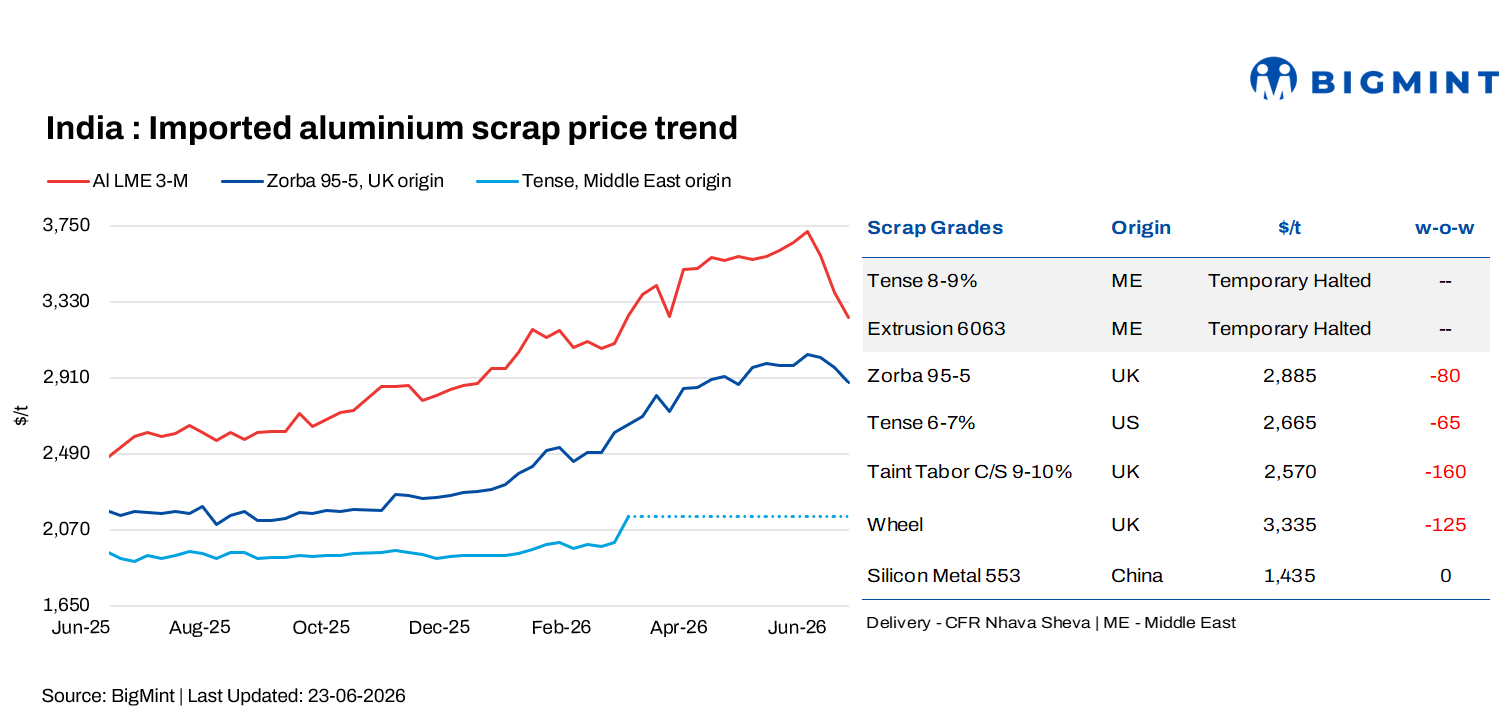
According to BigMint’s latest assessment for CFR Nhava Sheva deliveries, UK-origin zorba 95-5 scrap prices fell by $80/t w-o-w to $2,885/t, while US-origin tense 6-7% scrap prices declined by $65/t w-o-w to $2,665/t, reflecting cautious buying sentiment and softer global market trends.
LME aluminium weakens further w-o-w
Three-month aluminium prices on the London Metal Exchange (LME) traded lower w-o-w, closing at $3,240/t on 23 June against $3,390/t on 16 June, down by $150/t or 4.4% w-o-w.
Meanwhile, LME aluminium inventories declined by 5,700 t, or 1.8% w-o-w, to 313,800 t on 22 June from 319,500 t on 15 June, indicating continued destocking across LME warehouses.
Aluminium prices corrected as geopolitical tensions in the Middle East began to ease, reducing concerns over prolonged supply disruptions. The trend reversed after ceasefire discussions gained momentum and prospects of a broader US-Iran agreement improved. The reopening of the Strait of Hormuz further alleviated fears surrounding Gulf exports, prompting the market to unwind a significant portion of the geopolitical premium that had built up during the conflict. As supply concerns eased and risk-driven buying subsided, aluminium prices corrected by nearly 10% from their highs.
Market scenario
India’s imported aluminium scrap market remained under pressure this week, amid a sharp correction in LME aluminium prices following the easing of geopolitical tensions in the Middle East. Trading activity was largely subdued as buyers adopted a cautious stance due to heightened price volatility and uncertainty over the near-term direction of global aluminium markets. Market participants noted a widening gap between suppliers’ offer levels and prevailing domestic market prices, making it difficult to conclude deals. At the same time, weaker demand and lower trading volumes in the local market further weighed on sentiment.
Despite continued tight availability of imported scrap, softer domestic fundamentals limited buyers’ willingness to accept higher offers. Market participants reported that current supplier prices were difficult to match, particularly as domestic aluminium scrap prices and transaction volumes have declined in recent weeks.
Meanwhile, logistics sentiment improved significantly following the reopening of the Strait of Hormuz and the implementation of the US-Iran ceasefire. Vessel traffic through the strategic waterway rebounded sharply, easing concerns over potential supply chain disruptions and supporting smoother trade flows. The improvement was further aided by a reported agreement between the US and Iran to facilitate the safe passage of commercial vessels, encouraging greater participation from international shipping operators.
In addition, reports regarding a potential restriction on aluminium scrap exports from the UAE circulated in the market. However, with no official confirmation from authorities, market participants remain cautious and continue to monitor developments while awaiting greater clarity on both the policy front and the direction of LME aluminium prices before committing to fresh purchases.

On the domestic front, trading activity also weakened. Following softer global aluminium prices, the domestic market witnessed a notable decline, particularly in casting-grade aluminium scrap prices, which fell sharply w-o-w across both southern and northern regions amid weak demand and cautious buying sentiment.
Chinese silicon prices
According to BigMint’s latest assessment, China-origin silicon metal 553 prices remained stable w-o-w at $1,435/t CFR Mundra, supported by firm import offers, steady demand, and stable market sentiment.
Outlook
India’s imported aluminium scrap market is expected to remain under pressure in the near term as subdued demand, lower domestic prices, and cautious buying sentiment continue to weigh on trading activity. While tight scrap availability and declining LME inventories may offer some support, buyers are likely to remain watchful until there is greater clarity on LME price trends and potential policy developments regarding UAE scrap exports.
Leave a Reply