- Rebar prices drop on rainfall-driven construction slowdown
- Firm coking coal prices offer cost support as iron ore dips
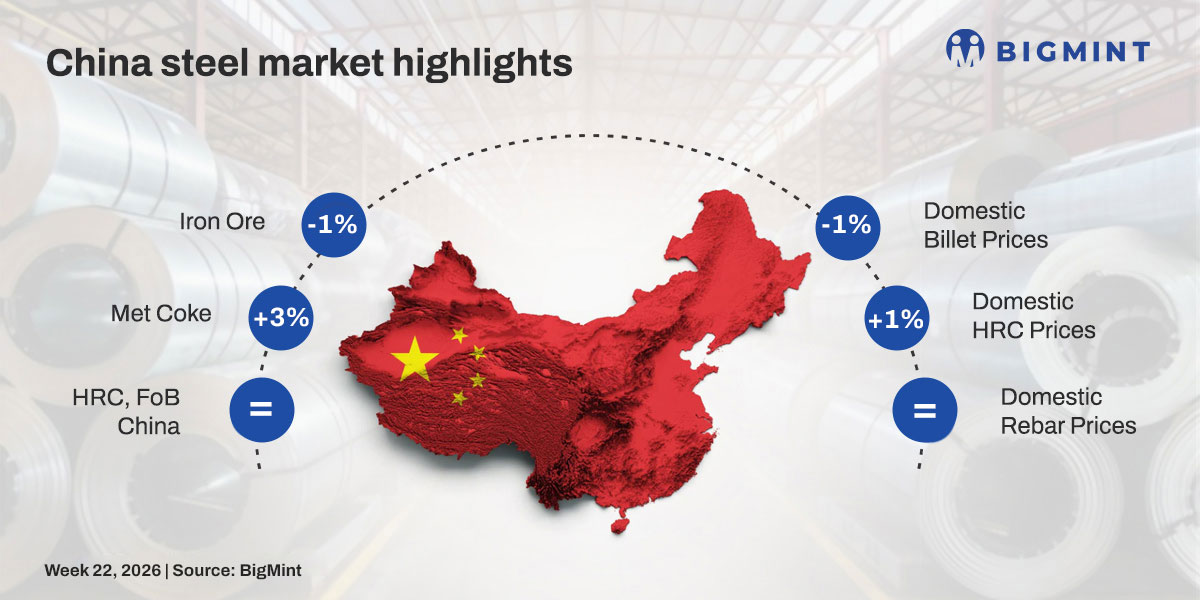
China’s steel prices showed mixed trends in the week ended 29 May 2026, with domestic hot-rolled coil (HRC) increasing while rebar prices fell w-o-w. On the raw materials front, prices of iron ore and billets also trended downward, though domestic coking coal prices were stable w-o-w.
Slower offtake led to the accumulation of unsold material. The China Iron and Steel Association (CISA) reported that the total steel inventories at key CISA mills stood at around 18.77 million tonnes (mnt) in mid-May (11-20 May), an increase of 1.89 mnt or 11.2% compared with 16.88 mnt in early-May. Compared with the previous month, inventories inched up by 140,000 tonnes (t) or 0.8% m-o-m from 18.63 mnt in mid-April. Furthermore, compared with the same period last year, inventories increased by 2.42 mnt, or 14.8% y-o-y, from 16.35 mnt recorded in mid-May 2025.
Steel prices show mixed trends
Domestic HRC prices increase w-o-w: Chinese HRC prices increased by RMB 20/t ($3/t) w-o-w to around RMB 3,250/t ($480/t) on 29 May from RMB 3,230/t ($477/t) from the previous week. However, SHFE HRC futures (October 2026 contract) edged down by RMB 7/t ($1/t) w-o-w to RMB 3,378/t ($499/t) from RMB 3,385/t ($500/t) a week earlier. Meanwhile, China’s HRC export offers stood at around $520/t FOB Rizhao, stable w-o-w.
The domestic HRC prices inched up this week, whereas on the demand side market remained weak. Growing caution among traders and the onset of the seasonal demand slowdown kept transactions subdued, while easing supply-demand dynamics further pressured market sentiment.
Amid disruptions in global demand and slower trade activity, Chinese HRC export offers remained stable.
Rebar prices decrease w-o-w: Rebar prices in China were down by RMB 10/t ($1/t) w-o-w to around RMB 3,310/t ($489/t) as on 29 May, compared with RMB 3,320/t ($490/t) in the previous week. Moreover, SHFE rebar futures (October 2026 contract) also inched down by RMB 14/t ($2/t) w-o-w to RMB 3,157/t ($466/t) as on 29 May from RMB 3,171/t ($468/t) a week earlier. Seasonal demand weakness, caused by rainfall in the south and heat in the north, slowed construction activity.
Raw material prices
Iron ore spot prices decline w-o-w: Benchmark iron ore fines prices (Fe 61%) declined by $1/dmt w-o-w to $105/dmt CFR China on 29 May.
Prices dropped as additional cargoes of low-grade Australian fines entered the Chinese portside market, weighing on sentiment despite expectations of firm steel production in China. As per reports, Chinese mills are closely monitoring developments in the coking coal and coke markets. Recent supply concerns following the Liushenyu coal mine accident and a fourth round of coke price hikes have increased raw material costs for steelmakers. Higher coal and coke costs could narrow steel margins and reduce mills’ appetite for iron ore purchases.
a) Spot pellet premium remains firm w-o-w: The spot pellet premium for Fe 65% grade pellets stood at $17.85/t CFR China on 27 May.
b) Spot lump premium unchanged w-o-w: The spot lump premium remained stable w-o-w at $0.1825/dmtu on 29 May.
China’s coking coal market stays firm: China’s coking coal market remained firm, supported by supply-side constraints arising from production disruptions, intensified mine safety inspections, and restricted output across key mining regions, including Shanxi and Shaanxi. On the demand side, healthy coke plant operating rates, low coking coal inventories, and sustained blast furnace utilisation continued to support procurement activity. Additionally, expectations of further coke price increases in China reinforced bullish sentiment across the metallurgical coke supply chain.
Meanwhile, Australian premium hard coking coal (PHCC) prices remained stable w-o-w at $241/t FOB as of 29 May 2026. Reflecting steady international market conditions, BigMint’s PHCC index also remained unchanged at $268/t CNF Paradip, India.
Chinese billet prices decline w-o-w amid weak demand: Chinese billet prices declined to RMB 3,010/t ($444/t) on 29 May from RMB 3,040/t ($447/t) on 22 May, pressured by sluggish downstream steel demand, slower inventory digestion, and cautious market sentiment.
Prices briefly increased to RMB 3,060/t ($451/t) on 25 May after a major coal mine accident in China triggered a sharp rise in coking coal futures and expectations of tighter coal supply. However, the market later corrected as weak steel consumption, softer iron ore prices, and stable steel output levels weighed on sentiment.
Billet export offers from China were heard around $472/t FOB (down by $4/t) during the week, as export activity remained subdued amid holiday-related slowdowns in overseas markets and uncertainty surrounding potential new EU tariffs on Chinese steel exports.

Outlook
The domestic steel market is expected to face continued demand weakness in June 2026. Seasonal weakness in downstream demand, slower inventory drawdown, and increasing supply pressure are likely to keep long steel prices under pressure.
Leave a Reply