- FY26 spice exports decline 5.3% on weaker cumin and chilli shipments
- Turmeric, coriander demand stays resilient despite geopolitical disruptions
India’s spice exports remained under pressure in FY26 as geopolitical tensions in the Middle East, rising freight costs, and subdued overseas demand disrupted trade flows across key commodities. Total spice export earnings declined 5.3% y-o-y to $2.80 billion from $2.96 billion in FY25, largely due to weaker cumin and chilli exports.
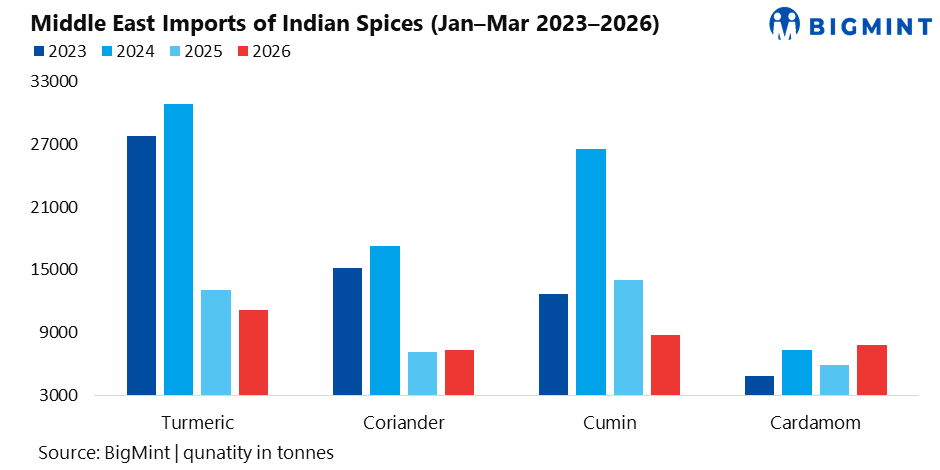
Cumin recorded the sharpest decline among major spices, with export value falling 28.4% y-o-y to $524.2 million from $732.3 million a year earlier. India’s cumin exports to the Middle East during January-March 2026 dropped sharply to 6,735 t compared with 11,951 t in the same period last year and 24,535 t in 2024, reflecting significantly weaker regional demand.
Gulf tensions disrupt spice trade
Trade participants said the Iran-Israel-USA conflict emerged as a major bearish factor for spice markets during the quarter. Concerns over potential disruption in the Strait of Hormuz triggered volatility in crude oil prices and shipping movement, resulting in higher freight rates, war-risk premiums, and marine insurance costs for Gulf-bound cargoes.
Exporters reported freight costs to West Asia increased by 15-25% during peak escalation periods, while delayed vessel schedules and container shortages affected shipments to the UAE, Saudi Arabia, Iraq, and Iran. Buyers largely adopted a cautious hand-to-mouth purchasing strategy amid uncertainty over logistics and crude oil movement.
China demand weakens
Indian cumin exports also faced pressure from weaker Chinese buying interest. One exporter source said China had sufficient domestic cumin production this season, reducing immediate import dependence on India.
“China’s crop outlook is better this year and harvesting is expected by May-end or June, so buyers remained inactive in the international market,” the source said.
The slowdown in Chinese demand affected sentiment in Gujarat’s Unjha market, where traders reported slower export enquiries despite farmers continuing to hold quality stocks expecting price recovery later in the year.
UAE, Saudi Arabia cut cumin imports
Country-wise trade data showed the UAE remained the largest Middle Eastern buyer of Indian cumin, although imports declined considerably during January-March. UAE imports declined nearly 45% y-o-y from 8,735 t last year. Saudi Arabia’s imports also dropped to 539 t during January-March from 1,132 t a year earlier.
Coriander and turmeric remain stable
Unlike cumin, coriander exports showed resilience. FY26 export earnings rose 2.9% y-o-y to $77.04 million, while Middle East export volumes during January-April reached 5,253 t, marginally above 5,064 t last year.
Turmeric exports declined modestly by 4.2% y/y to $327.2 million. January-April Middle East turmeric shipments fell to 9,100 t from 11,037 t in 2025 due to abundant Indian supplies, although demand from food-processing and nutraceutical sectors supported premium high-curcumin varieties.
Meanwhile, cardamom remained the strongest-performing spice, with export earnings surging 112% y-o-y to $449.5 million amid strong Gulf demand ahead of Ramadan.
The near-term outlook for India’s spice trade remains volatile, with market direction dependent on developments in the Middle East, crude oil prices, Gulf freight movement, and post-harvest Chinese cumin demand.
Leave a Reply