- Rupee risks entering triple-digit territory
- Foreign investor outflows hit record highs
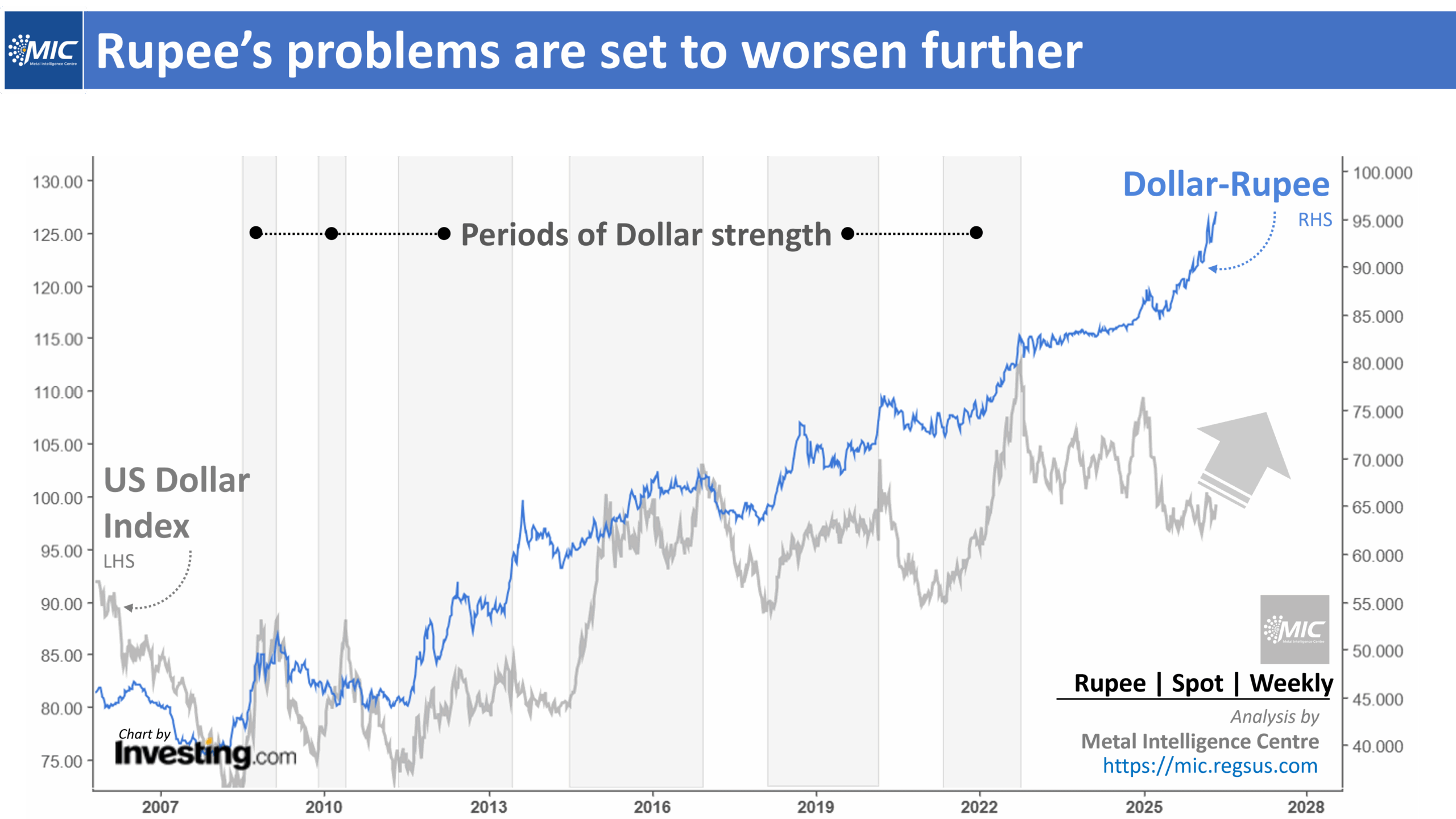
Metal Intelligence Centre: Since September 2022, the Indian Rupee has depreciated by nearly 16%, despite the US Dollar Index (DXY) falling around 14% during the same period. This divergence is highly unusual. Historically, the Rupee has typically appreciated during phases of Dollar weakness, as witnessed during periods such as 2010-2011, 2013-2017, and 2020-2021. However, the recent depreciation trend has been driven less by global currency movements and more by domestic vulnerabilities, particularly widening trade deficits and sustained capital outflows.
While these structural challenges remain unresolved, the external environment is now becoming even more concerning for the Indian currency. After almost four years of decline, the US Dollar Index appears to be positioning for a fresh upward cycle. For the Rupee, already trading near record lows despite repeated interventions by the Reserve Bank of India (RBI), this could create significant additional pressure.
Several factors are now aligning in favour of a stronger Dollar. The US economy has continued to display resilience, supported by a firm labour market and persistent inflationary pressures. Recent economic data from March and April reinforced expectations that the Federal Reserve may maintain a tighter monetary stance for longer, even amid geopolitical tensions arising from the Iran war. Fed futures currently indicate a 45% probability of at least one 25 basis point rate hike by the end of 2026, further strengthening the case for Dollar appreciation.
Historically, periods of Dollar strength have coincided with weakness in emerging market currencies, including the Indian Rupee. The Dollar Index, which measures the US currency against a basket of major global currencies, tends to rally sharply during phases of monetary tightening by the Federal Reserve. Past Dollar upcycles have repeatedly pushed the Rupee toward fresh lows, with the severity of depreciation depending on factors such as oil prices, foreign capital flows, and the pace of Dollar appreciation.

India’s domestic economic challenges have further intensified pressure on the currency in recent years. In 2024, following a weaker-than-expected GDP print, Foreign Institutional Investors (FIIs) withdrew nearly $6.8 billion from secondary equity markets. Although primary equity and debt markets still attracted approximately $11 billion in inflows, investor sentiment remained fragile. In 2025, trade tensions with the United States widened India’s trade deficit and triggered an additional $5 billion in net foreign outflows. The situation worsened in 2026 after the Iran war drove energy prices sharply higher, resulting in record year-to-date FII outflows of nearly $22 billion.
Against this backdrop, a broad-based Dollar rally could significantly amplify downside risks for the Rupee. Despite RBI interventions aimed at stabilising the currency, market pressures continue to build, raising concerns over the sustainability of current levels.
Economists and market participants increasingly believe that incremental measures may no longer be sufficient. Instead, the RBI may need to consider broader macroeconomic actions such as calibrated rate hikes and issuance of attractively priced Dollar bonds to restore investor confidence. Simultaneously, the government may have to accelerate structural reforms focused on attracting long-term foreign capital and reducing dependence on imports, particularly energy imports.
So far, however, the policy response has remained largely tactical rather than strategic. As global and domestic pressures converge, concerns are growing that the Rupee could move toward triple-digit levels against the Dollar before the end of the year if corrective measures are delayed. Although a decline in oil prices could provide temporary relief, it may not be enough to offset the impact of a sustained Dollar rally.
With domestic vulnerabilities persisting and external risks intensifying, the Indian Rupee appears to be entering one of its most challenging phases in recent years — a situation many analysts now describe as a perfect storm for the currency.
Note: This article has been published as part of a content partnership between MIC and BigMint.
Leave a Reply