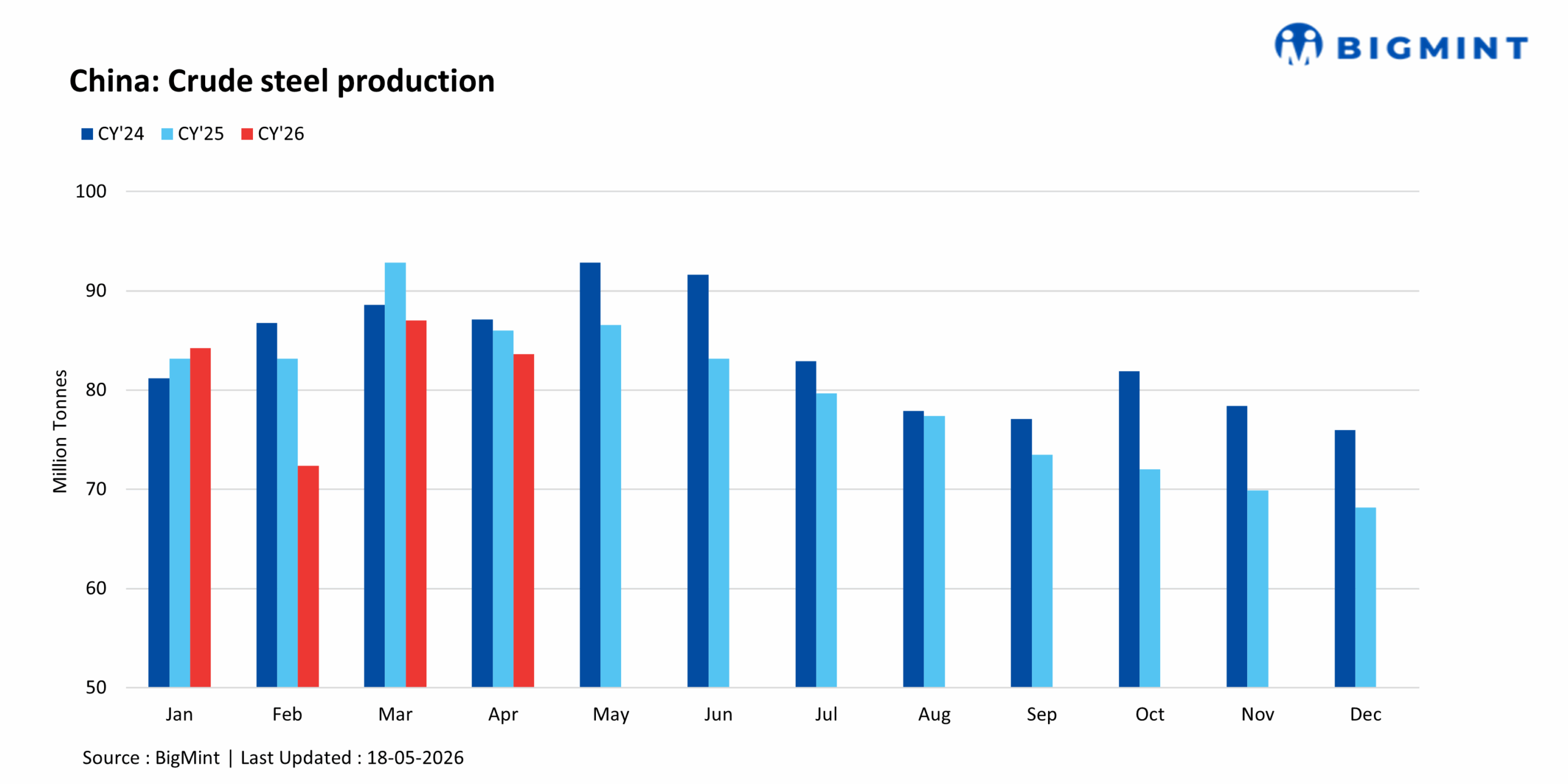
- China produced 331.12 mnt of crude steel during Jan-Apr’26
- Weak demand, cautious sentiment continue to pressure steel market
China’s crude steel production reached 83.63 million tonnes (mnt) in April 2026, marking a decline of 2.8% y-o-y, according to data from the National Bureau of Statistics (NBS). Furthermore, crude steel output in January-April 2026 stood at around 331.12 mnt, down 4.1% y-o-y.
Factors affecting crude steel output
Weak domestic demand: Demand remained subdued as weaker construction and manufacturing activity reduced procurement appetite, leading to slower transactions and rising inventories. During the Qingming holiday (6-8 April), buyers adopted a cautious stance and limited purchases to immediate requirements, avoiding large-scale restocking amid uncertain market conditions.
A similar trend was observed before the May Day holiday, when traders and end-users refrained from building fresh inventories and focused only on demand-based procurement. Even though rebar prices increased, demand from the construction sector remained weak, and new orders were limited. Buyers became more cautious toward higher prices, keeping overall market confidence and trading activity under pressure.
Reflecting this trend, data from China’s National Bureau of Statistics shows that total real estate development investment declined by 13.7% y-o-y to RMB 2,396.9 trillion ($352 trillion) in January-April, adding further pressure on overall steel demand due to the continued slowdown in the property sector.
Decline in steel exports: China’s steel exports are navigating a difficult phase as global uncertainties continue to reshape trade dynamics. Escalating tensions in the Middle East have disrupted shipping routes, increased freight and insurance costs, and created volatility across key export markets. Meanwhile, global steel demand remains weak, with the World Steel Association projecting only 0.3% growth through 2026, reflecting sluggish construction activity and uneven industrial recovery worldwide.
At the same time, rising protectionist measures in countries such as India, Vietnam, Malaysia, South Korea, and Brazil are making overseas markets tougher for Chinese steelmakers. Increasing anti-dumping duties and trade restrictions have reduced the competitiveness of Chinese steel products globally. Adding to the challenge, China’s export licensing rules introduced in January 2026 for nearly 300 steel categories have increased compliance requirements, slowing shipment flows during the early phase of implementation.
Leave a Reply