- Heatwave lifts peak demand, tightening supply on Indian Energy Exchange
- Coal-led supply lags demand, driving higher spot power rates
Generation rises 6.5% as coal and renewables lead the way
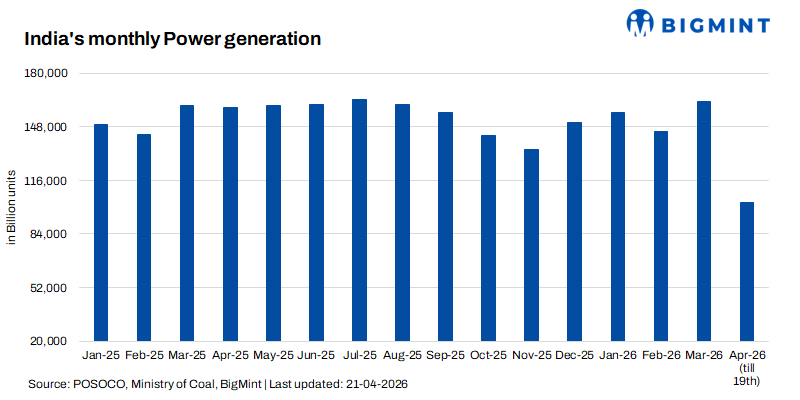
India’s power sector is feeling the heat. During the first 19 days of April 2026, total electricity generation reached 102,855 million units (MU) , according to official data from the Central Electricity Authority. That is 6.5% higher than the 96,578 MU generated over the same period in 2025.
The increase came mostly from coal and renewables. Coal-fired generation rose from 71,437 MU in April 2025 to 73,039 MU in April 2026 – a gain of 2.2%. But the real star was renewable energy (wind, solar, biomass, and others). Renewable generation jumped from 14,443 MU to 17,061 MU, an increase of 18.1%. Hydropower also climbed from 5,936 MU to 6,835 MU, helped by higher reservoir levels and early snowmelt.
Gas, naphtha, diesel, lignite, and nuclear generation all saw small declines, but their combined share of total generation remains below 10%.
Peak demand hits new highs
The heatwave is the main driver. Maximum power demand met during the day has been consistently higher in 2026 compared to 2025.
In the first 19 days of April 2025, the highest peak demand was 223,554 MW (on April 9). In 2026, demand has already crossed that mark multiple times. On April 17, 2026, demand peaked at 238,945 MW – the highest so far. April 18 was nearly as high at 238,805 MW.
Even on cooler days, demand remains strong. The average peak demand for the first 19 days of April 2026 is 221,300 MW, compared to 213,500 MW in 2025 – a rise of nearly 4%. The timing of peak demand has also shifted slightly later into the evening, reflecting increased use of air conditioners after sunset.
IEX market turns tight as buyers scramble for power
The most dramatic changes are visible on the Indian Energy Exchange (IEX). As temperatures rose, buyers rushed to secure power, while sellers held back.
In early April 2025, purchase bids and sell bids were relatively balanced. But by late April 2025, a sharp imbalance emerged: on April 22, 2025, purchase bids reached 590,829 MWh while sell bids were only 149,673 MWh – more than three times as much demand as supply.
A similar pattern is unfolding in 2026, but even more intensely. On April 17, 2026, purchase bids soared to 749,118 MWh, while sell bids stood at just 294,183 MWh. That is a ratio of over 2.5 buyers for every seller.
The result? Market Clearing Volume (MCV) – the actual power traded – has not risen as fast as demand. On April 17, 2026, MCV was 154,370 MWh, only slightly higher than the 132,152 MWh traded on the same day in 2025. The market is struggling to match buyers with sellers, forcing many buyers to go unscheduled.
Spot prices explode higher
With so many buyers chasing limited sell bids, electricity prices have surged.
In April 2025, the daily Market Clearing Price (MCP) averaged around INR 4,200-4,500 per MWh for most of the month, with occasional spikes above INR 6,000. The highest in April 2025 was INR 7,480 on April 22.
In April 2026, prices have been higher from the very start. After a relatively calm first week (INR 3,700-5,000), prices began climbing sharply from April 13 onward. On April 16, MCP hit INR 6,764. On April 17, it reached INR 6,805. On April 18, it was INR 6,730. On April 19, it was still high at INR 5,544.
For the first 19 days of April 2026, the average MCP is approximately INR 4,450 per MWh, compared to INR 4,150 in 2025 – a rise of about 7%. However, the peak prices in 2026 are already nearly as high as last year’s maximum, and the heatwave is not over yet.

What this means
India is experiencing an earlier and stronger heatwave in 2026 compared to 2025. Power generation has increased, but peak demand has grown even faster. The IEX market shows clear signs of strain: buyers are desperate, sellers are cautious, and prices have risen sharply.
Coal remains the backbone of Indian power, supplying over 70% of generation. But renewables are playing a growing role, adding nearly 2,600 MU more than last year. Even so, on the hottest days, the market tightens quickly. If temperatures continue to rise through late April and May, India could see new demand records and even higher electricity prices.
For now, the system is coping – but the margins are getting thinner. The next two weeks will be critical.

Leave a Reply