- Sub-threshold iron ore gets separate ASP mechanism
- Royalty to be levied on lumps and fines post screening
India has introduced a structural correction to its iron ore pricing framework with the notification of the Minerals Concession (Third Amendment) Rules, 2026 on 10 April. The amendment creates a separate Average Sale Price (ASP) mechanism for sub-45% Fe iron ore, addressing a long-standing distortion in royalty assessment.
Until now, iron ore below the Fe 45% threshold – including BHQ and BHJ (Fe 30-48%) – was benchmarked against the Fe 45-51% ASP, despite having no comparable market value. This resulted in disproportionately high royalty outgo, making beneficiation projects commercially unviable.
According to Indian Bureau of Mines, India holds around 35.29 billion tonnes of iron ore reserves/ resources (haematite and magnetite combined as on 1 April 2020). A substantial share of this lies below Fe 45%, largely in the form of BHQ (Banded Haematite Quartzite) and BHJ (Banded Haematite Jasper), typically assaying Fe 30-48%. While beneficiation technologies today are capable of upgrading such material to Fe 64%+ pellet-grade concentrates, their commercial utilisation remained limited.
The constraint was not technological, but fiscal. The absence of a realistic pricing benchmark meant that low-grade ore could not be processed economically despite its technical viability.
Policy gap bridged
Until 10 April, te Indian Bureau of Mines (IBM) did not publish an Average Sale Price (ASP) for haematite iron ore below Fe 45%. In practice, the ASP of the Fe 45-51% band was applied uniformly to all sub-threshold material.
This created a distortion where ore with Fe 30-44% attracted royalty and auction premiums at the same base as significantly richer material. As a result, beneficiation economics were fundamentally misaligned, making project-level financial modelling difficult and, in many cases, unviable.
Discounted ASP structure :

Relief uniform in structure but impact uneven
While the formula is standardised, the quantum of benefit will vary across states due to differences in ASP levels. With February 2026 ASP data as reference, higher-ASP states such as Karnataka are likely to see the sharpest absolute reduction in statutory costs, followed by Odisha, while states like Goa and Madhya Pradesh will see relatively lower gains.
Quality deterioration makes this shift timely
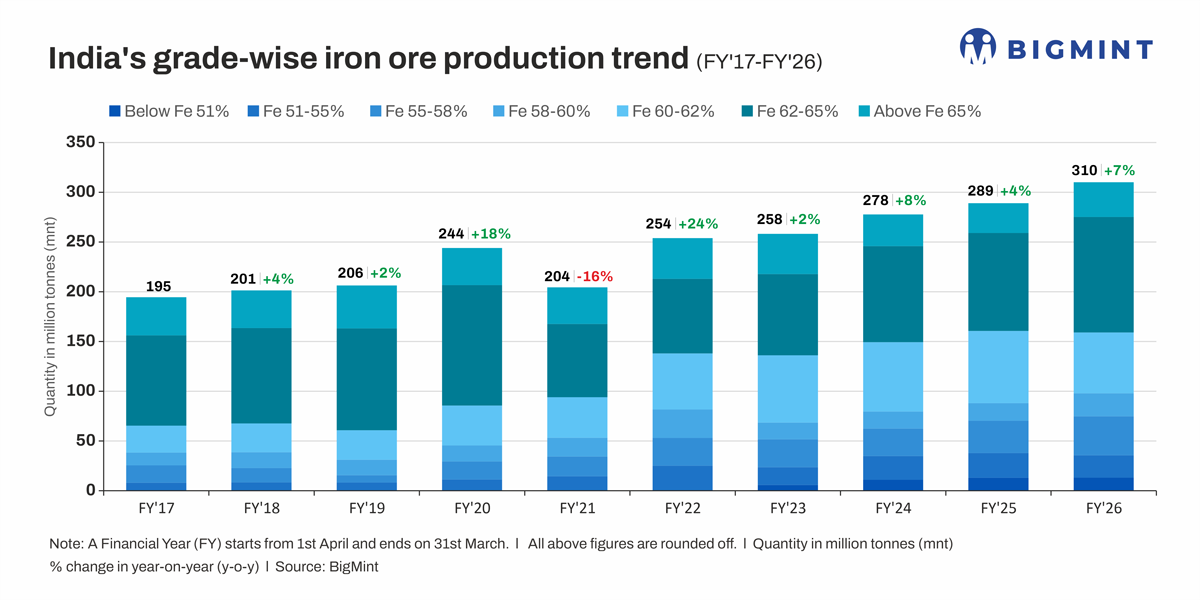
On a comparison note, India’s production of below 51% Fe grade jumped significantly from 5.8 mnt in FY’23 to 13.3 mnt in FY’26, gaining 129% hike in a matter of years. The policy comes at a time when India’s iron ore sector is undergoing a structural decline in grade quality. Even as total production has increased, the share of high-grade ore has reduced, with a growing proportion of output falling in lower-grade bands.
This has already begun to affect blast furnace efficiency, pellet quality, and import dependence, particularly for high-grade ore and pellets. In this context, beneficiation is transitioning from an optional process to a structural necessity.

Closing regulatory gaps
The amendment also introduces important clarifications around royalty applicability. It specifies that royalty on run-of-mine ore will be levied on lumps and fines after initial screening, while also restricting any artificial lowering of ore value through processing declarations. This ensures that while the framework becomes more realistic, it remains robust against misuse.
Outlook
The new ASP framework is expected to improve the viability of beneficiation and pellet feed production, particularly for operators handling BHQ and BHJ. By establishing a defined royalty baseline, it enables investors and mine lessees to evaluate projects with greater clarity, which could gradually support capacity expansion across the value chain.
However, the pace of impact will depend on capital deployment, operating costs, and demand visibility from the steel sector. While the policy provides the foundation, execution will determine the scale of transformation.
Leave a Reply