- Tight supply drives price surge
- High input costs pressure margins
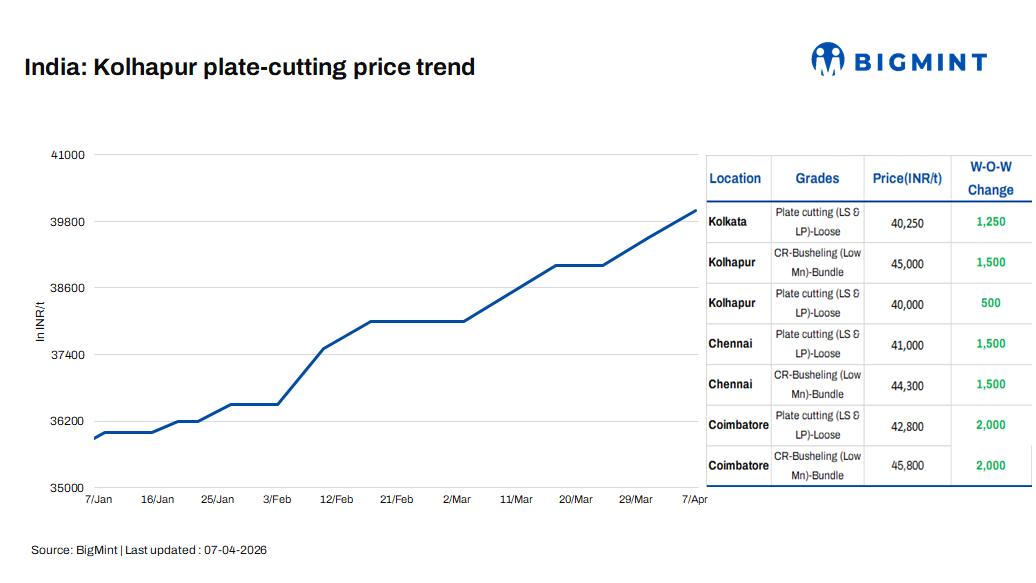
Foundry-grade scrap prices across India continued their upward trajectory, as assessed on 7 April 2026, with stronger gains compared to the previous week. The rally remains supply-driven, supported by tight availability of CR-busheling and rising replacement costs.
Western India leads momentum
In Kolhapur, prices witnessed a sharp uptick, especially in prime grades:
Plate-cutting scrap (4-8 mm) increased by INR 500/t to INR 40,000/t
CR-busheling (low Mn) surged by INR 1,500/t to INR 45,000/t
The significant rise in CR-busheling reflects acute shortage of high-quality scrap, driven by reduced generation from OEMs and tight CRC availability.
South Indian markets show acceleration
Markets in south India saw stronger-than-expected gains, indicating reduced resistance at higher price levels:
Coimbatore
Plate-cutting scrap rose sharply by INR 2,000/t to INR 42,800/t
CR-busheling increased by INR 2,000/t to INR 45,800/t
Chennai
Plate-cutting scrap gained INR 1,500/t to INR 41,000/t
CR-busheling moved up INR 1,500/t to INR 44,300/t
The stronger rise this week suggests tightening supply conditions outweigh buyer resistance, particularly for prime scrap grades.
East Indian markets remain firm
Kolkata
In Kolkata, plate-cutting scrap (4-8 mm) prices rose by INR 1,250/t to INR 40,250/t, supported by limited inflows and stable regional demand.
Overall market momentum continues to be driven by supply-side constraints, as scrap generation remains restricted due to lower OEM production, with many units operating at reduced capacity (single shift). Additionally, challenges in sourcing import-dependent CRC material are limiting the availability of CR-busheling grades. As a result, the current price rise is largely cost-driven rather than demand-led, with casting and engineering demand remaining steady but not aggressive, thereby exerting continued pressure on foundry margins as higher input costs are not fully passed on.
Outlook
Foundry scrap prices are expected to remain firm in the near term, supported by persistent supply tightness, elevated replacement costs, and continued constraints in prime scrap availability. These factors are likely to keep market sentiment positive and support price levels.
Leave a Reply