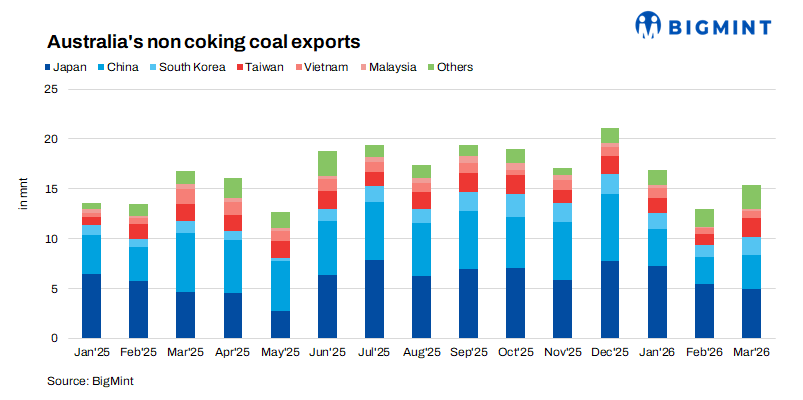
- Exports rise over 19% m-o-m to 15.4 mnt in Mar’26
- Demand up in China, South Korea, Taiwan and Vietnam
Australia’s non-coking coal exports recorded a significant increase in March 2026, rising by 19.2% m-o-m to 15.4 million tonnes (mnt), compared with 12.92 mnt in February.
On a y-o-y basis, shipments were marginally lower by 8.2% from 16.77 mnt in March 2025. The sequential decline was largely attributed to seasonal factors, moderated winter demand across key Asian markets, and logistical adjustments at major export terminals.
On a q-o-q basis, shipments rose 1.4% to 45.2 mnt in Q1 2026 from 44.51 mnt in Q1 2025, supported by improved export flows and stable production levels. The increase was also aided by a recovery in buying interest from key Asian markets, although gains remained moderate due to cautious procurement and comfortable inventory levels.
Import trends in key destinations
Among the key destinations, Japan remained the largest importer despite a 9.7% m-o-m decline in shipments to 4.92 mnt, reflecting cautious procurement amid comfortable inventories. Exports to China sharply increased by 26.4% m-o-m to 3.45 mnt, driven by improved buying interest, competitive supplies from alternative origins, and relatively softer seasonal demand.
Similarly, shipments to South Korea increased by 51.8% m-o-m to 1.73 mnt, while Taiwan’s imports increased by 74.8% to 1.94 mnt and Vietnam import’s rose by 29.3% to 0.75 mnt indicating synchronised inventory management and lower power demand during the late winter period. Malaysia’s imports also increase with shipments rising 53.8% to 0.2 mnt, respectively, as buyers adjusted procurement amid adequate stock levels.
Port performance and terminal activity
The expansion in shipments was broadly reflected across major Australian coal export terminals, indicating widespread strength in export activity. Thermal coal exports at key terminals showed strong momentum in March, with the Port of Newcastle rising 16.2% m-o-m to 11.36 mnt, while Abbot Point edged up 5.3% to 1.20 mnt. Port of Gladstone recorded a sharp 49.6% increase to 1.69 mnt, reflecting improved shipment flows and stronger export activity.
DBCT recorded a sharp 115.2% m-o-m surge to 0.71 mnt, signalling a strong rebound in cargo movement. In contrast, Port of Brisbane saw shipments decline 35.2% m-o-m to 0.35 mnt, reflecting softer loading activity. Meanwhile, Port Kembla resumed exports at 0.09 mnt from no shipments in Feb, indicating a gradual recovery in trade flows.
Overall, the increase across multiple terminals suggests that the rise in exports was driven by broader market recovery rather than isolated operational factors.
Outlook
Australian thermal coal exports are likely to strengthen gradually, supported by winter demand in Northeast Asia and steady imports from China, with further upside dependent on sustained regional demand and competitive pricing.

Leave a Reply