- Renewables replacing coal in incremental demand
- IEX’s traded volume surges y-o-y, prices decline
The first 29 days of March 2026 offer a revealing snapshot of India’s electricity sector — one that points to a resilient economy, a gradual but unmistakable shift away from coal, and a power market that is growing in scale but becoming increasingly dynamic in its price behaviour.
Generation and demand: Modest growth, steady economy
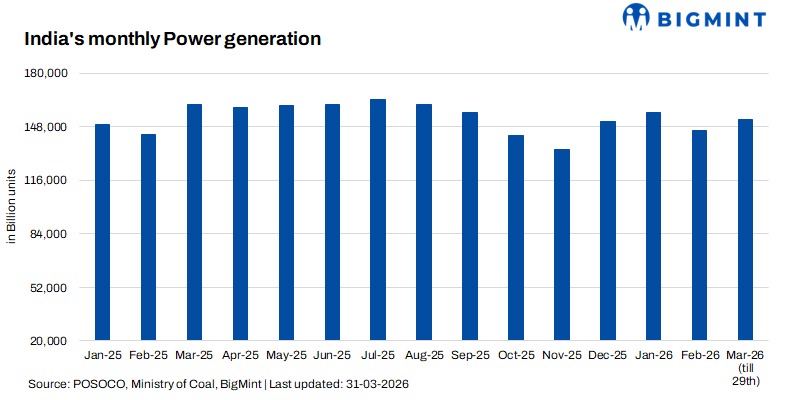
Total electricity generation during 1-29 March 2026 reached 152,179 million units (MU), marginally lower than the 160,933 MU recorded in the same period of 2025. However, this headline figure requires context. Daily averages in early and mid-March 2026 were consistently higher than 2025 levels, with several days crossing 5,500 MU. The lower aggregate is driven by a sharp dip in the final week of the month, where generation fell to 4,600-5,200 MU levels.
Peak demand told a similar story of underlying strength with late-month softness. Average demand rose marginally by 0.2% to 221,491 MW, while the maximum peak touched 238,378 MW, up 1.3% from the previous year. Notably, peak demand in 2026 showed higher highs but also deeper troughs, falling to 194,000-200,000 MW in late March, lower than comparable days in 2025.

This pattern of steady demand growth interrupted by late-month volatility signals an economy that remains resilient but is increasingly subject to supply-side variability. The absence of a sharp, sustained demand surge suggests industrial activity is consolidating rather than overheating, while the deeper demand troughs point to emerging weather-driven variability.
Coal’s declining footprint: A structural shift
Perhaps the most significant signal from the data is the changing role of coal in India’s power mix. While coal remains dominant, contributing approximately 72% of total generation, its share is slowly eroding.

This decline is not an aberration but a structural signal. The 629 MU reduction in absolute coal-fired output was more than offset by a 1,331 MU increase in renewable energy generation, reflecting stronger solar output and recent capacity additions.
For the power sector, this trend has profound implications. Coal consumption by utilities is no longer growing in sync with electricity demand. Renewables, particularly solar, are increasingly meeting incremental demand, a shift that will only accelerate as storage solutions become more viable. For coal producers and thermal power generators, the data signals a ceiling: while coal remains the backbone of the grid, its growth phase may be behind it.
Market signals: Lower prices, higher liquidity, growing volatility
The Indian Energy Exchange (IEX) provided the clearest confirmation of these shifting dynamics, but with an important twist: the market has become not only larger and more liquid, but also markedly more volatile.

The 8.9% decline in average spot prices reflects the growing influence of low-marginal-cost renewable energy in the merit order. More striking is the 37% surge in traded volumes, indicating that distribution companies are increasingly turning to the exchange for procurement, a sign of growing market sophistication.
However, beneath these averages lies a market swinging between scarcity and surplus within days. Sell bids — a measure of surplus power offered — surged to 350,000-560,000 MWh in 2026, far exceeding the 180,000-300,000 MWh range of 2025. This surge in supply, combined with stronger purchase bids, created the conditions for extreme price swings: from a low of INR 1,976/MWh in late March to a high of INR 6,695/MWh during the mid-month tightening.
A distinct weekend effect further underscores renewable dominance. On weekends, when industrial demand softens, average prices fell to INR 2,795/MWh, a 31% discount to weekday prices, as sustained renewable generation met lower load. This pattern creates new arbitrage opportunities for utilities with flexible procurement strategies but also highlights the growing challenge of managing renewable intermittency.
Conclusion: An economy in transition
The data for March 2026 tells a story of resilience and transition. Electricity demand remains steady, supported by underlying economic activity. However, the power sector is undergoing a structural transformation: coal’s decades-long dominance is slowly giving way to renewables, a shift now visible in generation data, market prices, and trading patterns.
Yet this transition comes with new complexities. The same renewable growth that has lowered average prices and deepened market liquidity has also introduced significant volatility. The IEX now swings between scarcity and surplus within days, a dynamic that will intensify as renewable penetration deepens.
For policymakers and industry observers, the signal is clear. India’s electricity sector is successfully balancing the twin imperatives of meeting rising demand and decarbonising the generation mix. The challenge ahead lies in managing the volatility that comes with higher renewable penetration — a task for which the deepening of the power exchange, the development of storage capacity, and the continued build-out of flexible generation will be essential.

Leave a Reply