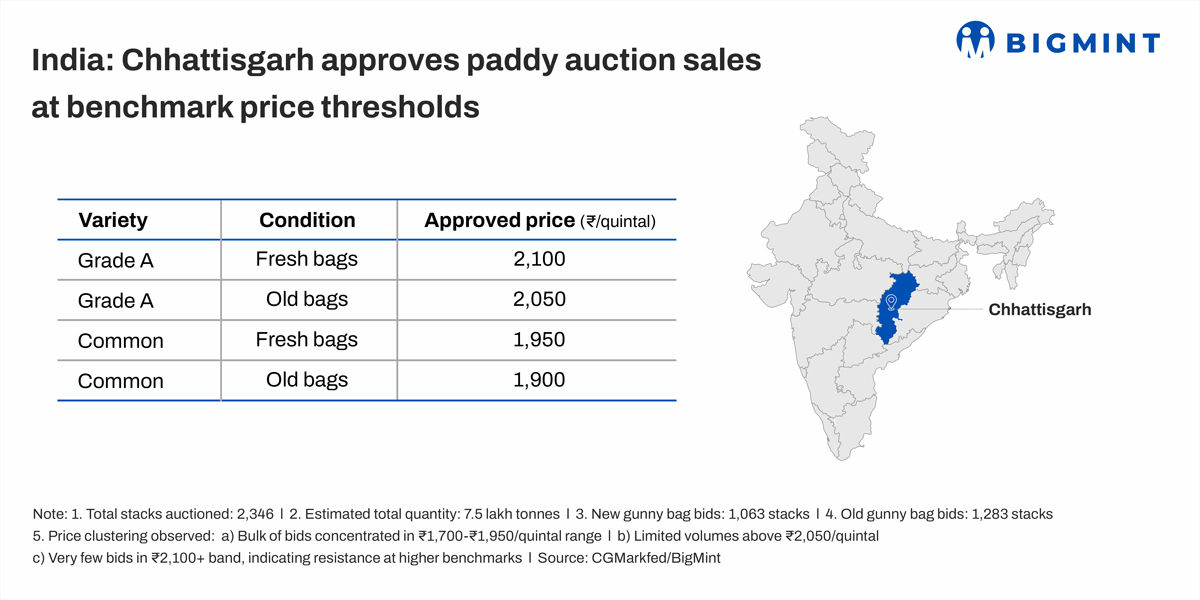
- Fresh and aged paddy cleared at INR 1,900-2,100 per quintal across grades
- State moves to streamline liquidation of procured stocks amid steady supply
The Chhattisgarh State Cooperative Marketing Federation has approved the sale of paddy through e-auctions at defined benchmark price levels, following decisions taken in the ministerial sub-committee meeting held on 17 March 2026. The move comes after the state successfully auctioned around 0.75 million tonnes (7.5 lakh tonnes) of paddy across key districts in February and March 2026, reflecting steady participation from millers.
As per the official communication dated 26 March, the state has permitted the disposal of both fresh and old paddy stocks across Grade A and common varieties, based on auction price discovery conducted earlier in March.
Fresh Grade A paddy has been approved for sale at INR 2,100 per quintal or higher, while older Grade A stocks have been cleared at a slightly lower threshold of INR 2,050 per quintal. For common varieties, fresh paddy has been approved at INR 1,950 per quintal and aged stock at INR 1,900 per quintal, indicating a structured discounting mechanism for older inventory.
Price differentiation reflects quality and stock age dynamics
The approved rates highlight a clear segmentation strategy based on grain quality and stock vintage, a common practice in bulk rice procurement and liquidation cycles. The premium for Grade A over common varieties remains intact, reflecting stronger demand for higher-quality grain in both domestic milling and export-oriented segments.
Similarly, the discount applied to older stock suggests an effort to expedite inventory clearance while maintaining market-linked pricing discipline. This is particularly relevant as prolonged storage impacts grain quality, milling recovery, and downstream realisations.
Auction mechanism aimed at transparent stock liquidation
The state has emphasised that all transactions will be conducted through an online auction platform, ensuring transparency and competitive bidding. Registered bidders have been instructed to participate through the designated portal and comply with tender norms, including timely payment and lifting procedures.
This move is expected to improve price discovery and facilitate faster liquidation of government-held stocks, aligning with broader supply chain efficiency goals.
Steady supply flow, limited price upside
The release of paddy at these benchmark levels is likely to maintain steady raw material availability for millers, particularly in central and eastern India. However, the calibrated pricing suggests limited room for a sharp upside in domestic paddy rates in the near term.
From a trade perspective, the availability of competitively priced raw paddy could support milling activity and ensure consistent rice output, especially for non-basmati segments catering to export markets such as West Africa.
At the same time, the structured pricing approach indicates that the state is balancing inventory liquidation with market stability, avoiding any aggressive undercutting that could disrupt prevailing price trends.
Leave a Reply