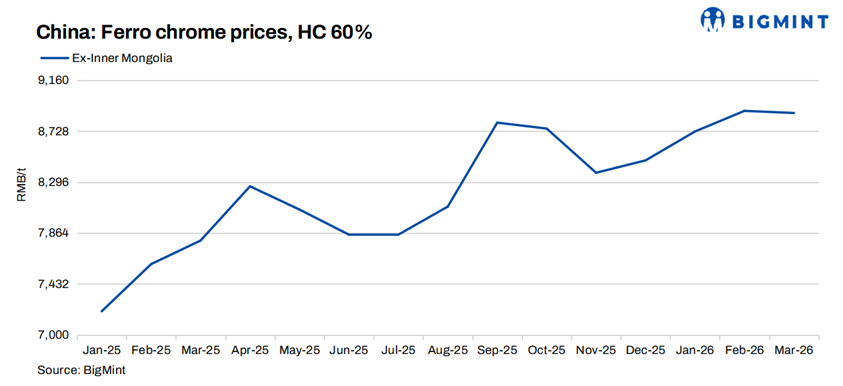
- Chrome ore costs support stable ferro chrome prices
- Stainless steel demand shows mixed structural trends
High-carbon ferro chrome (Cr 50%, C 6-8%) prices remained unchanged at RMB 8,690-9,100/t ($1,264-1,324/t) exw, including taxes. Medium-carbon (Cr 60%, C 1%) prices also remained flat w-o-w to RMB 13,300-13,500/t ($1,935-1,964/t), and low-carbon (Cr 60%, C 0.1%) also remained unaltered at RMB 14,000-14,300/t ($2,037-2,081/t), all exw and inclusive of taxes.
China’s domestic ferro chrome market remains steady, underpinned by high chrome ore costs and rising smelting expenses, while weak downstream stainless steel demand and cautious buying keep trading largely stable.
Market Updates
Raw material market trends
The chrome ore market maintained a stable and robust performance, with spot prices inching higher and forward quotations remaining elevated. Overseas mine offers stayed firm, as suppliers remained reluctant to release material. Despite relatively high port inventories, supply-side pressure on prices has eased.
Ferro chrome producers continued operating at high rates, sustaining rigid demand for chrome ore. Rising raw material costs have increased smelting expenses, reinforcing price support while further compressing ferro chrome producers’ profit margins.
Downstream market trends
The stainless steel market demand exhibits notable structural differentiation. As the direct downstream of ferro chrome, the industry faces weak overall procurement due to centralized maintenance activities. Traditional end-use sectors such as ceramics, coatings, and related industries are recovering slowly, constrained by sluggish real estate and infrastructure activity, prompting cautious buying.
Conversely, high-end manufacturing shows strong momentum, with rising demand for superalloys and chromium metal in aerospace, AI data centers, and gas turbines, providing targeted support for raw materials. While short-term demand remains subdued, medium to long-term market sentiment remains optimistic.
Outlook
The ferro chrome market is expected to remain stable in short-term, supported by tight supply and high costs, while weak stainless steel demand limits price gains; cautious monitoring of production resumption and procurement trends is essential.
(With inputs from CBC)

Leave a Reply