- Shipment of Jimblebar fines marks second* cargo procured from BHP
- Procurement of Jimblebar fines banned by China due to pricing dispute
Leading Indian steelmaker JSW Steel has imported a trial iron ore cargo of around 0.17 million tonnes (mnt) from BHP for its 10 mnt/year integrated steel plant in Dolvi, Maharashtra, marking a rare shipment from Australia after nearly seven months, according to BigMint’s vessel line-up data.
This is notable because this is the second* shipment sourced by JSW Steel from major Australian exporter, BHP. The cargo, with an estimated grade of Fe 60% and likely Jimblebar fines, is currently en route to India, according to vessel tracking data. Prior to this, the miner had booked BHP ore in Apr’24.
As per media reports, the cargo was likely procured at a steep discount, though this could not be confirmed by BigMint. It was initially destined for China but was later routed to India last week.
As per JSW officials, the shipment from BHP is for trial purposes, as JSW has largely relied on higher-grade Brazilian ore in CY’25. Last year, the steelmaker regularly sourced material from Vale, including supplies routed via Oman, where Vale operates a processing facility.
Historically, JSW has imported lower-grade fines from Australian miners such as Roy Hill and Fortescue Metals Group (FMG). However, such imports from Australia have declined sharply, with BigMint data showing a 49% y-o-y drop in CY’25, entirely ceasing from August.
Move may reflect possible market diversification efforts by BHP
The latest shipment also possibly signals BHP’s efforts to diversify markets. Jimblebar fines — produced from BHP’s Western Australian operations and containing around 60% iron — are widely used in Chinese sintering blends.
However, in September 2025, China’s China Mineral Resources Group Co. (CMRG) reportedly instructed domestic steel mills to temporarily halt usage of BHP’s Jimblebar fines after negotiations over long-term supply contracts stalled due to a price-related dispute. The directive reflects Beijing’s broader push to strengthen its bargaining power in iron ore pricing.
Earlier in March 2026, mills were given a short one-week window to draw down existing portside inventories, though seaborne purchases are still restricted. Moreover, following previous curbs on Jimblebar (September 2025) and Jinbao (November 2025) products, Newman fines and lumps were added to the restricted list in March 2026.
India’s iron ore imports surge in CY’25
India’s imports of iron ore fines and lumps almost doubled to around 10.3 mnt in CY’25, as per data maintained with BigMint. This is the highest annual import volume since 2018 and only the third instance when imports crossed the 10 mnt mark.
JSW Steel accounted for 96% of imports. JSW Steel’s iron ore production fell by 25% y-o-y in CY’25 to 19 mnt (provisionally) against 25.4 mnt in the previous year, following the surrender of its Jajang mines in Odisha, announced in August 2024. This production loss was evidently compensated for through imports.
The surge in imports was also driven by a shortage of high-grade Fe 62% ore, critical for blast furnace-based steelmaking in India. Delays in operationalising auctioned mines (101 out of 138) contributed to tightened availability.
JSW Steel’s iron ore sourcing mix
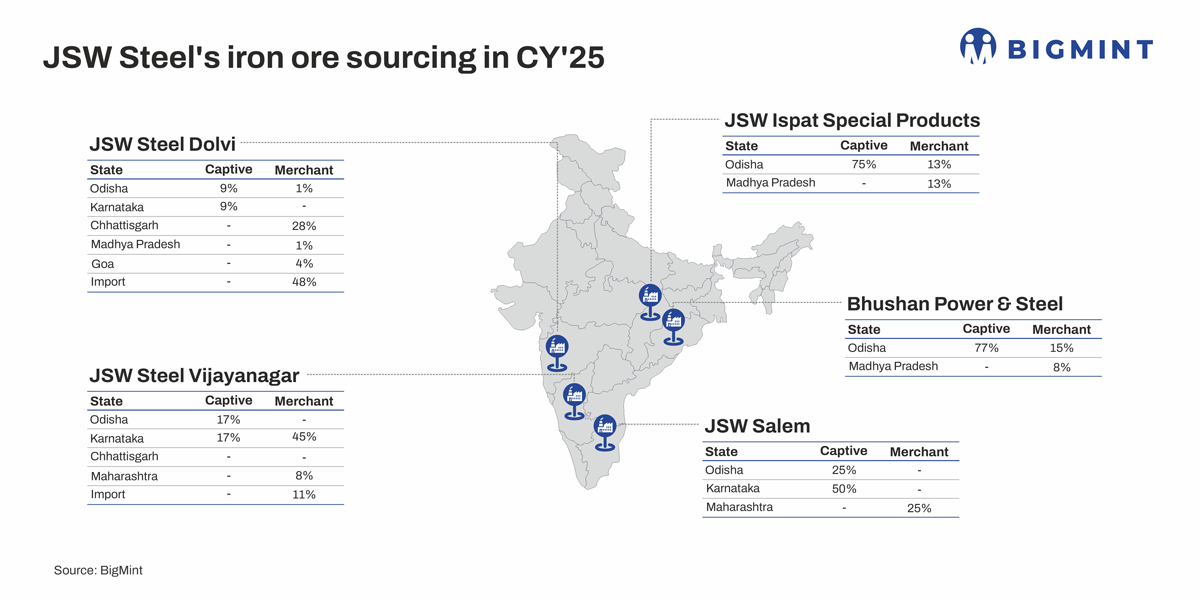
In terms of iron ore sourcing, JSW Steel follows a diversified strategy, combining captive production, domestic merchant purchases, and imports to meet its requirements. In CY’25, the company produced 29 mnt of crude steel, requiring around 55-56 mnt of iron ore.
Of this, approximately 22 mnt was met through captive sources, primarily from Odisha (12** mnt) and Karnataka (10** mnt). Domestic merchant sourcing contributed about 23.7 mnt, led by Karnataka (15 mnt), followed by Chhattisgarh (4 mnt), Maharashtra (2.9 mnt), Odisha (1.3 mnt), and others.
Imports accounted for roughly 10 mnt.
Move follows Tata Steel’s trial of Canadian iron ore
JSW Steel’s move to diversify its raw material sourcing aligns with similar strategies adopted by other Indian steelmakers, including Tata Steel, aimed at strengthening supply security. In January, Tata Steel brought a trial shipment of iron ore from its Canadian arm, Tata Steel Minerals Canada (TSMC), to India. As per sources, the shipment included Fe64% iron ore lumps (10-40 mm size range), material typically suited for blast furnace operations.
*Note: The previously reported first shipment has been revised to reflect that it pertains to the second shipment.
**Sourcing fig from captive mines have been revised
Leave a Reply