- LME aluminium slips 1.28%, copper climbs 0.59%
- Guinea considers bauxite export quotas, tightening aluminium supply outlook
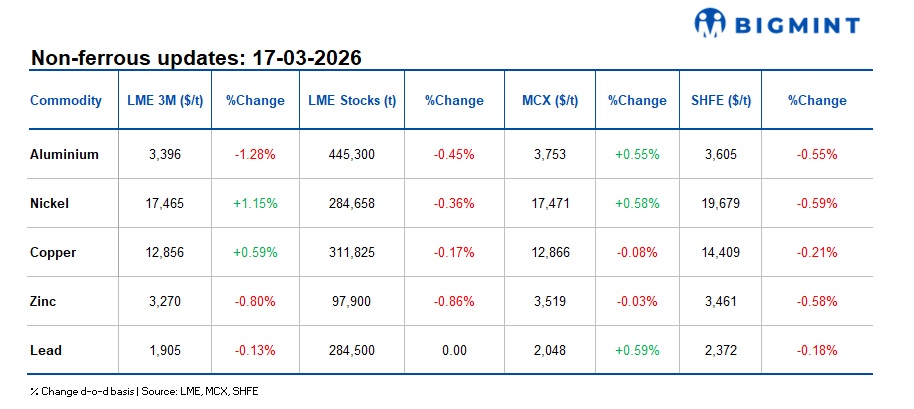
Base metals on the London Metal Exchange (LME) showed mixed trends but largely edged lower d-o-d on 17 March 2026 amid cautious market sentiment. Aluminium declined 1.28% to $3,396/t, while zinc slipped 0.80% to $3,270/t. Lead edged down 0.13% to $1,905/t, whereas nickel gained 1.15% to $17,465/t, and copper increased 0.59% to $12,856/t.
Warehouse inventory levels were mostly lower. Aluminium stocks fell 0.45% to 445,300 t, while zinc inventories dipped 0.86% to 97,900 t. Nickel stocks decreased 0.36% to 284,658 t, and lead inventories remained unchanged at 284,500 t. Meanwhile, copper stocks edged down 0.17% to 311,825 t.
Domestic market overview
Non-ferrous scrap prices in India showed mixed trends, reflecting cautious market sentiment. Aluminium tense scrap (loose), ex-Delhi, increased by INR 1,000 or 0.4% to INR 240,000/t from INR 239,000/t, while ex-Chennai prices also rose by INR 1,000 or 0.4% to INR 244,000/t from INR 243,000/t.
Meanwhile, copper armature scrap (Cu 99%), ex-Delhi, declined by INR 10,000 or 0.9% to INR 1,110,000/t from INR 1,120,000/t, indicating weak buying sentiment.

Other updates
Rio Tinto secures control of resolution copper project land
Rio Tinto has gained control of 2,400 acres in Arizona required to develop the Resolution Copper project, following the end of a long-running legal dispute with Native American groups.
The land swap with the US Forest Service involved Rio Tinto transferring 5,400 acres of land in exchange for access to the copper-rich site, which is estimated to contain over 40 billion pounds (≈18.1 million tonnes) of copper.
The project-jointly owned by Rio Tinto (55%) and BHP (45%)—could become one of the largest copper mines in the United States, supporting domestic supply for sectors such as electric vehicles, electronics, and energy infrastructure.
Following the ruling, Rio Tinto plans to launch a $500 million drilling campaign to further explore the deposit before determining a timeline for production.
Centaurus signs nickel offtake agreement with Glencore
Centaurus Metals has signed a binding nickel offtake agreement with Glencore for its Jaguar nickel sulphide project in Brazil, marking a key step toward commercial development.
Under the deal, Centaurus will supply 20,000 dry metric tonnes per year of high-grade nickel concentrate (~32% Ni) to Glencore, containing about 6,400 t of nickel annually. The material will be processed at Glencore’s Sudbury smelter in Canada, with the contract starting in 2029 and running for five years.
The agreement covers about one-third of Jaguar’s planned output and is estimated to be worth over $450 million during the initial period. Pricing will be linked to the LME nickel price, supporting project financing and strengthening prospects for global nickel supply used in stainless steel and battery materials.
Guinea considers bauxite export quotas as prices fall
Guinea, the world’s largest bauxite producer, is considering introducing export quotas for mining companies as global prices of the aluminium feedstock decline and freight costs rise, squeezing producer revenues.
Bauxite prices have fallen 20-35% from 2025 highs, with benchmark Guinea and Australia cargoes trading around $60-$70/t. Meanwhile, Guinea’s exports jumped 25% in 2025, with more than 70% shipped to China.
Authorities are assessing quotas for individual mining projects, particularly targeting large producers, although no final decision has been taken yet. Given that Guinea supplies over 40% of global bauxite, any export restrictions could tighten global supply and impact the aluminium value chain.
US and Japan plan joint development of critical minerals
Japan and the United States are expected to announce a partnership for the joint development of critical minerals including rare earths, lithium and copper.
The initiative aims to strengthen supply chains for EV batteries, semiconductors and defence technologies, while reducing dependence on China’s dominant rare-earth supply chain. The collaboration highlights growing efforts among allied economies to secure strategic mineral resources.
Leave a Reply