- Japan aluminium premium hits 11-year high at $350/t amid Middle East supply risks
- IEA considers largest-ever oil stock release to stabilise markets
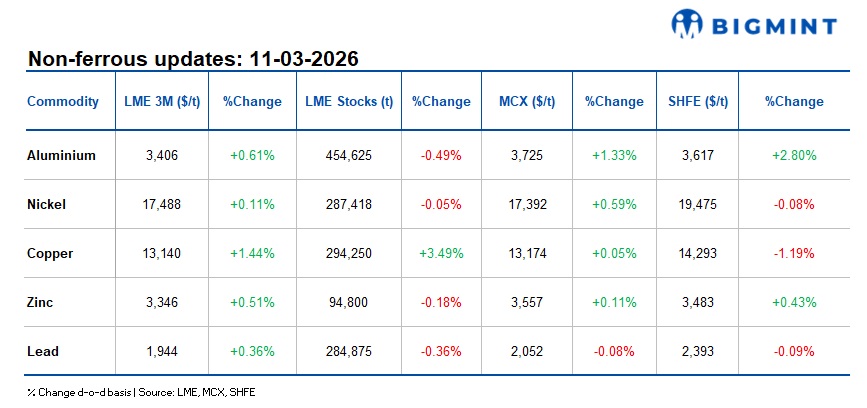
Base metals on the London Metal Exchange (LME) traded higher d-o-d on 11 March 2026, supported by improved market sentiment and buying interest. Aluminium rose 0.61% to $3,406/t, while zinc advanced 0.51% to $3,346/t. Lead increased 0.36% to $1,944/t, and nickel edged up 0.11% to $17,488/t. Meanwhile, copper posted the strongest gain, rising 1.44% to $13,140/t.
Warehouse inventory trends were mostly lower. Aluminium stocks declined 0.49% to 454,625 t, while zinc inventories fell 0.18% to 94,800 t. Nickel stocks dipped slightly 0.05% to 287,418 t, and lead inventories decreased 0.36% to 284,875 t. In contrast, copper stocks rose 3.49% to 294,250 t.
Domestic market overview
Domestic non-ferrous scrap prices in India trended higher across key markets, reflecting steady demand and cautious trading activity. Aluminium tense scrap (loose), ex-Delhi, rose by INR 500 or 0.2% to INR 231,500/t from INR 231,000/t, while ex-Chennai prices increased by INR 6,500 or 2.8% to INR 238,500/t from INR 232,000/t.
Meanwhile, copper armature scrap (Cu 99%), ex-Delhi, increased by INR 5,000 or 0.4% to INR 1,140,000/t from INR 1,135,000/t, reflecting improved buying interest amid firm refined copper prices.

Other market updates
Rio Tinto secures $1.18 bn financing for Argentina lithium project
Global mining major Rio Tinto has secured $1.18 bn in financing from four international lenders to support the development of its Rincon lithium project in Argentina’s Salta province. The funding forms part of the company’s $2.5 bn investment plan to expand lithium production capacity.
Once operational, the project is expected to produce around 60,000 t/y of battery-grade lithium carbonate, a key raw material used in electric vehicle batteries and energy storage systems. The move highlights the growing global push to secure lithium supply amid rapidly rising demand from the energy transition and EV sectors.
Middle East conflict pushes Japan aluminium premium to 11-year high
Aluminium premiums for shipments to Japan’s main ports (MJP) have surged to $350/t for Q2 shipments, the highest quarterly premium since 2015, as supply concerns intensify amid the Middle East conflict.
The premium, paid on top of LME cash aluminium prices, is a key benchmark for aluminium pricing across Asia. Disruptions to shipping through the Strait of Hormuz, a vital trade route for Gulf exports, have heightened supply risks from a region that accounts for roughly 9% of global aluminium output.
Oil prices fall as IEA considers largest-ever strategic stock release
Global oil prices declined after reports that the International Energy Agency (IEA) is considering the largest coordinated release of strategic oil reserves ever, potentially exceeding the 182 mn barrels released in 2022 following Russia’s invasion of Ukraine.
The proposed release aims to stabilise energy markets and ease supply concerns triggered by the escalating US-Israel conflict with Iran, which has raised fears of disruptions to oil shipments through key Middle East routes.
Strike threat looms at Glencore’s Australian copper refinery
Workers at Glencore’s Townsville copper refinery in Queensland are preparing for strike action following prolonged wage negotiations between the company and the Australian Workers’ Union (AWU).
The refinery produces around 300,000 t/y of refined copper and processes third-party concentrate, including feed from BHP’s Olympic Dam mine. If the strike proceeds, it could disrupt refining operations and tighten refined copper availability, adding to existing supply concerns in the global copper market.
Lead-Zinc mines resume production, boosting concentrate supply
Several lead-zinc mines in China have resumed operations following the Spring Festival, increasing the supply of lead and zinc concentrates and improving trading activity heading into March-April.
Production recovery is expected to add around 500 t of zinc concentrate in March, with some operations potentially increasing output by up to 2,000 t m-o-m as normal operations resume. The additional supply could ease earlier raw material tightness for smelters, though overall market balance will depend on downstream demand in the coming months.
Leave a Reply