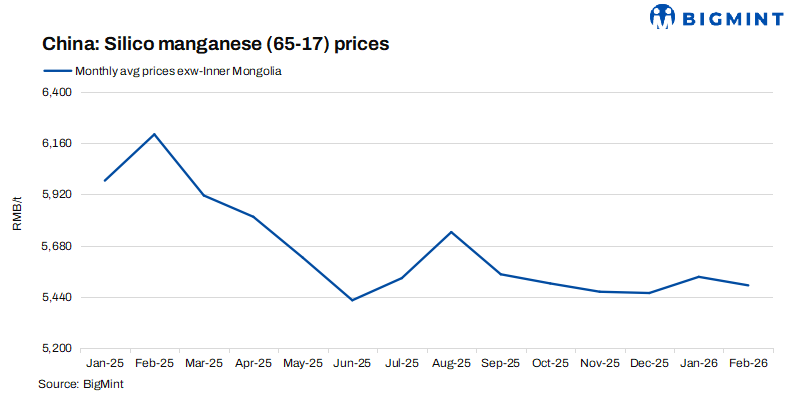
- Rising manganese ore, electricity, coke costs drive up prices
- Moderate demand recovery as mills make need-based purchases
Chinese silico manganese prices (Mn 65%, Si 17%) edged up by RMB 90/t ($13/t) to RMB 5,760-6,030/t ($840-879/t) exw, inclusive of taxes, on 28 February compared with 24 February 2026.
Silico manganese prices remained largely stable, supported by strong raw material costs and elevated production expenses that limited downside risk. Demand recovered gradually but remained cautious, with steel mills focusing on inventory digestion and maintaining on-demand procurement, leaving the market balanced and awaiting clearer direction.
Market updates
Raw material market trends
Raw material costs offered rigid support for silico manganese. Manganese ore quotations remained strong, as overseas shipments were tight, and port inventories were insufficient, with miners showing a clear willingness to support prices.
Meanwhile, the prices of electricity, coke, and other production auxiliary materials were high, and electricity tariffs in some production areas were raised, further increasing smelting costs.
As a result, strong raw material costs offered a solid price floor for silico manganese. Manufacturers were reluctant to sell at lower prices, and any potential downside was significantly suppressed.
Downstream market trends
Demand was primarily driven by rigid needs, and the pace of recovery remained moderate. Steel mills gradually resumed operations, but as pre-holiday raw material inventories were high, the main focus was on inventory dilution.
The pace of bidding was slow, and the willingness to push for lower prices remained strong. The stainless steel sector mainly procured material on need basis, with no aggressive restocking activity.
Overall, downstream demand rebounded steadily, but the driving force for silico manganese prices remained limited. The market was in a supply-demand stalemate, awaiting clearer momentum.
Outlook
Chinese silico manganese prices are expected to remain largely stable in the near term, as firm raw material costs will continue to limit downside risks. The market will likely remain in a supply-demand stalemate until clearer momentum emerges.
(With inputs from CBC)
Leave a Reply