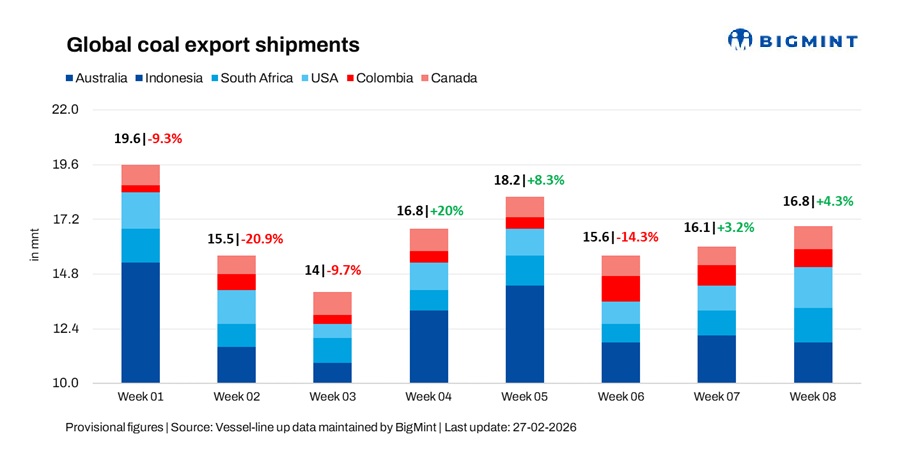
- US leads gains; Australia softens
- India-bound freight remains capped
Global coal export shipments increased 4.3% w-o-w to 16.8 mnt in Week 08 (14 Feb-20 Feb’26), supported by a sharp recovery in Atlantic basin loadings, while Pacific volumes remained largely stable.
Country-wise trends

Port & shipper-wise trends
Pacific flows remain mixed
In the Pacific, Australia shipments eased to 5.4 mnt, reflecting moderated loading activity, with Newcastle at 2.77 mnt and Gladstone at 1.17 mnt; Yancoal contributed 0.54 mnt, while Japan and China received 2.00 mnt and 0.72 mnt, respectively.
Indonesia exports held steady at 6.4 mnt, supported by firm demand from China (1.97 mnt) and India (1.41 mnt), with Taboneo and Bunati loadings at 1.55 mnt and 1.13 mnt, respectively.
Atlantic lifts overall volumes
The US recorded the strongest weekly increase, with shipments rising to 1.8 mnt, led by Norfolk (0.67 mnt) and Baltimore (0.54 mnt), while India absorbed 0.72 mnt amid improved vessel clearances and stronger cargo execution.
South Africa posted a healthy rise to 1.5 mnt, with Richards Bay accounting for 1.53 mnt and India lifting 0.73 mnt, supported by improved logistics and steady buying interest.
Canada volumes moved higher to 1.0 mnt, led by Roberts Bank (0.54 mnt), with South Korea taking 0.29 mnt amid improved West Coast loadings and selective Asian restocking.
In contrast, Colombia shipments declined to 0.8 mnt, with Prodeco Group and Cerrejon Mines contributing 0.34 mnt and 0.31 mnt, respectively, via Puerto Nuevo (0.34 mnt) and Puerto Bolivar (0.31 mnt), reflecting softer European offtake.
Freight rates muted
Although overall export volumes improved, dry bulk coal freight rates to India remained muted amid cautious chartering activity and balanced vessel availability. Limited fresh enquiries continued to restrict upward momentum across key routes.
Outlook
Shipments from the USA, South Africa, and Canada may stay supportive, while Australia and Indonesia remain steady; freight rates could stay range-bound unless demand from India and China improves.
Leave a Reply