- LME metals ease as Indian scrap stays mixed
- Global cues supportive as Japan PMI hits 52.8
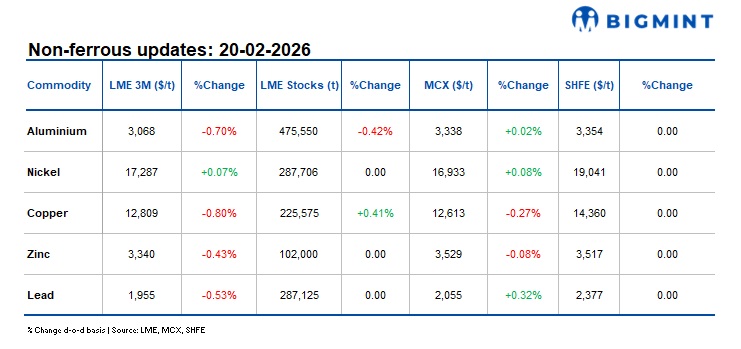
Base metals on the London Metal Exchange (LME) traded mostly lower d-o-d as of yesterday’s closing 19 February 2026 amid cautious sentiment and profit-booking pressure. Aluminium slipped 0.07% to $3,068/t, copper declined 0.8% to $12,809/t, zinc fell 0.43% to $3,340/t, and lead dropped 0.53% to $1,955/t, while nickel edged up 0.07% to $17,287/t.
Warehouse inventory movements were largely steady. Aluminium stocks held stable at 475,550 t, nickel inventories were unchanged at 287,706 t, and zinc stocks stood at 102,000 t. Meanwhile, copper inventories increased by 0.41% to 225,575 t, while lead stocks remained flat at 287,125 t.
Domestic market overview
Domestic non-ferrous scrap prices in India were mixed across key markets, reflecting uneven demand conditions. Aluminium Tense Scrap (Loose), ex-Delhi, held firm at INR 213,000/t, while Aluminium Tense Scrap (Loose), ex-Chennai, slipped by INR 500/t or 0.2% to INR 217,500/t.
In contrast, Copper Armature Scrap (Cu 99%), ex-Delhi, rose by INR 10,000 or 0.9% to INR 1,120,000/t from INR 1,110,000/t, reflecting improved scrap buying and tighter copper fundamentals, supported by relatively firm copper pricing in India’s domestic market

Other market updates
China’s trade push supports metal markets
China is accelerating its global trade push by pursuing around 20 new trade deals to counter U.S. tariffs and embed its manufacturing base deeper into major economic blocs. With a $19 trillion economy, Beijing’s strategy supports continued output and export flows that could influence global base metal demand dynamics.
Japan factory momentum builds
Japan’s manufacturing sector expanded at its fastest pace in nearly four years, with the flash PMI rising to 52.8 in February from 51.5 in January—the strongest since May 2022. Improved factory output and export orders may lend support to regional non-ferrous metal consumption, including aluminium and copper scrap demand.
Energy costs rise on Iran tension
Oil prices advanced after U.S. President Donald Trump imposed a time limit on the Iran stand-off, raising concerns over potential supply disruptions. The uptick in energy markets could translate into higher power and logistics costs for metal production and scrap processing, thereby adding cost pressure across non-ferrous markets.
India expands nickel & lithium push
India plans to roll out incentives to spur lithium and nickel processing, proposing a 15% capital subsidy for qualified projects that begin operations on or after April 1, 2026. The scheme, valid for up to five years and capped at a share of annual sales, aims to attract investment in two lithium and two nickel plants to help meet rising demand for critical minerals and support the EV battery supply chain by 2030
Leave a Reply