- Mixed manganese ore price trends persist as currency pressure offsets alloy gains
- Smelters hold prices firm, eye production cuts amid margin pressure
Indian silico manganese export prices edged higher in the week ended 27 January, despite volatility in imported manganese ore prices. The uptick was largely driven by an ongoing ore crunch, with smelters facing delayed deliveries at elevated costs, which significantly influenced alloy pricing.
Market participants noted that minor variations in ore prices had little immediate impact, as smelters maintained firm offers. Additionally, limited availability in the spot market continued to lend marginal support to prices, keeping export sentiment slightly positive.
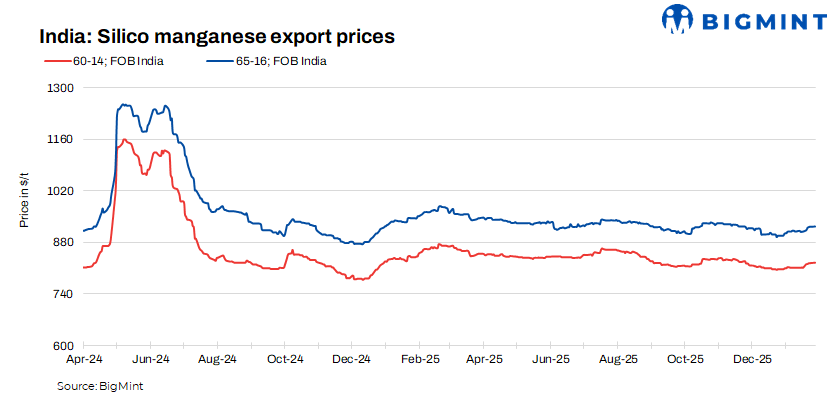
BigMint’s assessment on 27 January 2026 reveals silico manganese export prices were slightly higher w-o-w across grades. The 65-16 variant stood at $922/t FOB, up by $10/t w-o-w from $912/t FOB on 19 January, while the 60-14 grade was assessed at $825/t FOB, up by $4/t w-o-w.
Market overview
Imported manganese ore prices fluctuate narrowly; rupee depreciation lifts landed costs: Imported manganese ore prices fluctuated within a narrow range during the week ended 24 January, reflecting mixed market sentiment even as manganese alloy prices moved higher. Further pressure came from currency depreciation, which raised smelters landed ore costs.
- Australian high-grade ore (Mn 46%): Up $0.01/dmtu w-o-w to $5.53/dmtu CNF Haldia/Vizag.
- Gabonese high-grade ore (Mn 44%): Up $0.01/dmtu w-o-w to $5.17/dmtu CNF Haldia/Vizag.
- South African lumps (Mn 37%): Down $0.01/dmtu w-o-w to $4.47/dmtu CNF Haldia/Vizag.
Smelters hold firm on prices as losses mount amid weak deal flow: Sellers remained firm on prices, with several smelters considering production cuts and planned maintenance to limit further losses. A key Durgapur-based smelter told BigMint that silico manganese prices have failed to keep pace with sharply rising imported raw material costs.
The smelter added that higher-priced deals are difficult to conclude, leaving margins extremely thin. Given the uncertain market outlook, producers are evaluating strategic shutdowns to reduce losses. Market participants do not expect any meaningful price upside unless bulk export demand emerges from Europe and the Middle East.
Currency headwinds lift landed Mn ore costs for Indian smelters: The elevated USD/INR (near INR 91.64 levels) increases landed costs for manganese ore purchases, adding cost pressure on smelters. Unless the rupee strengthens or ore prices moderate in USD terms, imported raw material inflation will remain a key headwind for cost structures in the near term. A weaker INR means paying more in rupees for the same dollar-priced ore.
If ore costs $5.50/dmtu, at INR 91.64 this translates to significantly higher INR outlay than when rates were lower (e.g., ₹85–88 last year). This directly inflates smelters’ raw material costs and squeezes margins, especially for imported manganese ore settled in USD.
The rupee has been under depreciation pressure due to global risk aversion, capital outflows, and stronger dollar dynamics, keeping the USD/INR elevated near historic highs.
Outlook
Silico manganese export prices are expected to remain range‑bound to slightly firm in the near term, supported by constrained supply dynamics despite muted demand conditions in key overseas markets. However, any significant downside in prices is likely to be well protected, as spot availability remains limited, driven by production curtailments and planned maintenance shutdowns at several domestic smelters.
Leave a Reply