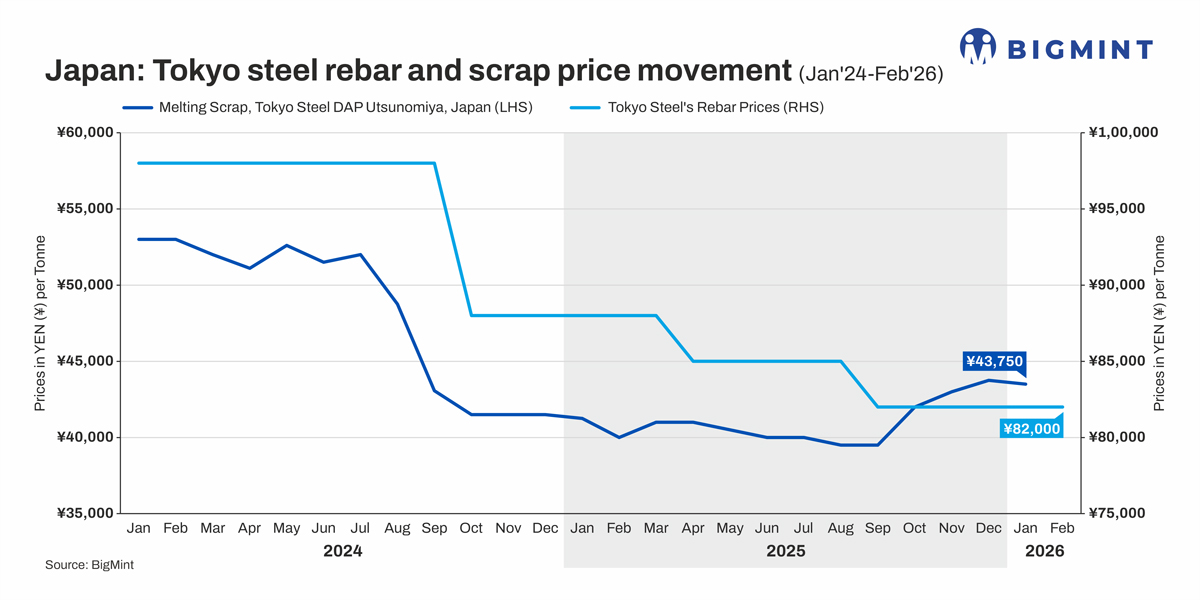
- Price stability reflects cautious stance amid weak demand
- Baosteel also keeps HRC prices unchanged m-o-m in Feb’26
Tokyo Steel, Japan’s leading electric arc furnace (EAF) steel producer, has kept its HRC (1.7-22 mm) prices unchanged for February 2026, marking the second consecutive month of price stability. Moreover, prices of rebar and H-beams were also kept stable m-o-m.
The latest prices are as follows:
- HRC (1.7-22 mm): JPY 86,000/tonne (t) ($543/t)
- Rebars (D13-25): JPY 82,000/t ($517/t)
- H-beams (100-300 mm): JPY 103,000/t ($650/t)
Factors influencing Tokyo Steel’s pricing
1. Domestic HRC market sentiment remains subdued: Japan’s domestic HRC market sentiment remains subdued due to slow shipments and weather-related construction delays. However, bulk orders with shorter delivery timelines and ongoing order discussions have lent support to expectations of price transmission and a gradual market recovery.
2. Leading global mills’ prices show mixed trends: Baosteel, the world’s leading steelmaker, kept its HRC prices unchanged for February sales compared with January, supported by steady SHFE HRC futures m-o-m. However, it raised March prices by RMB 100/t ($14/t) m-o-m. Prices of hot-dip galvanised products also remained stable m-o-m for February, while March’s prices were raised by RMB 100/t ($14/t) m-o-m.
Additionally, Vietnam’s leading steel manufacturer, Formosa Ha Tinh (FHS), raised its hot-rolled coil (HRC) prices by around $15/t for sales in February 2026. However, domestic demand in Vietnam remained weak, with market participants showing limited buying interest.
3. Kanto scrap export offers rise: Japan’s Kanto scrap tender increased by JPY 1,083/t for the sixth consecutive month to a 17-month year-high of JPY 46,771/t FAS in January 2026, with similar levels last seen in August 2024 (JPY 47,956/t). Compared with the previous month, the increase in dollar terms was limited to about $6/t, as a weaker Japanese JPY (slipping from around 156.7/$ in December to 157.2/$ in early January) supported higher export offers despite modest underlying price gains.
Outlook
Tokyo Steel’s price stability for February reflects a cautious stance due to subdued domestic demand and weather-led disruptions. However, rising scrap costs, firmer overseas price signals, and selective order inflows may gradually support market recovery.
Leave a Reply