- Copper rises despite notable exchange stock inflows
- Indonesia nickel policy adds supply-side uncertainty
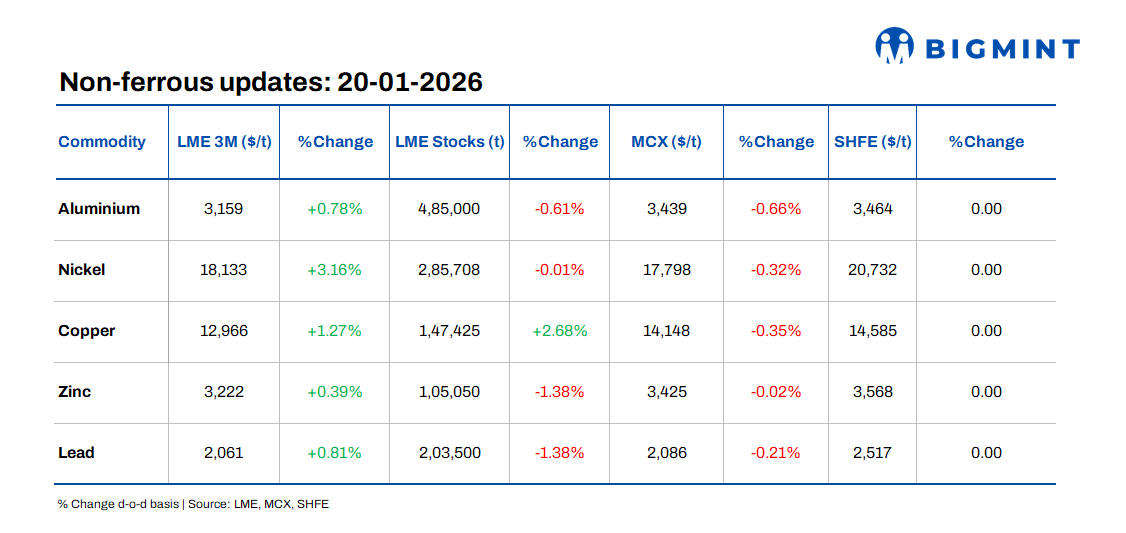
Base metals prices on the London Metal Exchange (LME) rebounded on 20 January, with gains recorded across the complex. Aluminium prices rose 0.78% to $3,159/t, while LME stocks declined 0.61% to 485,000 t, indicating continued inventory drawdowns. Nickel led the rally, climbing 3.16% to $18,133/t, as inventories were largely stable, edging marginally lower by 0.01% to 285,708 t.
Copper prices increased 1.27% to $12,966/t, even as stocks jumped 2.68% to 147,425 t, pointing to fresh inflows at exchange warehouses. Zinc also traded higher, up 0.39% to $3,222/t, supported by a sharper 1.38% fall in inventories to 105,050 t. Lead extended gains as well, rising 0.81% to $2,061/t, with stocks declining 1.38% to 203,500 t, signalling tightening availability.
Domestic market overview
In India’s non-ferrous metals markets, aluminium Tense scrap prices moved in a narrow range d-o-d. Ex-Delhi assessments declined by INR 1,000/t to INR 206,000/t, reflecting cautious buying sentiment, while ex-Chennai prices increased by INR 2,000/t to INR 204,500/t, indicating relatively firmer regional demand.
Meanwhile, copper armature scrap prices, ex-Delhi, edged up by INR 7,000/t (up 0.6%) to INR 1,127,000/t. The uptick reflected limited availability and selective buying, even as market participants remained wary following recent price hikes.
 Other updates
Why are zinc prices edging higher?
Zinc prices extended gains, supported by a weaker US dollar following fresh tariff announcements by President Donald Trump and stronger-than-expected macroeconomic data from China. Improved sentiment was underpinned by faster industrial output growth and marginally better GDP readings, easing near-term demand concerns.
However, upside remained limited amid mixed fundamentals, as rising SHFE zinc inventories, a discount in the LME cash-to-three-month structure, and a sharp increase in China’s refined zinc output highlighted ample supply. Further weighing on sentiment, ILZSG data indicated the global refined zinc market shifted into a sizeable surplus in the first 10 months of 2025, reinforcing expectations of surplus conditions extending into 2026.
Indonesia’s nickel quota policy reshapes supply
Indonesia’s evolving nickel mining quota policy is aimed at managing price volatility and supporting government revenue, though it has added complexity to market signals. Planned production cuts in 2026 through tighter RKAB quotas could help ease global oversupply and support prices, after years of rapid output growth driven by Chinese-backed investments.
Recent policy revisions seek to curb speculative quota hoarding and narrow the gap between approved capacity and actual production, which has inflated perceived supply. However, Indonesian nickel output still exceeds demand, particularly from China, where growing use of LFP batteries has weighed on nickel-intensive demand, keeping near-term fundamentals mixed.
Leave a Reply