- PM E-DRIVE achieves 3W target well ahead of schedule
- CESL concludes one of largest e-bus tenders to date
India’s push towards electric mobility gained significant momentum in 2025, with electric vehicle (EV) sales surpassing 2.3 million units, as per a report by the India Energy Storage Alliance (IESA). This is equivalent to an 8% share of total vehicle registrations, based on IESA data from the government’s Vahan Portal.
This statistic gains particular relevance, as it comes amid the Ministry of Heavy Industries (MHI) reporting substantial progress across multiple production-linked incentive (PLI) schemes aimed at reducing import dependence and achieving the nation’s zero-emission targets.
Notably, India aims to achieve net-zero emissions by 2070 and 50% electric vehicle penetration by 2030. As such, the government has repeatedly prioritised domestic manufacturing and self-reliance in energy transition minerals. The country’s strategic initiatives now span the entire EV value chain – from battery cell production to vehicle manufacturing.
Highlights of govt’s PLI scheme progress
PLI auto scheme drives EV production
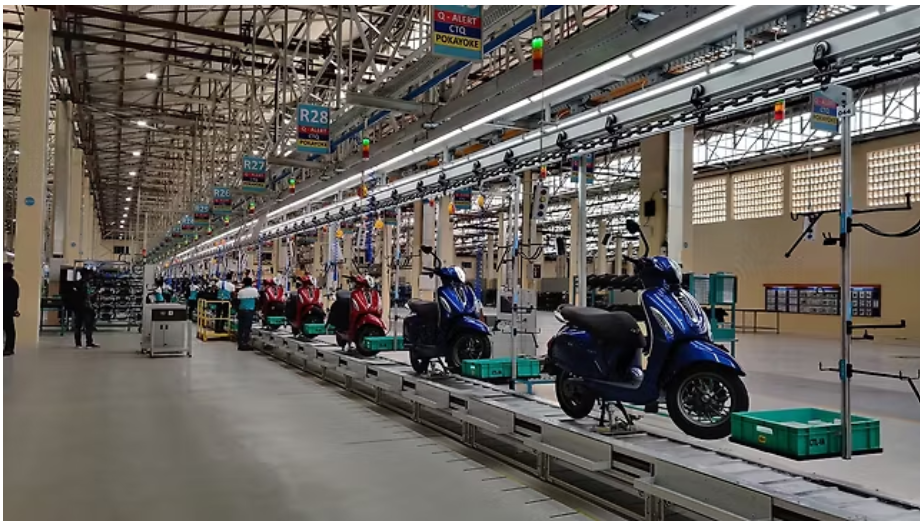
The government’s PLI scheme for automobiles has catalysed production of 1.36 million EVs as of 31 December 2025. This includes 1.04 million electric two-wheelers, 238,385 electric three-wheelers, 79,540 electric four-wheelers, and 1,391 electric buses.
Approved in September 2021, the five-year PLI scheme (FY’24-FY’28) has a budgetary outlay of INR 25,938 crore. According to the MHI, 82 applicants have been approved for incentives ranging from 13-18%, with an estimated total investment of INR 42,500 crore and projected incremental sales of INR 231,500 crore.
As of 30 September 2025, the scheme had attracted cumulative investments of INR 35,657 crore and achieved cumulative determined sales of INR 32,879 crore.
The scheme incentivises products achieving a minimum 50% Domestic Value Addition (DVA). The MHI has disbursed claims totalling INR 1,999.94 crore for the performance year 2024-25, making 2025 a landmark year for e-mobility in India.
To date, eight original equipment manufacturers (OEMs) have achieved this threshold across 94 variants, while 10 component manufacturers produced 37 variants with over 50% DVA.
PM E-DRIVE scheme accelerates adoption
Under PM E-DRIVE – a scheme to accelerate EV adoption, launched in September 2024 with an outlay of INR 10,900 crore – sales of 2.14 million electric vehicles and claims amounting to INR 1,703.32 crore had been disbursed as of 31 December 2025. Notably, the target of 288,809 electric three-wheelers was achieved in December 2025, well ahead of the scheme’s terminal date.
The Convergence Energy Services Limited (CESL) has also concluded one of the largest e-bus tenders to date for 10,900 vehicles, covering five metropolitan cities — Delhi, Ahmedabad, Surat, Hyderabad, and Bangalore – in phase one.
ACC battery manufacturing
The INR 18,100 crore National Programme on Advanced Chemistry Cell (ACC) Battery Storage, approved in May 2021, aims to establish 50 GWh of domestic ACC manufacturing capacity. In the first round, 30 GWh capacity was awarded to three beneficiaries: ACC Energy Storage Pvt Ltd (5 GWh), Ola Cell Technologies Pvt Ltd (20 GWh), and Reliance New Energy Battery Storage Ltd (5 GWh). In round two, Reliance New Energy Battery Ltd secured an additional 10 GWh capacity, while another 10 GWh has been earmarked for grid-scale stationary storage applications.
The scheme attracted investments of INR 2,878 crore as of October 2025, says the MHI release. Of the approved projects, Ola Cell Technologies has established India’s first giga-scale ACC manufacturing plant with 1 GWh installed capacity and is currently stabilising operations for full-scale commercial production.
No progress details shared on passenger EV scheme
No concrete outcomes were shared for the Scheme to Promote Manufacturing of Electric Passenger Cars (SMEC), notified on 15 March 2024, which targets global investments in the passenger EV segment.
Approved applicants must invest a minimum of INR 4,150 crore (USD 500 million) within 3 years, achieving 25% DVA during this period and 50% within five years. It permits limited imports of electric four-wheelers at reduced customs duty, capped at 8,000 vehicles annually, with total duty foregone per applicant limited to INR 6,484 crore or the committed investment amount.
Leave a Reply