- China pellet inventory at ports reach 3-month high in Jan
- Lower-alumina material fetches greater interest from buyers
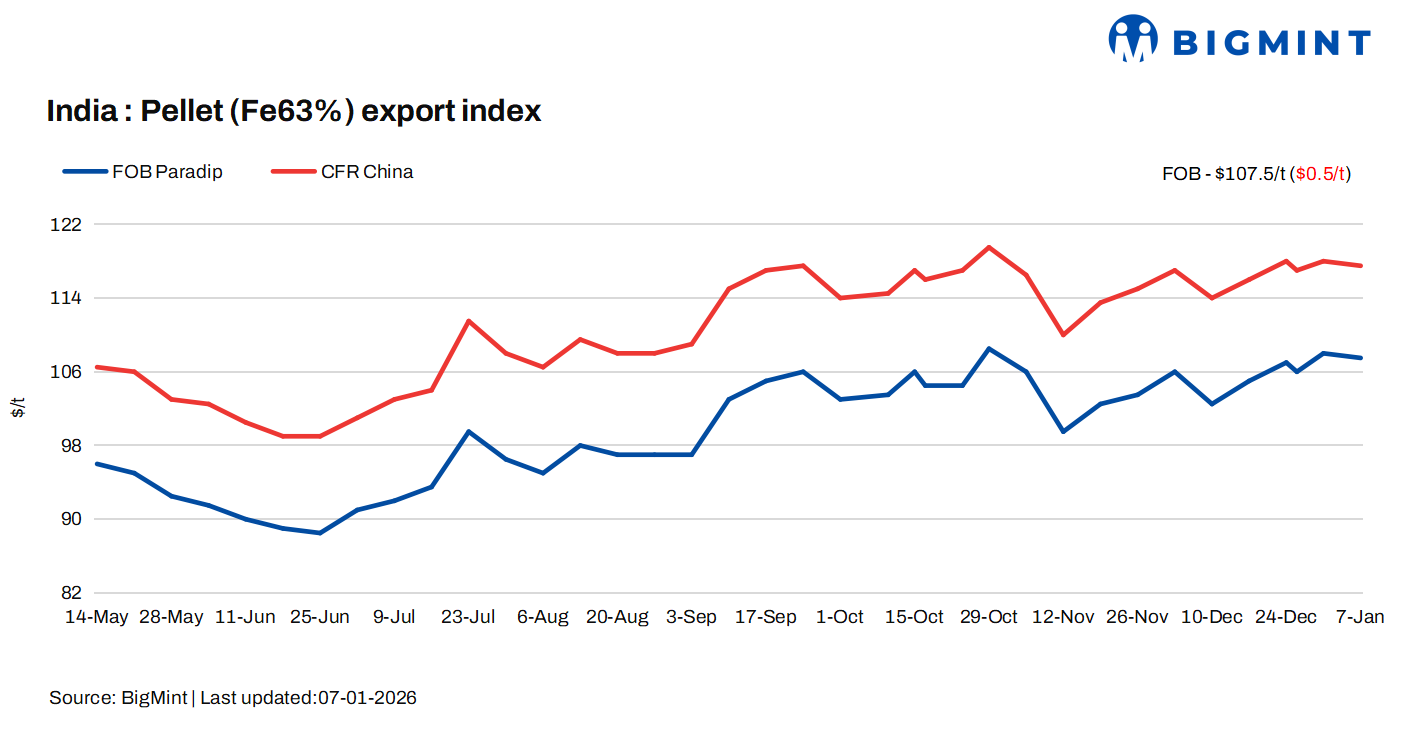
Pellet prices in the seaborne market remained largely stable during the first week of CY’26 but were weighed down by subdued demand in China due to elevated inventory at ports, market participants informed BigMint. Despite the regular availability of cargoes, buying interest from consumers, particularly Chinese mills, remained limited.
Price update
BigMint’s India pellet (Fe 63%, 3-3.5% Al) export index remained largely stable w-o-w at $107.5/t FOB east coast on Wednesday. Additionally, a producer offered around 50,000 t of Fe 64.5% pellets today, which is concluded at a higher price level ($119-120/t FOB India) due to lower alumina content.
Meanwhile, another seller was heard offering high-grade Fe 64% pellets in the export market, but the response from buyers was poor due to bid-offer disparity.
Market movement
Market participants noted that Indian pellet suppliers were actively offering cargoes in the seaborne market; however, the response from buyers had been weak. An international trader said, “Chinese mills are currently well covered, thanks to port inventories and are not aggressive in booking seaborne material.”
According to sources, mills are prioritising utilisation of existing inventories or readily available port material, reducing the urgency for fresh seaborne purchases. This has resulted in cautious buying and limited counterbids.
A supplier said, “Counter bids from buyers are either very slow or significantly lower than our offers. Given this situation, we are adopting caution and waiting for better prices.”
International traders highlighted that some buying interest was visible for low-alumina pellets. A trader quipped, “Seaborne pellet buyers are booking low-alumina material at around $128-129/t CFR China for higher Fe content. In contrast, average-grade material has seen lower bids on muted demand, reflecting selective buying preferences among mills.”
However, market participants remain cautiously optimistic about near-term prospects. Some partcipants expect buying activity to improve in the coming week as inventories normalise and mills reassess their raw material requirements.
Another trader informed, “We may see some deals getting concluded soon, although prices are likely to remain rangebound.”
Sources mentioned that today’s higher grade Fe 64.5% pellet export tender received active response due to lower alumina content.
Another market participant said that sellers were holding offers in anticipation of a potential pickup in demand.
Domestic vs export market
Domestic prices exceeded export offers by around INR 475/t ($5/t), with the gap widening by INR 150/t w-o-w. Pellet (Fe63%) prices in Odisha’s Barbil were recorded at INR 8,450/t ($93/t) exw, rising by INR 150/t ($2/t) last weekend. Meanwhile, the ex-plant realisation in exports from Barbil remained stable w-o-w at INR 7,975/t ($80/t) exw.
Rationale
- No confirmed deal from India’s east coast was recorded in this publishing window for T1 trade. Thus, this category was allotted 0% weightage for today’s price calculations. Click here for the detailed methodology.
- Nine (9) indicative prices were received, and six (6) were considered for the calculation of the index and given a balance 100% weightage.
Factors impacting pellet exports
- Chinese iron ore fines prices firm: The benchmark iron ore fines index was assessed at $107/t CFR China on 6 January. Some trades were recorded, mainly in medium-grade fines, as mill demand showed a mild pick-up. Higher inquiries and spot deals pointed to steady buying interest, though not aggressive. Port inventories remained stable, and with downstream demand still flat, buyers saw no need to build stocks.
- DCE iron ore futures rise w-o-w: Iron ore futures on the Dalian Commodity Exchange (DCE) for the May 2026 contract closed at RMB 828/t ($112/t) on 7 January, rising by RMB 31/t ($4/t) w-o-w.
Pellet inventories at major Chinese ports stood at 3 mnt on 31 December, increasing by 0.1 mnt w-o-w, as per data published by SteelHome. With this, port inventories have reached a three-month high to reach levels last seen in mid-September last year.
Outlook
Leave a Reply