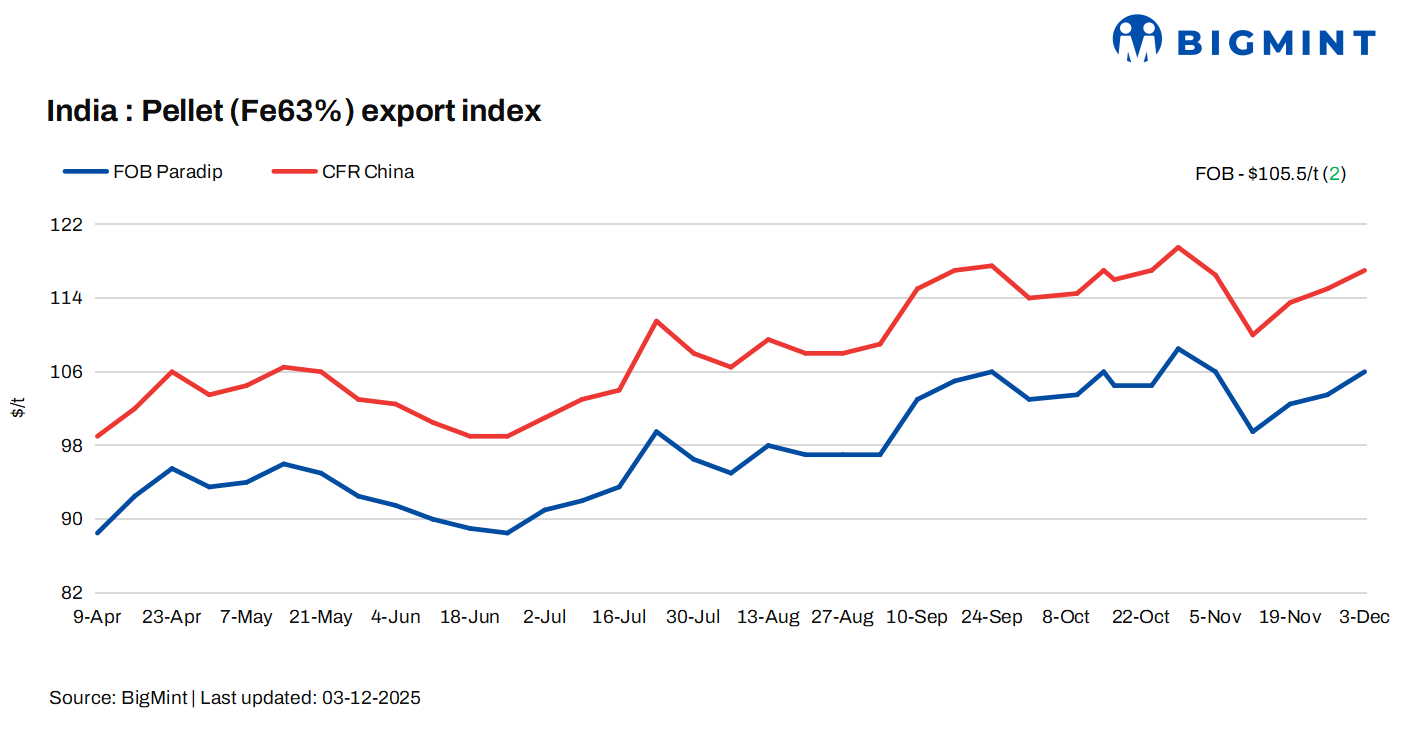
- Recent deal for higher-grade pellets lifts market sentiment
- Suppliers focus on domestic sales amid inconsistent inquiries
Indian pellet export prices up w-o-w on 3 December, supported partly by a recent deal for higher-grade material, which boosted short-term sentiments. However, the overall market remained cautious, with participants noting limited buying interest from Chinese mills and fluctuating pricing trends.
Price update
BigMint’s India pellet (Fe 63%, 3-3.5% Al) export index increased by $2/tonne (t) w-o-w to $105.5/t FOB east coast on 3 December. Pellet demand was weak in the seaborne market, as Chinese steelmakers showed caution.
No deal for Fe 63% pellets was recorded from the Odisha region in this publishing window due to a lack of offers from exporters and firm demand in the domestic market.
Meanwhile, an export deal for around 75,000 t of Fe 64% pellets was recently closed at $125/t CFR China for end-of-December loading.
Market movements
According to market players, demand from China for Indian pellets remained subdued. An international trader said, “Chinese buyers are not very active at the moment, and the bids we receive are often below workable levels. The lack of consistent inquiries has driven many Indian suppliers to prioritise the domestic market, where prices and volumes are more stable.”
Another international market participant highlighted that the pellet market remains volatile. He added, “Demand is weak, and pricing has been extremely unstable. The recent deal helped lift sentiments briefly, but it has not translated into broader buying support.”
Sources also indicated that Odisha-based suppliers have been largely absent from export activity as domestic opportunities appear more profitable.
Chinese iron ore prices remained firm during the week amid ample liquidity and upbeat sentiment ahead of the Politburo meeting, offering some support to pellet export offers. However, higher raw material costs in the Indian market are posing a challenge for pellet exporters.
A pellet producer noted, “The recent increase in iron ore prices at the OMC auction has significantly pushed up pellet production costs. Export prices, however, have not improved enough to match this rise.”
Another supplier echoed similar concerns, stating that domestic bookings have already absorbed much of their capacity. “We received some bids from overseas, but these did not meet our targeted levels. At such low prices, exports are simply not viable.”
Domestic vs export market gap shrinks
Domestic prices exceeded export offers by around INR 800/t ($9/t), with the gap narrowing by INR 400/t w-o-w. Pellet (Fe63%) prices in Odisha’s Barbil were recorded at INR 8,350/t ($93/t) exw, stable compared to last weekend. Meanwhile, the ex-plant realisation in exports from Barbil rose by INR 350/t ($4/t) w-o-w to INR 7,500/t ($83/t) exw.
Rationale
- No (0) confirmed deals from India’s east coast were recorded in this publishing window for T1 trade. Thus, this category was allotted zero % weightage for today’s price calculations. Click here for the detailed methodology.
- Eleven (11) indicative prices were received, and seven (7) were considered for the calculation of the index and given the balance 100% weightage.
Factors impacting pellet exports
- Chinese iron ore fines prices inch up w-o-w: The benchmark iron ore fines index rose $1/t w-o-w to $108/t CFR China on 2 December. The Asian seaborne iron ore market firmed up on improved macro sentiment, with a rebound driven by expectations of US Fed rate cuts and support from the upcoming year-end Politburo meeting. Trades were focused on mid-grade fines. Meanwhile, the Chinese domestic market saw the first round of met coke price cuts.
- DCE iron ore futures stable w-o-w: Iron ore futures on the Dalian Commodity Exchange (DCE) for the January 2026 contract closed at RMB 799.5/t ($112/t) on 3 December, edging up by RMB 2.5/t ($0.5/t) w-o-w.
Pellet inventories at major Chinese ports stood at 2.65 mnt on 27 November, inching up by 0.05 mnt w-o-w as per data published by SteelHome.
Outlook
Leave a Reply