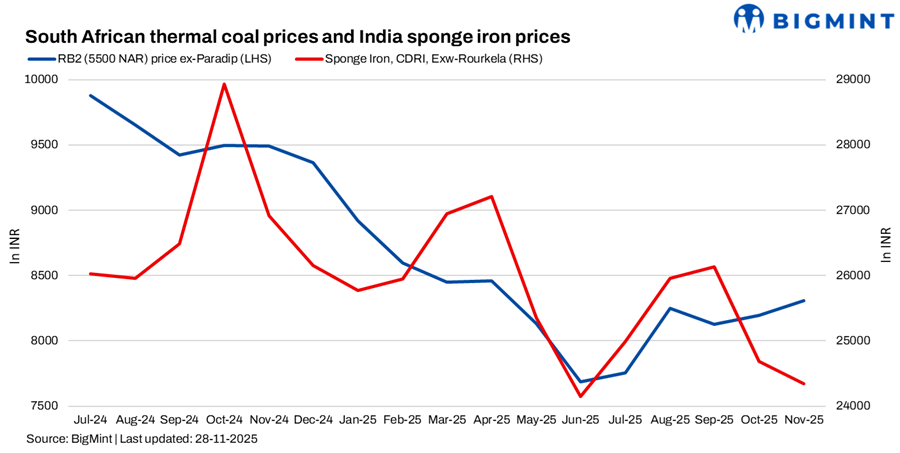
- South African coal offers rose while Indian buyers remained cautious
- Firm North Asian demand tightened seaborne supply and supported prices
- Indian inventories mixed, limiting aggressive buying despite stronger sponge iron sentiment
South African thermal coal offers rise w-o-w amid firm global cues
South African thermal coal offers strengthened w-o-w on 28 Nov across key Indian ports, tracking higher international benchmarks and the impact of INR depreciation. Ex-Paradip RB2 increased by INR 150 to 8,550/t, while RB3 stayed stable at 7,200/t. Ex-Gangavaram RB2 rose by INR 50 to 8,400/t and RB3 increased to 7,250/t. Ex-Vizag RB2 climbed by INR 50 to 8,400/t, with RB3 holding steady at 7,200/t.
A 50,000 t deal was concluded at INR 8,700/t ex-Paradip. Smaller trades included 4,000 t at INR 8,300/t ex-Mangalore and another 4,000 t at INR 8,100/t on advance payment, reflecting selective buying at negotiated levels.
Asian Thermal Coal Market Report: Seaborne Strength Meets Indian Portside Caution
The Asian thermal coal market presented a tale of two trends this week. Seaborne prices, particularly for South African and high-calorific value Indonesian coal, found firm support from robust North Asian demand. Conversely, the Indian portside market exhibited a cautious stalemate, with prices inching up for South African origin coal but facing resistance from end-users amid high seaborne offers and mixed inventory trends across its ports.
Seaborne Market Overview: Firming Fundamentals
Global seaborne coal prices showed resilience, driven by supply tightness and competitive buying from Japan and South Korea.

Market Analysis: Industry sources attributed the strength in South African prices to a “supply crunch situation,” noting that significant volume purchases by South Korean and Japanese buyers have tightened the market for prompt cargoes. This has created a challenging environment for other importers, particularly in South Asia.
India Market Deep Dive: Portside Analysis
Inventory Snapshot: Mixed Signals Across Coasts Overall portside thermal coal inventories in India rose marginally by 0.3% week-on-week to 12.88 million tonnes. However, this masked significant regional disparities:
East Coast: Showed strength with notable stock builds at key ports like Paradip and Vizag, with one terminal seeing a surge of over 240% due to renewed unloading activity.
West Coast: Trends were uneven, with draws at several major ports offset by a significant 32% inventory increase at the country’s largest commercial port, highlighting inconsistent vessel arrivals.
Price Movement & Market Sentiment
The following table summarizes the price action and prevailing sentiment for key imported grades.
Key Themes from the Indian Market:
Support from Sponge Iron Sector: Market participants reported that firming prices in the sponge iron industry provided underlying support for South African coal, a key raw material, with at least one major trade confirmed at the higher end of the price range.
High Costs Dampen Demand: The primary challenge cited across the market was the high cost of seaborne coal, driven by strong FOB prices and elevated freight rates. This has made imports less competitive against domestic coal, leading to a widespread “wait-and-see” attitude among industrial buyers.
Diverted Cargoes: For Indonesian coal, traders noted that increased Chinese buying interest for mid- and high-CV material was diverting cargoes away from the Indian market, creating a floor for prices despite sluggish local demand.
Outlook for the Indian Market
The Indian imported coal market is expected to remain range-bound in the near term.

Upside Risks: A sustained increase in sponge iron prices or a meaningful correction in international freight rates could renew buying interest for South African coal.
Downside Risks: Persistently high seaborne offers and a well-supplied domestic market may continue to suppress significant restocking activity. The market is likely to see a clearer direction post-mid-December, as traders assess pre-holiday procurement needs.
In conclusion, while the broader Asian seaborne market demonstrates strength driven by North Asian demand, India remains a price-sensitive buyer. The current standoff between firm global prices and tepid local demand is reflected in the cautious and fragmented activity across India’s portside markets.
Leave a Reply