- CCS key to mitigating emissions in hard-to-abate sectors
- CCUS expected to offset risk of stranded assets in steel, power sectors
- Technological developments, economies of scale to lower CCUS costs
Morning Brief: In the context of the global steel industry’s urgent requirement of cutting down GHG emissions within a pre-defined timeframe so as not to exacerbate the global climate crisis, carbon capture, utilisation and storage (CCUS) has emerged as a key decarbonisation pillar, especially in the mitigation of industrial emissions from the ‘hard-to-abate’ sectors.
Is CCUS the solution?
However, industry watchers and climate experts have objected to CCUS on two specific grounds: a) as to means of continuing usage of fossil fuels and perpetuating polluting industrial processes, and b) as an yet unproven technology in the steel industry.
In reply to the first objection it may be noted that despite the phenomenal growth of renewable energy in India the power sector only contributes to about 1/3rd of the aggregate CO2 emissions. The growing industrial economy emits close to another third of the aggregate emissions that are hard to abate, and will continue to increase unless new technologies and carbon abatement mechanisms are deployed.
“While India phases down the use of coal over time,” notes a NITI Aayog report, “India will be dependent on fossil energy sources like coal for a long time to support the industry and meet the requirements for affordable and reliable baseload power. Therefore, India’s decarbonization pathway has to also embrace technologies which will abate emissions from the hard to abate industrial sectors as well as for residual baseload power generation.”
So, three main reasons why CCUS should be adopted, according to this argument, are:
- It is the only known technology for decarbonising the hard-to-electrify and CO2 – intensive sectors such as steel, cement, oil and& gas, petrochemicals and chemicals, and fertilizers
- CCUS is expected to play a major role in enabling the hydrogen economy in India, through the production of blue hydrogen (i.e. coal gasification-based hydrogen production coupled with CCUS) based on the utilisation of India’s rich endowments of coal
- India’s comparatively young steel and power fleet will turn into stranded assets if not retrofitted with CCUS, thereby offsetting huge economic loss
CCUS in steel industry
As per the World Steel Association (WSA) and the Leadership Group for Industry Transition, most of the CCUS projects in the steel industry are located in Europe. ArcelorMittal in Belgium and France, ThyssenKrupp in Germany, Tata Steel in the Netherlands, Vattenfall and SSAB in Sweden are in the process of building projects based on multiple pathways such as methanol, ethanol and polyurethane and syngas production along with CO2 storage. In the Middle East, Emirates Steel is running an operational project.
In the US, only one plant, United States Steel, is operational that uses CO2 to produce carbonates. In Asia, carbon capture and storage projects can be found in Japan, where Nippon Steel is operating an enhanced oil recovery project, and POSCO is planning a carbon capture and storage project in South Korea. Chinese companies also have deployed projects that utilise carbon dioxide.
In India, JSW, Tata Steel and JSPL are working to develop and demonstrate different types of CCUS projects.
Cost factor
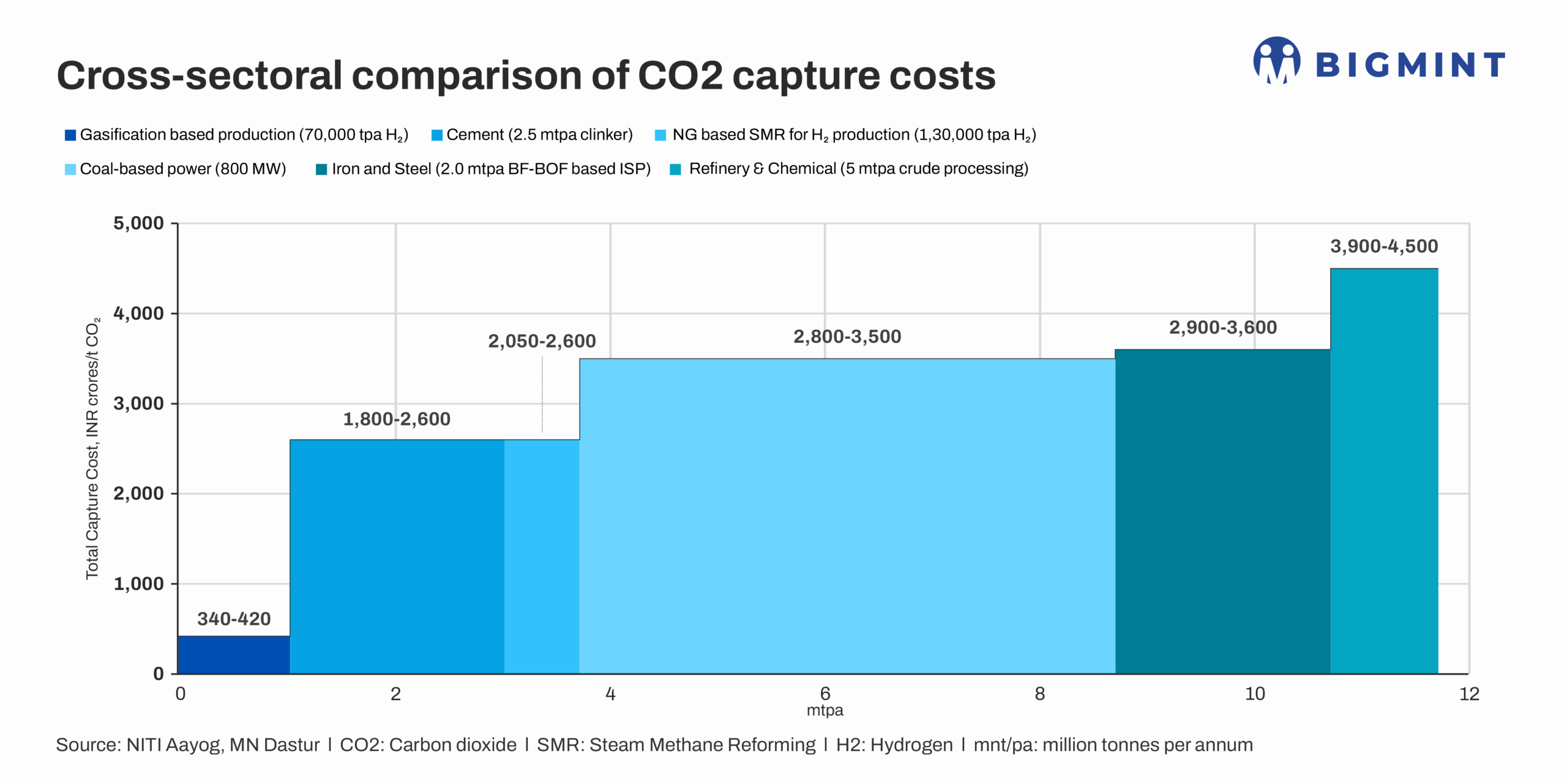
Therefore, the objection that CCUS as an unproven technology in the steel industry is not valid, although it must be admitted that it is a nascent technology. However, the key hurdle in the implementation of CCUS is cost. Carbon capture costs vary widely across industries and sectors, and depend on CO2 source characteristics (mainly pressure and concentration), capture technology, power and steam sourcing costs.
As the infographic (above) shows, capture and processing costs in the iron and steel as well as power sectors are currently quite steep. But it is expected that with technological development, expansion of storage potential, economies of scale, a rapidly accelerating hydrogen ecosystem and fast-emerging CO2 utilisation technologies the adoption of CCUS in India will be rendered feasible due to rapidly decreasing costs.
Leave a Reply