- Nickel Industries posts higher Q3 production
- China’s factory, retail growth slows further
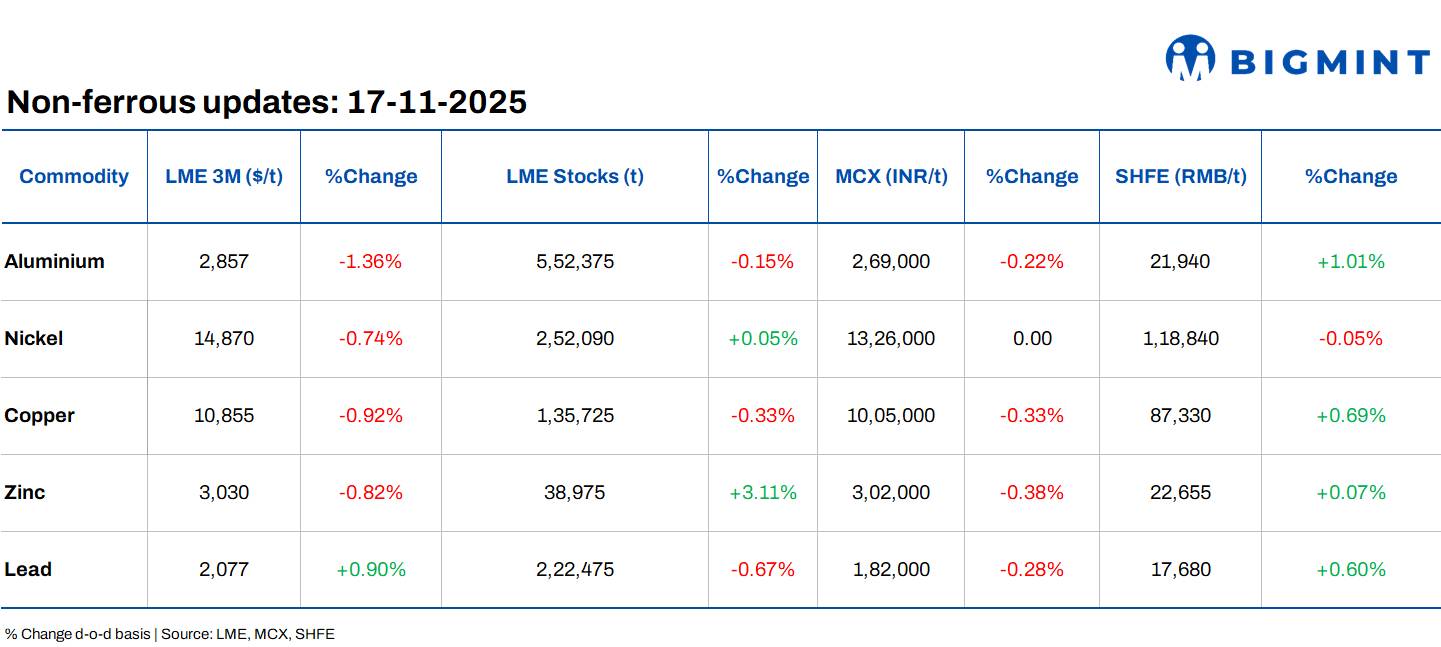
Base metals prices on the London Metal Exchange (LME) remained range-bound d-o-d, with aluminium decreasing by 1.36% to $2,857/tonne (t). Meanwhile, inventories at LME-registered warehouses witnessed divergent movements, with zinc recording the highest gain of 3.11%.
Domestic market overview
In India’s non-ferrous metals markets, BigMint assessed copper armature scrap at INR 880,000/t ex-Delhi, stable d-o-d. Aluminium Tense scrap prices were assessed at INR 190,000/t ex-Delhi and at INR 185,000/t ex-Chennai, both stable d-o-d.

Congo copper mine collapse kills dozens in Lualaba province
Around 30 people were killed at a semi-industrial copper mine in southeastern Congo after a bridge collapsed at the Kalando site in Lualaba province, with officials later confirming 32-49 deaths and 20 injured miners in critical condition. The incident was reportedly triggered by panic after gunfire from military personnel securing the area, causing miners to rush and pile over one another. Rights groups have called for an independent investigation into the military’s role, as mining accidents remain common in Congo’s largely unregulated artisanal sector.
Nickel Industries posts 2% q-o-q rise in Q3 output
Nickel Industries Ltd. recorded 31,148 t of nickel production in Q3CY’25, up 2.38% from the previous quarter, supported by a 1.29% increase in NPI output to 263,430 t across its four RKEF projects — Hengjaya, Ranger, Angel and Oracle — which together contributed over 31,000 t of nickel metal despite maintenance at Oracle Nickel. The company also produced 2,166 t, attributable to the HNC HPAL project, while commissioning at the Excelsior HPAL project (44% stake) is nearing completion, with full nickel and cobalt output for battery and high-temperature alloy markets expected next quarter.
China’s growth slows as factory output, retail sales weaken
China’s economy came under renewed pressure in October as factory output rose just 4.9% and retail sales 2.9%, both marking their slowest growth in over a year. The slump highlights weakening domestic demand, worsening trade war effects and growing challenges for manufacturers struggling with shrinking export orders. Policymakers now face mounting urgency to rebalance the economy, boost household consumption, and address rising local government debt, even as structural reforms remain politically sensitive. With exports unexpectedly collapsing and car sales breaking an eight-month growth streak, analysts warn that China’s traditional drivers of growth are losing momentum, signalling a tougher outlook heading into 2026.
Canada’s manufacturing steadies as US output remains weak
US manufacturing contracted for the eighth straight month in October, with ISM PMI slipping to 48.7, signalling declines in new orders and production. Canada, however, showed signs of improvement: its PMI rose to 49.6, and manufacturing sales increased 3.3% m-o-m to C$72.07 billion. Building permits also climbed 4.5% m-o-m, and the country added 67,000 jobs in October, bringing unemployment down to 6.9%. Meanwhile, US small business optimism eased to 98.2, with labour shortages still a major challenge.
Leave a Reply