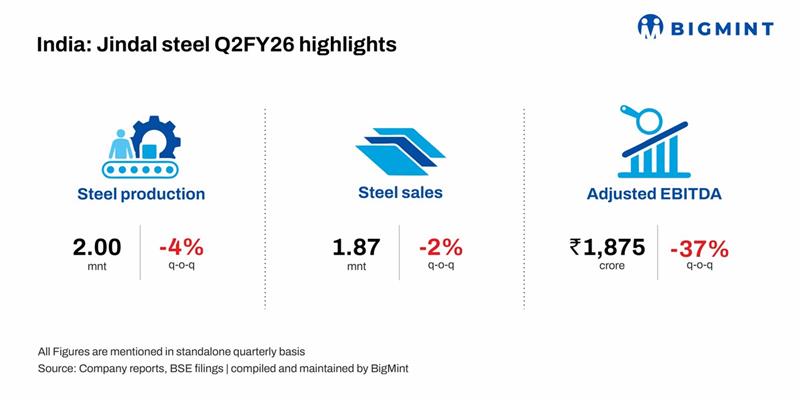
- Production and sales dip sequentially
- EBITDA declines amid cost pressures
Jindal Steel’s steel production fell by 4% q-o-q to 2 mnt, while steel sales declined by 2% q-o-q to 1.87 mnt in Q2FY’26. The company incurred a capex of INR 2,699 crore during the quarter, against the total announced capex of INR 47,043 crore.
Update on key projects
Key projects – Angul expansion updates
- Bhagavati Subhadrika BF-2: Commissioned in September’25; achieved first hot metal tapping in the same month.
- Basic Oxygen Furnace-2: Successfully commissioned in September.
- CRM Complex: CGL-1 commissioned; progressive commissioning of additional lines planned through FY’26.
- BOF-3 & PP-2: Construction progressing as per schedule.
Other highlights
Steel production declines q-o-q: The company’s steel production dipped by 4% q-o-q to 2 mnt in Q2 compared with 2.09 mnt in Q1FY’26. However, on a y-o-y basis, production inched up by 2% from 1.97 mnt recorded in Q2FY’25. Performance was impacted due to a prolonged monsoon as well as planned shutdowns.
Steel sales ease q-o-q: The company’s steel sales stood at 1.87 mnt in Q2, marking a 2% decline from 1.9 mnt in Q1. However, y-o-y, sales registered a marginal rise of 1% from 1.85 mnt recorded in Q2FY’25. This was impacted due to lower production.
EBITDA weakens q-o-q: The company’s EBITDA stood at INR 1,875 crore in Q2, reflecting a 37% decline from INR 2,984 crore in Q1FY’26. Y-o-y, EBITDA was lower by 12% compared with INR 2,124 crore reported in Q2FY’25.
The company’s EBITDA per tonne stood at INR 10,010 in Q2FY26, down 36% q-o-q from INR 15,680 in Q1FY26. On a y-o-y basis, it declined by 13% from INR 11,467 recorded in Q2FY25.
Steel price movements in Q2FY26: Indian steel prices witnessed a correction in Q2 due to seasonal weakness. HRC prices remained subdued amid declining Chinese steel prices, while TMT prices continued to fall owing to the prolonged monsoon. Consequently, TMT shifted from a premium to a discount over HRC compared to Q1FY’26.
Raw material & operating costs: Total operating costs rose in Q2FY’26, primarily due to planned shutdowns that increased maintenance expenses and the purchase of metallics to offset production losses. Additionally, higher iron ore prices added to cost pressures, though PCI coal prices remained largely stable, providing partial relief.
For Q3FY26, coal consumption costs are expected to rise by $3–5/t sequentially. Iron ore costs remain largely stable q-o-q, even as NMDC has announced price reductions, while OMC auction prices continue to stay elevated despite weaker steel prices.
Leave a Reply