- Shaanxi bucks trend with 3.7% y-o-y increase in output
- Output curbs, inspections, rising demand may lift prices
Mysteel Global: Raw coal production in China’s key mining regions declined y-o-y in September, according to the latest regional breakdown from the National Bureau of Statistics (NBS).
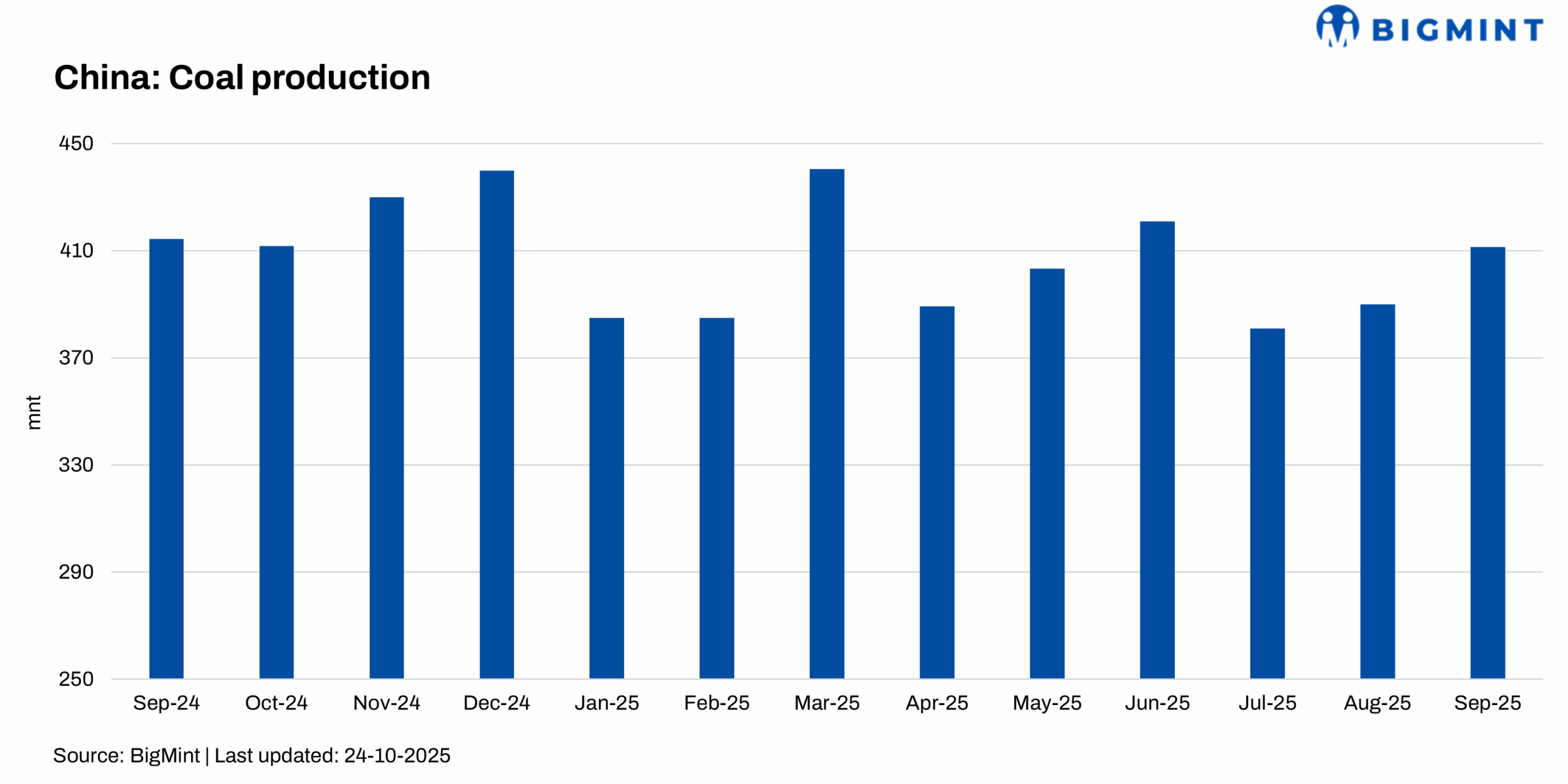
The combined output of the top five coal-producing regions — Shanxi, Inner Mongolia, Shaanxi, Xinjiang, and Guizhou — reached 347.22 million tonnes (mnt) last month, down 1.4% y-o-y but up 4.7% from August, the NBS data showed. These five regions accounted for 84.4% of China’s total coal production in the month, which slipped 1.8% y-o-y to 411.51 mnt.
Among the top five, Shanxi, Inner Mongolia, Xinjiang, and Guizhou all recorded y-o-y declines, while Shaanxi bucked the trend with a mild increase.
Shanxi remained China’s largest coal-producing province in September, supplying 114.38 mnt, representing 27.8% of the national total. The volume was down 4.3% y-o-y but up 6.2% m-o-m.
Shanxi’s production growth had been robust earlier in the year, jumping by 20.3% y-o-y in January-February, 19.6% in March, 11.4% in April, and 3.4% in May, Mysteel Global notes. However, output began turning negative y-o-y from June onward, recording -1.6% that month, -5.3% in July, -6.7% in August, and -4.3% in September.
This reversal indicates that Shanxi began tightening its supervision of mining activity in the second half of the year, in line with the central government’s directive to curb overproduction, a move aimed at enhancing mine safety as authorities argue that excessive output can lead to equipment overuse and unsafe operations.
Inner Mongolia, Xinjiang, and Guizhou experienced similar reductions in output. Notably, Inner Mongolia’s production not only fell 2.5% on year in September, but its year-to-date production also dropped 0.8% y-o-y, making it the only region among the five to post a y-o-y decline for the first nine months.
During National Energy Administration (NEA) inspections earlier this year, 15 out of 299 coal mines in Inner Mongolia were found to have exceeded 110% of their approved capacity in the first half. These mines, with a combined capacity of 34.6 mnt/year, were ordered to suspend operations for at least one week pending rectification and inspection, as Mysteel Global earlier reported.
In contrast, Shaanxi stood out among the five last month with a 3.7% y-o-y rise in output, reflecting the province’s strategy of balancing capacity expansion and production discipline. Shaanxi plans to commission six new coal mines this year, which will add an estimated 20.2 mnt to annual capacity, a sign that the province is focusing on stabilising supply while maintaining regulatory compliance.
On the demand side, China’s total power consumption grew 4.5% y-o-y in September, according to NEA data, driven mainly by a 5.7% rise in the secondary industry (industrial sectors). Meanwhile, household electricity use fell 2.6%, as cooler weather curbed air-conditioning demand.
However, thermal power generation declined 5.4% y-o-y in September, suggesting lower coal consumption during the seasonal transition period between summer and winter.
Overall, the coal market experienced a supply-demand rebalancing in September. As the winter “heating season” already kicks off when coal is required for public housing boilers and measures remain in place to control overproduction at mines, the market balance is tilting toward tightness, and coal prices this quarter are expected to trend upward, albeit with some volatility, Mysteel Global noted.
Note: This article has been written in accordance with a content exchange agreement between Mysteel Global and BigMint.
Leave a Reply