- Turkiye sees nominal bookings despite rising prices
- Japan’s H2 export prices climb up amid weak yen
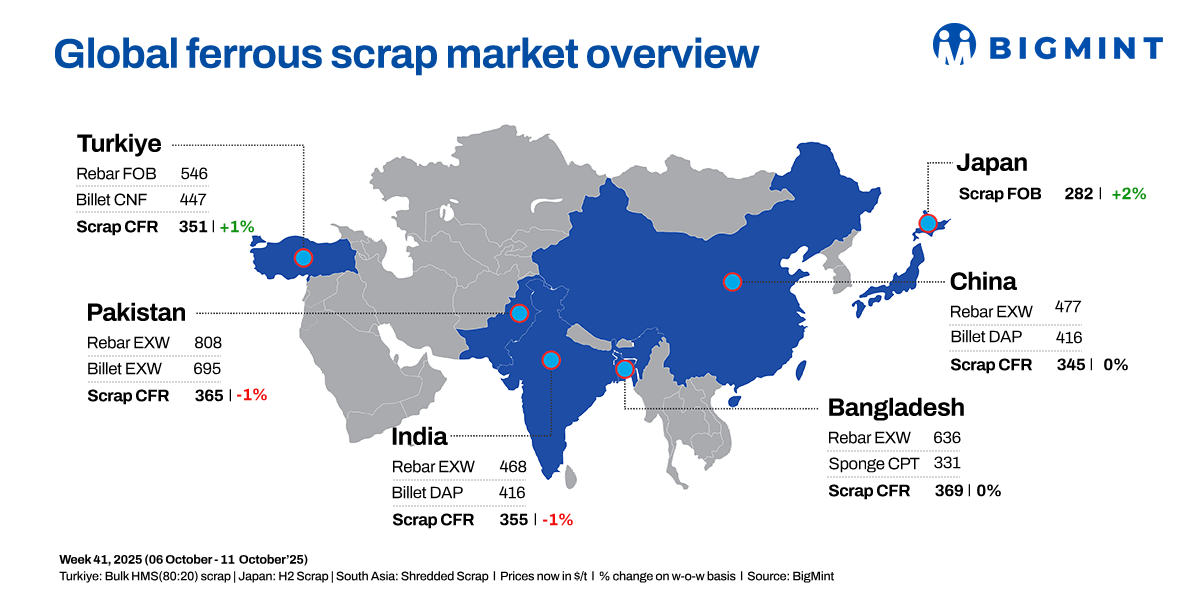
Global imported scrap markets remained mixed, with tight supply supporting prices in Turkiye, India, Bangladesh, Japan, the US, Pakistan, China, and the UAE, while weak steel demand and high freights weighed on trading activity.
Turkiye: Turkiye’s imported scrap market showed a gradual upward trend through the week, supported by firm ocean freights and limited material availability. US/Baltic-origin HMS 80:20 offers moved from $346-350/t CFR early in the week to trade around $351/t by the week’s end, as sellers held back cargoes amid rising costs and thin margins.
Although domestic sales continued to face pressure, some optimism emerged as Ukraine’s exemption from EU steel import tariffs was seen as a potential opportunity for Turkish mills to boost finished steel exports in the near term.
India: India’s imported scrap market was subdued, as market participants remained absent following last week’s Dussehra holidays. Weak steel demand also limited buying. Offers for shredded hovered at $355-360/t CFR, while buyers targeted $350/t. Offers for HMS 80:20 were at $325-330/t, with tradable levels below $325/t, keeping trade minimal.
A strong dollar, high freight, and weak domestic steel demand dampened sentiment. Mills avoided restocking as import prices remained unviable, especially for HMS and busheling grades, with buyers waiting for post-festival clarity before resuming fresh purchases.
In the last seven days, around 3,500-4,500 t of imported scrap were booked, including 1,000-1,500 t of HMS 80:20 at $318-325/t, while the rest comprised HMS 90:10, NTP, LMS bales, and turning scrap.
Pakistan: Pakistan’s imported scrap market remained mostly inactive, with limited buyer interest due to tight liquidity and weak downstream demand. EU/UK shredded traded around $365-370/t CFR Qasim, and UAE-origin held $385-388/t. No major deals were heard, and mills continued operating at 35-40% capacity.
The market remained muted amid tight cash flow and extended 90-day credit cycles. Imported shredded was at $363-364/t, while domestic scrap stayed steady, keeping trade sentiment under pressure.
Bangladesh: The imported scrap market remained mostly stable throughout the week, with limited buying interest amid weak steel demand and sluggish construction activity. Offers for HMS 80:20 and 90:10 from Brazil and Chile hovered around $350-360/t CFR Chattogram, while UK/EU shredded and Singapore PNS were quoted slightly higher, though bids stayed lower, reflecting continued resistance from mills.
Japan: H2 scrap export prices rose w-o-w, mainly driven by a weaker yen hitting a seven-month low against the US dollar. Traders said supply tightness contributed, but currency weakness was the primary factor supporting higher offers.
The October 2025 Kanto scrap tender showed market strength, with a 20,000-t H2 lot awarded to a Chattogram mill at JPY 44,316/t ($290/t) FAS, up JPY 2,346/t ($15/t) m-o-m, reflecting rising export interest despite subdued domestic activity.
Domestically, Tokyo Steel raised scrap prices by JPY 1,000/t at most plants, with H2 scrap now at JPY 41,000-42,000/t, amid concerns over Japan’s fiscal outlook.
China: Domestic EAF mills are expected to cut or halt production amid heavy losses on finished steel sales. Scrap demand may ease this month despite post-holiday replenishment, but the tight availability of steel scrap continues to support prices.
US: Export prices rose w-o-w on tight coastal supply and strong HMS demand, but key markets such as Turkiye, Bangladesh, and Vietnam remained cautious amid weak downstream demand and European tariff uncertainties.
UAE: Domestic scrap prices eased slightly, with processed HMS at AED 1,185/t and PNS at AED 1,200/t. The rebar market stayed balanced, while projects like Al Jazeera Steel’s UAE mill and Etihad Rail’s corridor may boost future steel demand.
Leave a Reply