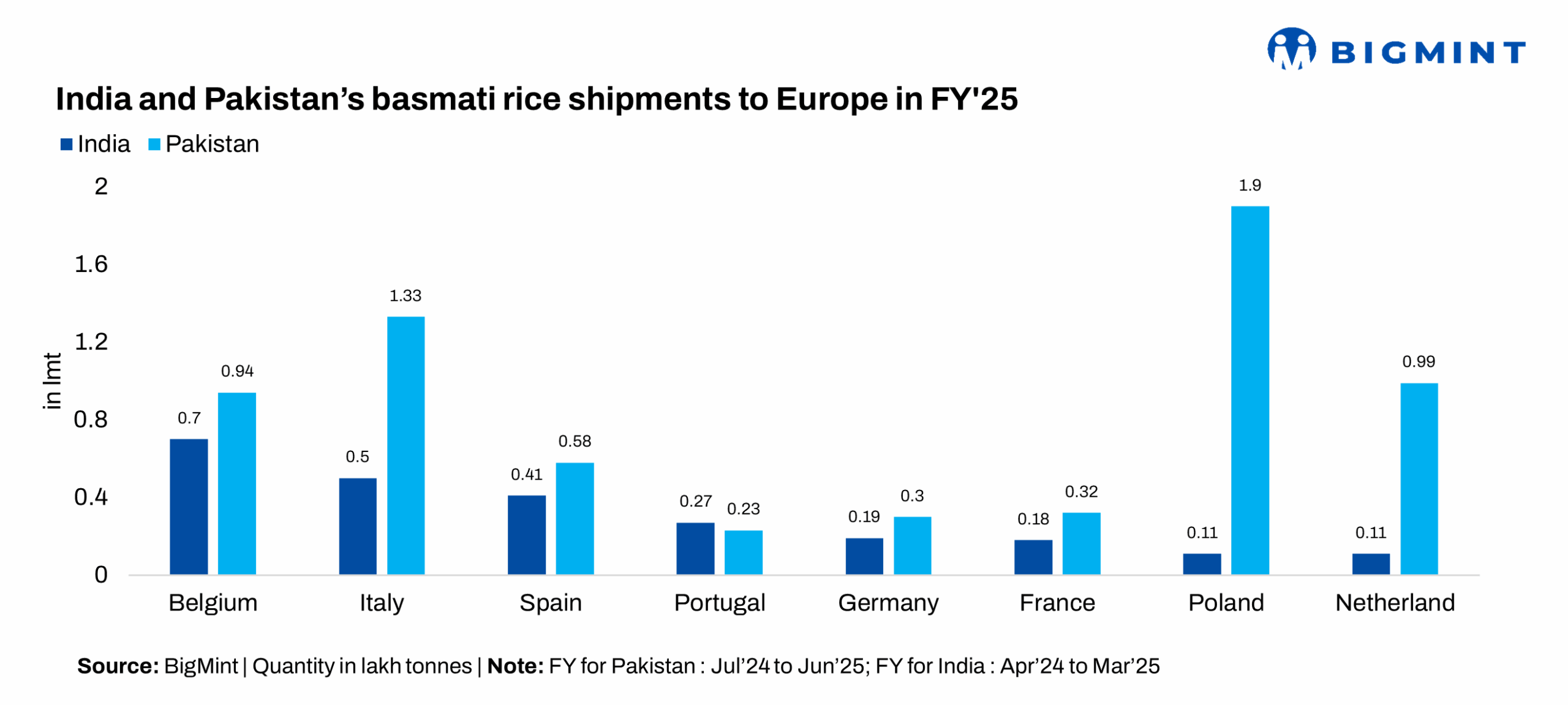
- Basmati rice grown in Punjab region spanning both India, Pakistan
- Both countries claim basmati as own, EU caught in middle of dispute
As India and the EU work on reaching a fair-trade agreement for several goods and services, including Darjeeling tea, the origin of basmati rice has emerged as a core issue, with both Indian and Pakistani products being labelled as basmati in European countries.
Basmati rice, which is known for its long grain and aromatic fragrance, grows in the Punjab region, spanning both Indian and Pakistani territories. India wants the EU to recognise it as their patent (an official label that shows where products come from and protects them from imitation), but Pakistan also claims basmati as part of its heritage and maintains that its products should be recognised too.
In the 1990s, India and Pakistan fought this battle together with a US company RiceTec, which patented basmati. They won in 2001. Later, between 2004 and 2008, both countries worked on a joint application to the EU. However, after the Mumbai terror attacks, relations between the countries broke down, and the cooperation stopped.
In 2018, India filed for a GI tag application alone, which upset Pakistan, with the country objecting that basmati should not be classified as Indian-origin exclusively. Subsequently, Pakistan filed its own GI tag application, including the parts of Kashmir — Mirpur, Bhimber, Poonch, and Bagh — as places where basmati rice is grown and a region both countries dispute.
Now, the EU is caught in the middle. Recognising basmati as belonging to one country could upset the other, especially because Kashmir is involved. The EU may try to push for joint recognition, giving both India and Pakistan shared rights to basmati to avoid a political conflict, Matteo Mariano, a trademarks expert at the Nova Graaf law firm, opined.
According to the lawyer, if India wants to have doors opened for itself, the EU can leverage that to benefit its own companies.
However, for that, the Commission will need to be a shrewd strategist, as Delhi is represented by “tough negotiators,” European Commissioner for Trade Maroš Šefčovič himself conceded in September.
As trade talks continue, basmati has become more than just rice; it is a symbol of national pride, politics, and economic power for both India and Pakistan.
Leave a Reply