- Turkish scrap prices rise on tight supply, firm offers
- Pakistan sees weak demand amid low mill activity
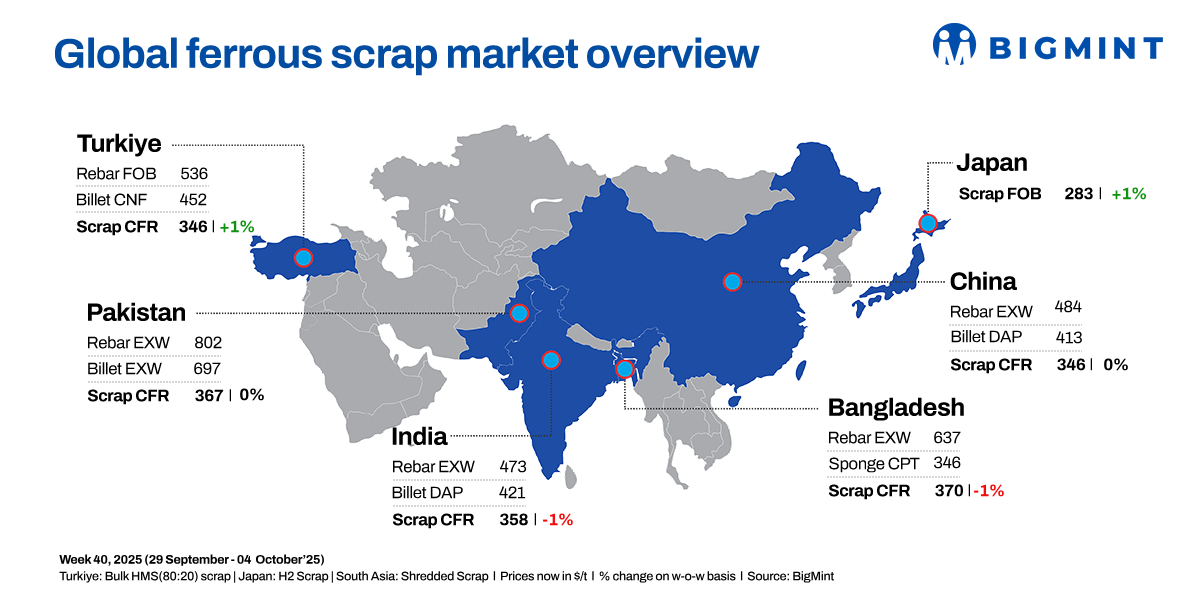
Global imported scrap markets remained mostly stable this week, with subdued buying across South Asia, especially in India due to Dussehra; firm offers in Turkiye; slight gains in Japan; and cautious trading in the UAE amid weak demand.
Turkiye: Turkiye’s deep-sea scrap market saw a slight rise this week, despite mills attempting to push prices lower amid weak finished steel demand. Suppliers resisted pressure, supported by reduced inbound flows, firm freights, and high European collection costs, keeping offers firm.
After securing most October cargoes, mills showed limited booking interest, though some sought late-October shipments. Activity remained muted, but tighter supply and rising freights contributed to the price increase, balancing the market despite subdued downstream demand.
India: India’s imported scrap market remained largely muted throughout the week, with offers holding steady across origins. Shredded scrap was quoted around $360/t CFR, HMS 80:20 near $330-335/t, busheling at $370-375/t, and PNS at $360-370/t, though workable bids were consistently below these levels.
Market sentiment was weighed down by sluggish finished steel demand, cheaper domestic scrap (about INR 1,500-1,800/t lower than imports), and seasonal disruptions from monsoon rains. The Dussehra holidays further slowed trading activity, with most mills staying on the sidelines and preferring to delay fresh bookings.
Sponge iron trials, limited liquidity, and cautious procurement kept the Indian imported scrap market subdued. Sellers held firm, but weak buying and festival slowdowns kept trading volumes thin.
Pakistan: Pakistan’s imported scrap market remained subdued throughout the week, with EU/UK shredded offers hovering at $365-370/t CFR Qasim and UAE shredded quoted higher at $380-388/t. Buying activity was muted, as mills ran at only 30-35% of their capacity, while many others kept production halted.
Weak finished steel demand, falling rebar prices, and cheaper domestic scrap at PKR 135,000-138,000/t ($477-488/t) kept buyers on the sidelines, leaving Pakistan’s imported scrap market quiet with very limited fresh trades.
Bangladesh: The imported scrap market stayed mostly stable through the week, with limited buyer interest and steady offers. Singapore PNS was quoted at $378/t CFR against bids near $370/t, while Malaysia PNS was sought at $370-372/t against offers of $380/t. Bulk HMS 80:20 (open origin) hovered at around $345/t CFR, while US bulk was last heard near $352/t.
Demand remained weak as mills, stocked up from earlier purchases, faced slumping construction and stalled public projects. Finished steel demand stayed low, and many mills operated at reduced capacity or were shut, with production down by around 40%. This kept trading muted despite firm offers.
Japan: H2 scrap export prices rose by JPY 300/t w-o-w to JPY 41,900/t ($284/t) FOB Tokyo Bay, supported by stronger supplier offers and yen fluctuations. Buyers’ near-term demand is expected to be stable, with mills adjusting restocking based on inventories and cost advantage.
South Korea: Ferrous scrap inventories at eight major steelmakers rose 5% w-o-w to 856,000 t in late September, driven by pre-holiday stockpiling and steady Japanese imports amid price concerns.
UAE: Domestic HMS scrap prices eased slightly this week, with HMS processed at AED 1,196/t ($326/t) amid muted export activity and slow Pakistani bookings. Local LMS and PNS also declined by $1-3/t, while rebar prices remained stable at AED 2,590/t ($705/t), supported by steady construction.
Leave a Reply