- Company announces INR 700 cr decarbonisation corpus
- Onsite green H2, RE, nuclear power key energy transition strategies
- Stainless steel major plans to raise capacity to 4.2 mnt per annum
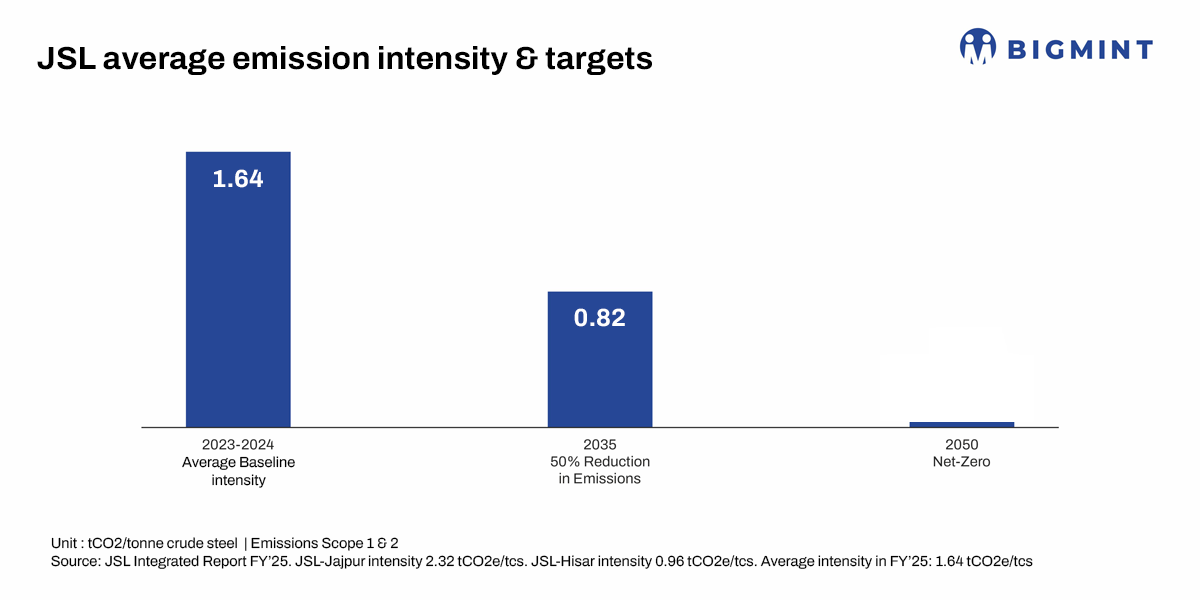
Morning Brief: Indian stainless steel major Jindal Stainless Ltd. (JSL) has drawn up an ambitious decarbonisation roadmap which targets 50% reduction in GHG (greenhouse gas) emissions by the year 2035 and reaching net neutrality by 2050. In its recent report on FY’25 sustainability performance, the company informed that emission reduction efforts led to the avoidance of 318,248 tonnes (t) of CO2 equivalent (CO2e) emissions, reinforcing its long-term climate ambition.
JSL is building a decarbonisation strategy with an aim to include a portfolio of carefully selected mitigation opportunities, demonstrating the potential to achieve transformation in its environmental footprint.
The No.1 stainless steel producer in India, with a capacity of 3 million tonnes (mnt) per annum, JSL is spread over 12 countries through its 19 subsidiaries. It has a diversified high-end product mix, producing around 120 grades of stainless steel, and targets to raise capacity to 4.2 mnt in the mid-term.
The company has announced an INR 700 crore corpus for steering its decarbonisation ambitions and consumed 2,95,210 MWh of renewable energy in FY’25, as part of its sustainability commitments.
Emissions intensity
The company’s Scope 1&2 CO2e emission intensity at its Jajpur facility was 2.32 (tCO2e/tcs) in FY’25 and 0.96 tCO2e/tcs at the Hisar facility.
Emissions from all operational units are calculated using methodologies outlined in the World Resources Institute–World Business Council for Sustainable Development (WRI–WBCSD) GHG Protocol and ISO 14064:2006 – Part 1. The reported data is subjected to independent third-party assurance annually, as per the International Standard on Assurance Engagements (ISAE) 3410 and ISAE 3000 standards.
Decarbonisation roadmap
Energy efficiency: By optimising its processes and maximising resource utilisation, significant emissions reductions are possible. As per JSL’s estimates, several key efficiency initiatives offer a negative abatement cost, meaning they generate cost savings while reducing the company’s carbon footprint.
JSL is exploring state-of-the-art systems, such as steam generation boilers and Organic Rankine Cycle (ORC) technology, to capture high-temperature waste heat from its furnace exhausts. This captured thermal energy is then converted into steam or electricity, reducing the company’s reliance on grid power and maximising the energy value.
By deploying advanced insulation materials for ladles, applying best practices in terms of refractory management (such as foamy slag), and adopting cold-setting linings for tundishes, JSL maintains the metal’s temperature more effectively, which in turn reduces the energy required for reheating and subsequent processing steps. Upgradation of motors and adopting technologies such as oxyfuel burners are other examples.
Transition to cleaner energy: A deliberate and phased transition away from carbon-intensive fuels is guided by a clear technology roadmap:
- JSL is actively exploring the partial substitution of metallurgical coke with biochar. It is set to introduce biomass co-firing, where a portion of the coal will be replaced with renewable biomass, such as agricultural residue or wood pellets.
- In the short term, the company will increase the use of sustainable biofuels, aiming for a significant replacement of liquid fossil fuels. In the medium term, the company plans to replace propane with lower-emission fuels such as natural gas and recovery gases from industrial processes (gases from coke oven batteries, blast furnace, and basic oxygen furnace) in its furnaces, before transitioning to advanced electric heating technologies and electric-driven vehicles in the medium to long-term.
- Beyond setting up its own renewable energy plants, JSL is securing direct Power Purchase Agreements (PPAs) to increase its proportion of green electricity. To manage the intermittency of renewables, the company is looking at baking facilities provided by different state distribution companies and, in the future, will look to explore integrating Battery Energy Storage Systems (BESS).
- JSL is keeping an eye on the development of Bharat Small Reactors (220 MW) offered by NPCIL, as well as Small Modular Reactor offerings, as one of the options to decarbonise its captive power generation and usage over the long term.
- JSL is increasing its on-site green hydrogen production. This initiative will allow the company to phase out the use of ammonia for hydrogen production and prepare it to explore next-generation technologies like hydrogen-based reduction, a key long-term decarbonisation lever.
- The company is exploring the feasibility of Carbon Capture, Utilisation, and Storage (CCUS).
Value chain decarbonisation: The stainless major is committed to addressing its Scope 3 emissions by building a sustainable supply chain. This involves, among other things, prioritising the purchase of raw materials with a lower carbon footprint, such as green ferro chrome and ferro nickel.
JSL is reimagining its transportation network by shifting a greater share of long-haul freight from road to more energy efficient rail transport. The company is electrifying its on-site vehicle fleets and short-haul logistics to eliminate tailpipe emissions from its direct sphere of influence.
Key endeavour
JSL Super Steel, a subsidiary of the company, has signed a PPA with Sunsure Energy to procure 11 MWp of solar power from Sunsure’s 49 MWp solar plant in Uttar Pradesh. This clean energy will meet approximately 40% of JSL Super Steel’s total power needs.
The agreement is expected to generate around 16.5 million units of renewable electricity annually, enabling the company to offset nearly 12 million kilograms of carbon emissions each year, equivalent to planting more than 545,000 trees.
Leave a Reply