- Indonesia’s production remains dominant despite quota caps
- Russian nickel imports into EU continue amid sanctions loophole
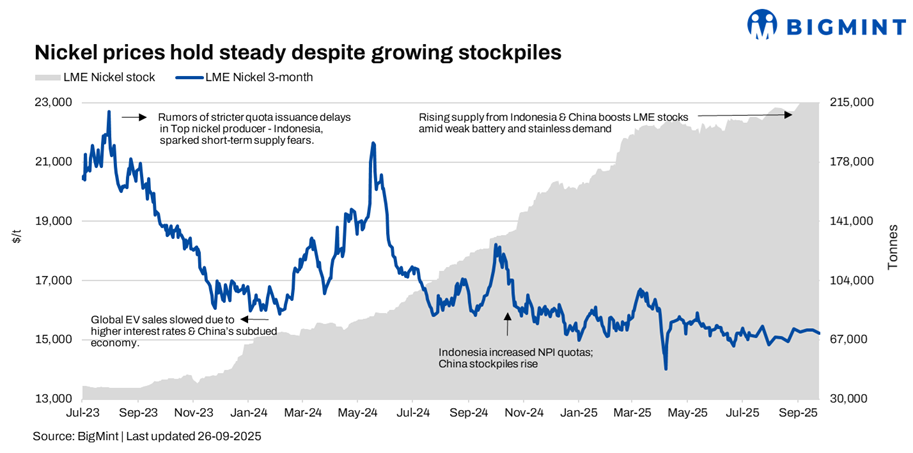
Nickel futures on the London Metal Exchange (LME) fluctuated moderately within a narrow range. The 3-month nickel futures started at $15,250/t on 22 September and closed at $15,225/t on the last day of trading on 26 September.
LME nickel inventory steadily increased throughout the week, to 230,124 t by 26 September from 228,900 t on 22 September, indicating continued supply pressure despite relatively stable prices. The market remained cautious amid these inventory buildups.
Nickel market faces oversupply despite Indonesia’s mining quota cuts
Despite Indonesia’s 35% reduction in nickel mining quotas, global oversupply continued to weigh on prices. Notably, Indonesia leads global nickel production, with expanding refining capacity in China further intensifying supply.
Robust electric vehicle demand was tempered by shifting battery chemistries and high inventory levels, keeping prices muted. Production in Indonesia reached 1.3 million tonnes (mnt) in H1CY’25, accounting for 69% of global output.
Participants believe that the market’s recovery depends on effective regulatory control, including reverting to annual quotas to manage output and stabilise prices.
EU sanctions loophole enables Russian nickel imports
A sanctions gap has been allowing Russian-mined nickel from Norilsk Nickel to flow into Western markets through Finland, circumventing US and UK bans. Since April 2024, the EU has legally imported nearly $1.3 billion worth of Russian nickel, part of which is transported to the US. While crucial for stainless steel and EV battery production, this dependency raises ethical and human rights concerns. Greater sanctions and tighter import controls are being urged to close this loophole.
Nickel prices forecast to rise in Q4CY’25
Nickel prices are expected to increase in Q4CY’25 as seasonal supply declines, particularly a predicted 50% drop in Philippine output. Indonesia’s recent regulatory efforts, including mining licence revocations and shortened permits, may also constrain supply. Combined with steady EV demand and tightening ore prices, these factors create conditions for a potential nickel price breakout after a prolonged period of stagnation.
Leave a Reply