- Global copper deficit expected to tighten 2025 supply
- Rupee steadies near record low on RBI support
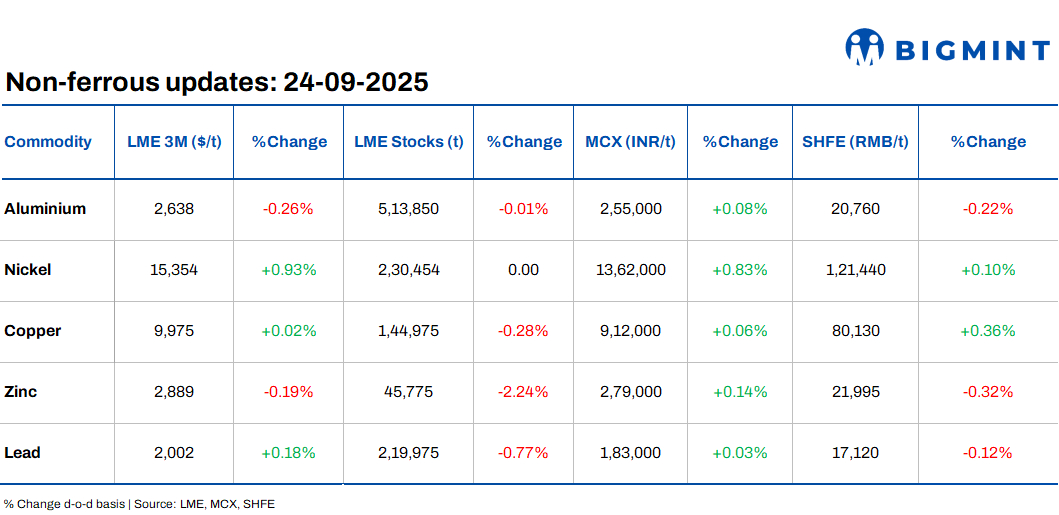
Base metals prices on the London Metal Exchange (LME) saw mixed trends d-o-d, with nickel increasing by 0.93% to $15,354/tonne (t). Meanwhile, inventories at LME-registered warehouses registered negative movements d-o-d, with zinc recording the highest decline of 2.24%.
Domestic market overview
In India’s non-ferrous metals markets, BigMint assessed domestic copper armature scrap at INR 827,000/t ex-Delhi, down by INR 5,000/t d-o-d. Aluminium Tense scrap prices were assessed at INR 194,000/t ex-Delhi, down by INR 1,000 d-o-d, and at INR 196,500/t ex-Chennai, lower by INR 500/t d-o-d.

Other updates
Rupee holds near record low on RBI support
The Indian rupee hovered close to its all-time low, ending nearly flat at 88.74 against the US dollar, supported by likely Reserve Bank of India intervention in the non-deliverable forwards and spot market. Despite pressure from persistent dollar demand by importers, steep US tariffs, and visa policy changes weighing on sentiment, central bank action helped the currency find stability. Equity markets also weakened, with benchmark indices down around 0.4% and IT stocks underperforming on concerns over higher US visa fees.
Global copper market faces deficit, driving price outlook higher
Copper, often called the “metal with a PhD in economics,” is expected to face a supply shortfall of over 500,000 tonnes in 2025, creating upward pressure on prices. Analysts project copper to trade in the range of $9,000-$10,500 per tonne as strong demand from infrastructure development, renewable energy, electrification, and agricultural modernization collides with persistent supply constraints. According to industry forecasts, demand will outpace supply by nearly 400,000 tonnes by year-end, pushing prices well above 2024 levels. This tightening balance underscores copper’s critical role in power grids, smart farming, EVs, and global development, with regions like China, India, Africa, and Latin America driving consumption growth.
Leave a Reply