- Weak steel demand, rising freights impact Turkish trades
- High stocks, heavy rains, Eid disrupt activity in Pakistan
South Asia’s imported scrap market remained subdued despite moderate demand, weighed down by weak steel trades, monsoon rains, festive holidays, currency volatility, and cautious buyer sentiment, while Turkiye, Japan, the US, and the UAE showed limited activity and softening prices.
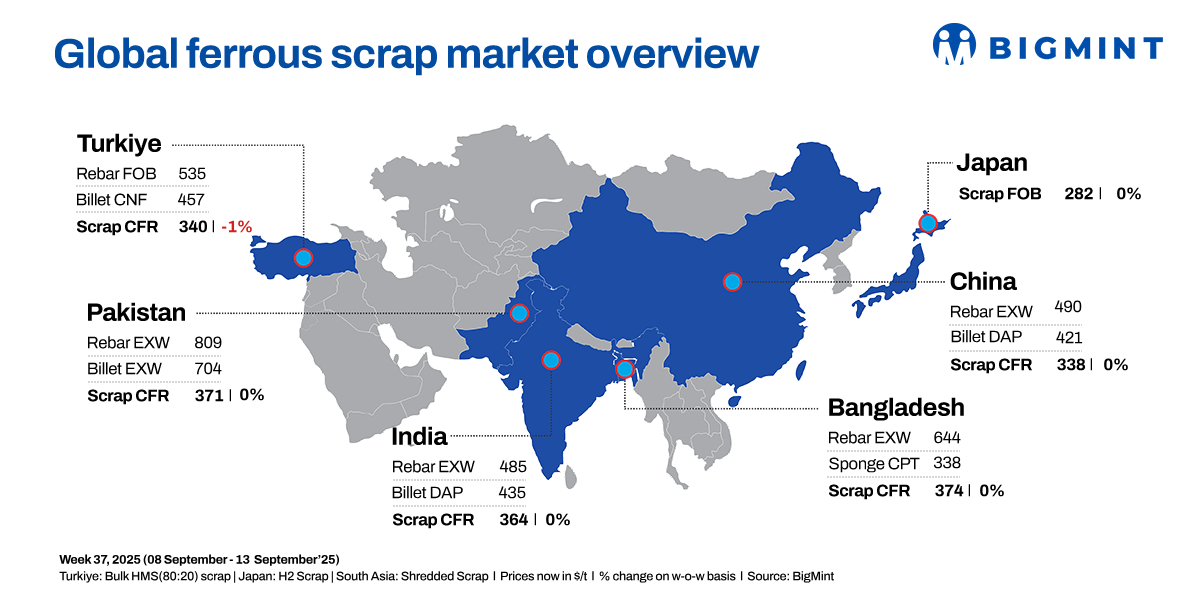
Turkiye: Turkiye’s deep-sea scrap market remained subdued through the week, with US/Baltic HMS 80:20 at $338-342/t CFR and EU-origin at $328-333/t CFR. Weak steel demand, slow exports, and rising freights kept trading thin, leaving mills cautious.
Market sentiment was mixed, with US suppliers largely absent and European supply weighing on prices. Currency fluctuations, high freights, and the central bank’s rate decision kept Turkish buyers cautious, limiting recovery despite steady tradable levels.
India: India’s imported scrap market stayed subdued, with UK/EU-origin shredded prices steady at $363/t CFR, nearly unchanged from $364/t last week. Weak steel demand, monsoon disruptions, and rupee volatility limited buying appetite, though Chennai’s domestic sentiment showed slight improvement.
Containerised shredded bids stood at $350-355/t CFR Nhava Sheva against firm offers of $365-366/t. Small trades in African HMS at $340/t and Australian shredded at $364-366/t failed to lift sentiment.
During the week, 3,700-4,500 t of imported scrap was booked, including 1,000-1,500 t HMS 80:20 at $340-350/t and 1,500-2,000 t of NTP bales and HMS-LMS bundles.
Pakistan: Pakistan’s imported scrap market stayed quiet through the week, weighed down by weak steel demand, high stock levels, and heavy rains that disrupted activity. Eid holidays added to the slowdown, with mills keeping bids lower to avoid restocking. At Qasim, UK/EU-origin shredded was offered at $372-375/t CFR against bids of $366-368/t, limiting trade.
Around 5,000 t of imported shredded was booked at $368-372/t, keeping overall prices stable at near $371/t CFR.
Bangladesh: The imported scrap market remained sluggish, as mills relied more on domestic scrap, pellets, and sponge after completing September bookings. Shredded offers held steady at $372-375/t CFR, with limited trades in Australian and Hong Kong cargoes, while dollar volatility and incoming Japanese supply kept buyers cautious.
Domestic scrap and billet prices in Dhaka and Chattogram rose by BDT 1,000/t ($/t), but rebar stayed stable on weak construction demand.
Around 30,500 t of imported scrap were booked this week, including 20,000-t bulk H2 and HS mix from Japan at $350-352/t and 5,000-6,000-t shredded, plus smaller bundle and HMS 80:20 volumes.
Japan: H2 scrap export market stayed range-bound, with BigMint assessing prices at JPY 41,600/t ($282/t) FOB Tokyo Bay, down just JPY 100/t ($1/t) w-o-w. The September Kanto tender awarded a 15,000-t H2 cargo to Bangladesh at JPY 41,970/t ($285/t), up JPY 82/t ($1/t) m-o-m, with limited near-term impact on export prices. Tokyo steel increased its two plant’s scrap purchase price by JPY 500/t ($3/t) on DAP basis.
US: Export prices eased, with HMS 80:20 at $309/t and shredded at $329/t FOB, pressured by weak Turkiye and Bangladesh demand, rising freights, and subdued domestic US markets. October is expected to be flat, with potential improvement in November-December.
UAE: Domestic HMS fell to AED 1,203/t ($328/t), pressured by weak export demand and cautious buying. Offers for PNS, shredded, and LMS remained high, while limited regional protection and rising imports kept margins tight.
Leave a Reply