- Oil prices decline d-o-d on oversupply, weak US demand
- IMF warns of US economic stress, rising inflation risks
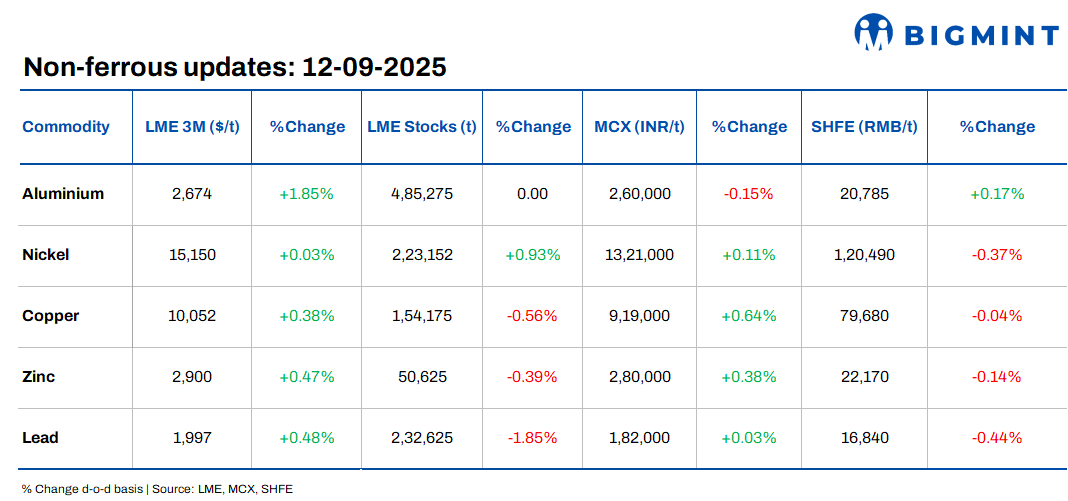
Base metals prices on the London Metal Exchange (LME) saw positive trends d-o-d, with aluminium increasing by 1.85% to $2,674/tonne (t). Meanwhile, inventories at LME-registered warehouses saw negative trends d-o-d, with lead recording the steepest fall of 1.85%.
Indian aluminium has taken the lead on the London Metal Exchange (LME), accounting for over 50% of total inventories in August 2025. Total stocks rose to 468,750 t, up 4.33% from July, with India-origin supplies nearly doubling since December to 235,950 t, surpassing Russia’s 228,025 t. Together, India and Russia made up nearly 99% of LME aluminium inventories. Notably, Type-2 Russian warrants increased 9.64% to 69,975 t, while delivery queues at Henry Bath Singapore eased to three days from seven.
Domestic market overview
In India’s non-ferrous metals markets, BigMint assessed domestic copper armature scrap prices at INR 810,000/t ex-Delhi, up by INR 4,000/t d-o-d. Aluminium Tense scrap prices remained stable d-o-d, with ex-Delhi at INR 195,000/t and ex-Chennai at INR 198,000/t.

Other market updates
Oil prices fall on oversupply, weak US demand outlook
Oil prices dropped on Friday as oversupply concerns and weakening US demand outweighed geopolitical risks. Brent crude slipped 0.74% to $65.88 a barrel, while WTI fell 0.82% to $61.86. The IEA projected higher global supply with OPEC+ output increases, while US inflation and rising joblessness claims dampened demand expectations. Despite earlier gains from conflict-driven risks, oil has lost momentum, highlighting a market caught between supply surplus pressures and limited geopolitical support.
IMF flags US economic strains, tariff-driven inflation risks
The IMF said the US economy is beginning to show strains, with slowing job growth and moderating domestic demand after years of resilience. Spokesperson Julie Kozack noted inflation is moving towards the Fed’s 2% target but warned that tariffs imposed by the Trump administration pose upside risks. Recent downward revisions to US employment data highlighted weakening labour conditions, with 911,000 fewer jobs estimated through March. The IMF suggested the Fed has room to cut rates but should proceed cautiously, with the issue set for review in November.
Leave a Reply