- Green steel will have 45% share of total demand by 2050
- INR 70,000 crore investment under PLI to boost specialty steel production
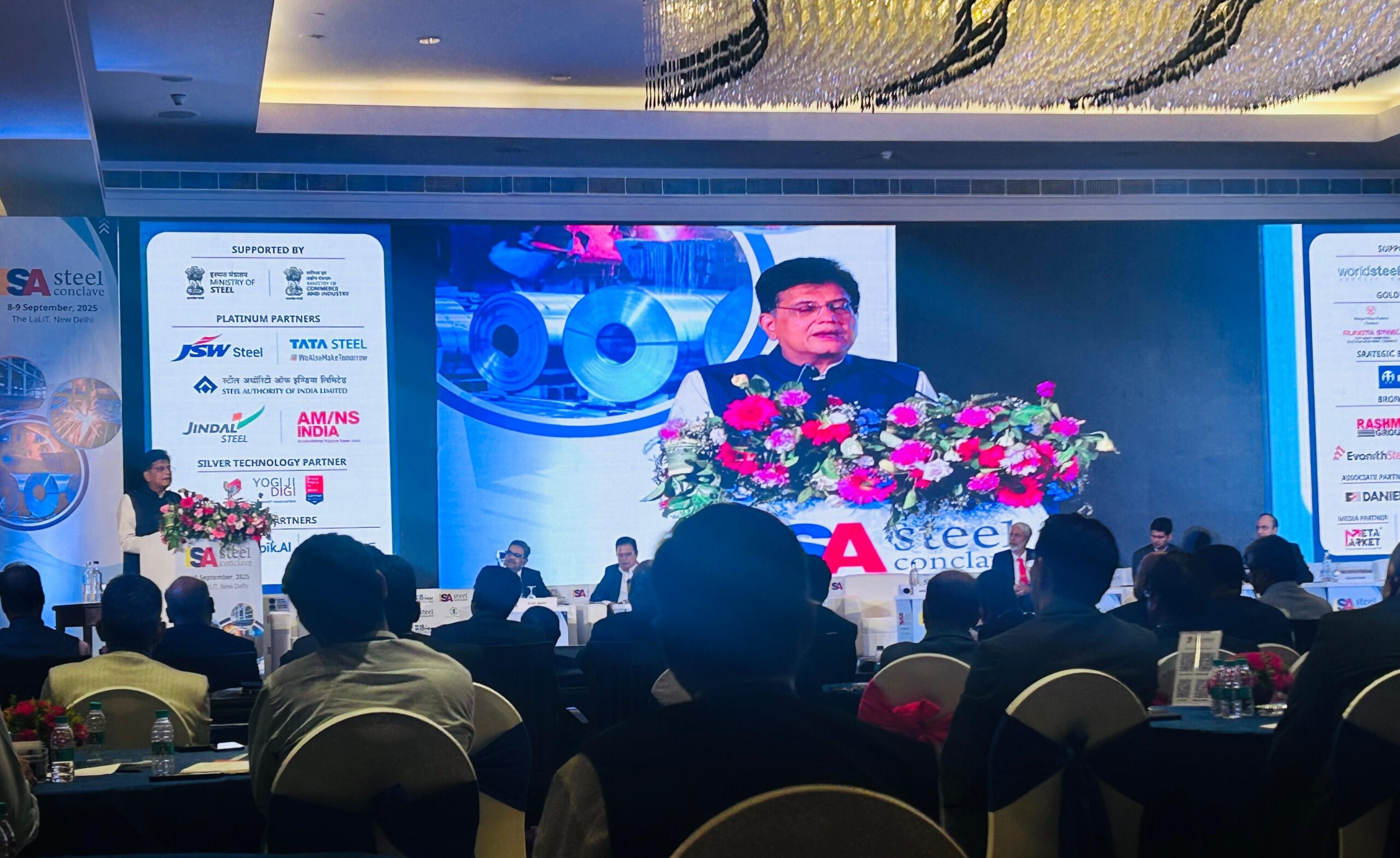
The ISA Steel Conclave on 9 September 2025 witnessed a gathering of industry leaders, government officials, and experts to dissect the critical challenges and transformative opportunities shaping India’s steel sector. The discussions on Day 2 provided a clear roadmap for the industry’s future, focusing on demand evolution, decarbonisation, market reforms, and strategic policy direction.
Key takeaways
Evolving demand and shift to Green Steel
The conclave highlighted a significant evolution in India’s steel demand, with increasing growth in specialty steels for sectors such as automotive, aerospace, and defence. Government initiatives, particularly the Production Linked Incentive (PLI) scheme, have been a powerful catalyst, driving over INR 70,000 crore in committed capital toward specialty steel manufacturing. This focus on high-value products is seen as a key strategy to reduce import dependency and capture premium markets.
A central theme was the accelerating momentum toward green steel. While currently a small part of the market, green steel could account for approximately 45% of total demand by 2050. This transition is expected to be fuelled by supportive government policies and the declining cost of green technologies, such as green hydrogen.
Although a premium of $100-200/ t for green steel can be expected today, industry experts are optimistic that this will shrink as production scales and technology matures. The discussions framed steel not as a “hard to abate” sector, but rather a “priority to abate” one, highlighting its potential for strategic innovation through the integration of hydrogen, biomass, and Carbon Capture and Storage (CCS) technologies.
Market dynamics and strategic growth
Panellists tackled the complexities of raw material price volatility, advocating for more robust price discovery mechanisms. The industry is moving away from informal, broker-based pricing towards more transparent, data-driven systems, including futures contracts, to help stakeholders manage risk. The goal is to standardise products and contracts to create a fairer and more efficient market.
With 65-70% of transactions currently spot-based, the industry is also exploring longer-term contracts to hedge against fluctuations in raw material costs, currency, and regulatory conditions.
India’s ambitious capacity expansion goals were a recurring point of discussion, with plans to scale production to 300 to 500 million tonnes by 2030 and beyond. This expansion is heavily focused on specialty and green steel, with active participation from both private and public sectors. Success, however, depends on developing a holistic industrial ecosystem that includes reliable upstream raw material supply chains and robust downstream demand centres.
The role of a circular economy was also a key takeaway. The conclave emphasized the critical need for better scrap management and recycling. Increasing scrap utilisation to 30% by 2030 and 50% by 2050 will not only reduce the reliance on virgin raw materials and lower emissions but also improve production cost competitiveness.
Logistics & related challenges
Logistics costs in India are 14-15% of the GDP against the global benchmark of 8%. The key challenges confronting steel logistics in the country are a) unpredictability related to lead times, b) dead freight and cost factor, c) empty truck backhauls which further push up costs, as well as last mile connectivity and availability of rakes for the eastern part of the country.
The government’s NLP as well as Bharatmala and Sagarmala schemes point to the way forward in mitigating logistics costs and preparing for exponential growth in industrial production and the need for a major overhaul of multi-modal logistics. Only about 1-2% of the available inland waterways networks are being utilised against the global average of 30-35%.
For 220 mnt of finished steel production in 2030, over 600 mnt of raw material has to be moved. Dedicated freight corridors (currently two are functional) will also play a key role. Likewise, slurry pipelines are expected to play an increasingly important role in raw material transportation for steel.
Policy support and outlook – Minister’s take
A highlight of the day was the address by Union Commerce & Industry Minister Piyush Goyal who laid out a bold vision for the Indian steel industry. He challenged the sector to raise its per capita steel consumption from the current ~104 kg to a level comparable with developed economies—up to 700 kg by 2047. This ambitious target positions steel as a foundational element of India’s economic development.
The Minister also advocated the adoption of prefabricated steel structures to accelerate infrastructure projects, improve quality, and reduce construction-related pollution. He underscored the immense potential of shipbuilding as a new growth avenue for the industry, emphasising the need for collaborative efforts between the government and the private sector.
Goyal’s candid remarks stressed upon the importance of self-reliance and strengthening domestic supply chains to avoid the dangers of import dependence. He urged the industry to focus on innovation and quality to gain a foothold in premium global markets. This vision aligns with the government’s efforts to protect domestic producers through safeguard duties while navigating global challenges like the carbon border adjustment mechanism (CBAMs).
Leave a Reply