- Guinea’s mining licence revocations raise supply concerns
- South32’s Mozal smelter shutdown tightens African output
London Metal Exchange (LME) aluminium prices remained range-bound during Week 36 of CY’25 (1-5 September 2025).
Aluminium prices slipped marginally, as concerns over US tariffs weighed on factory activity across Asia, but downside pressure was limited by upbeat Chinese economic data and optimism over potential US interest rate cuts.
Pricing, inventory trends
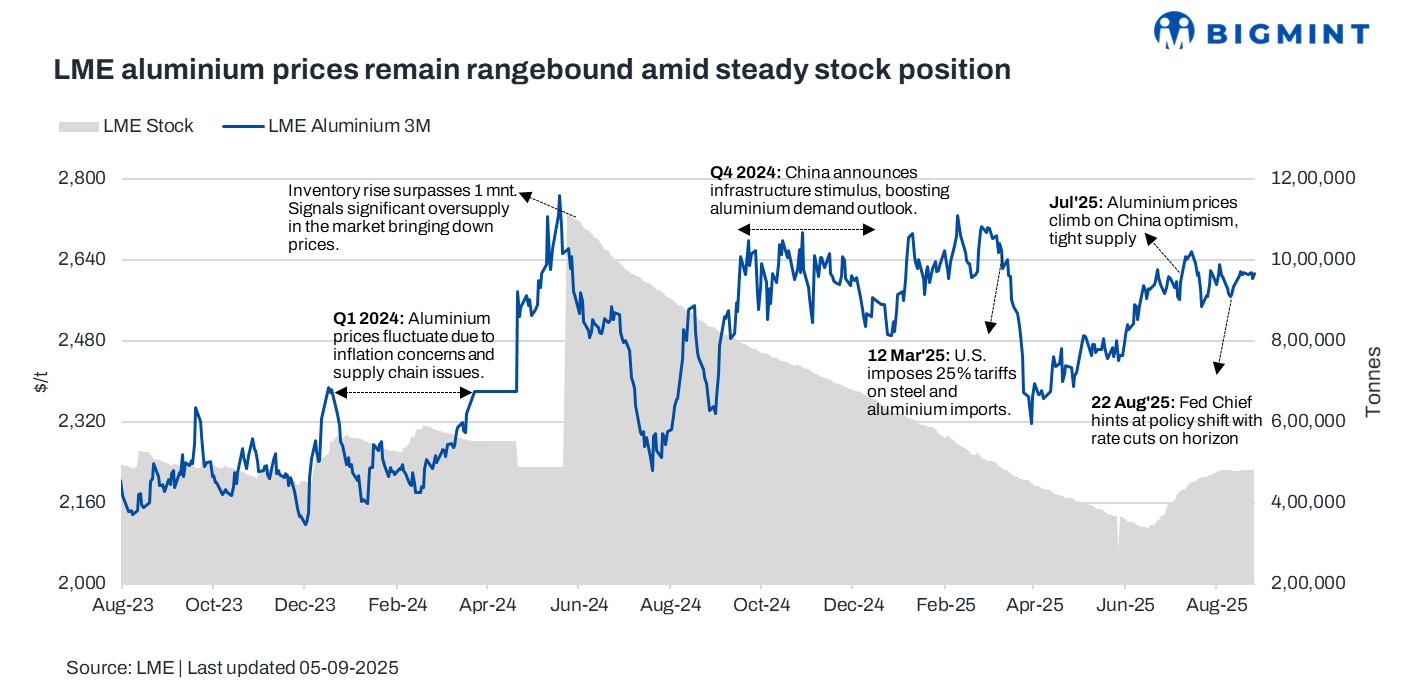
LME aluminium prices averaged $2,610/t in Week 36, easing marginally by 0.1% from Week 35 (25-29 August). Prices opened the week at $2,610/t, dipped mid-week to $2,601-2,602/t, and closed steady at $2,613/t.
Meanwhile, aluminium stocks at LME warehouses edged up 0.1% w-o-w, to 480,905 t in Week 36 from 480,381 t in Week 35.
Aluminium market steadies amid demand optimism but faces supply risks
Aluminium prices slipped marginally as concerns over US tariffs dampened factory activity across Asia, though downside pressure was cushioned by upbeat Chinese economic data and expectations of potential US interest rate cuts. A private survey showed China’s factory activity in August expanded at the fastest pace in five months, boosting demand prospects for industrial metals.
On the supply side, global output in H1CY’25 stood at 36.85 million tonnes (mnt), slightly trailing consumption of 36.88 mnt and creating a marginal deficit. July production rose 2.5% y-o-y to 6.37 mnt, according to the International Aluminium Institute (IAI). However, risks are emerging, with Guinea revoking key bauxite mining licences and transferring them to a state-owned entity, raising concerns for Emirates Global Aluminium. Additionally, South32’s closure of the Mozal smelter in Mozambique, Africa’s second-largest aluminium plant, has further tightened the supply outlook.
Outlook
LME aluminium prices are likely to remain range-bound in the near term, with supply-side disruptions and a marginal global deficit offering support. The revocation of key mining licences in Guinea and the shutdown of South32’s Mozal smelter in Mozambique have added to supply risks, while lower inventories also lend firmness.
On the demand side, steady Chinese consumption — backed by improving factory activity and stronger new orders — could underpin stability. However, the widening of US tariffs, ongoing macroeconomic uncertainties, and signals from the US Federal Reserve on interest rates remain key factors that may cap significant price gains.
Leave a Reply