- DRI emerges as key alternative amid limited scrap availability
- EFs projected to lift DRI share in metallic mix to 41% by FY’30
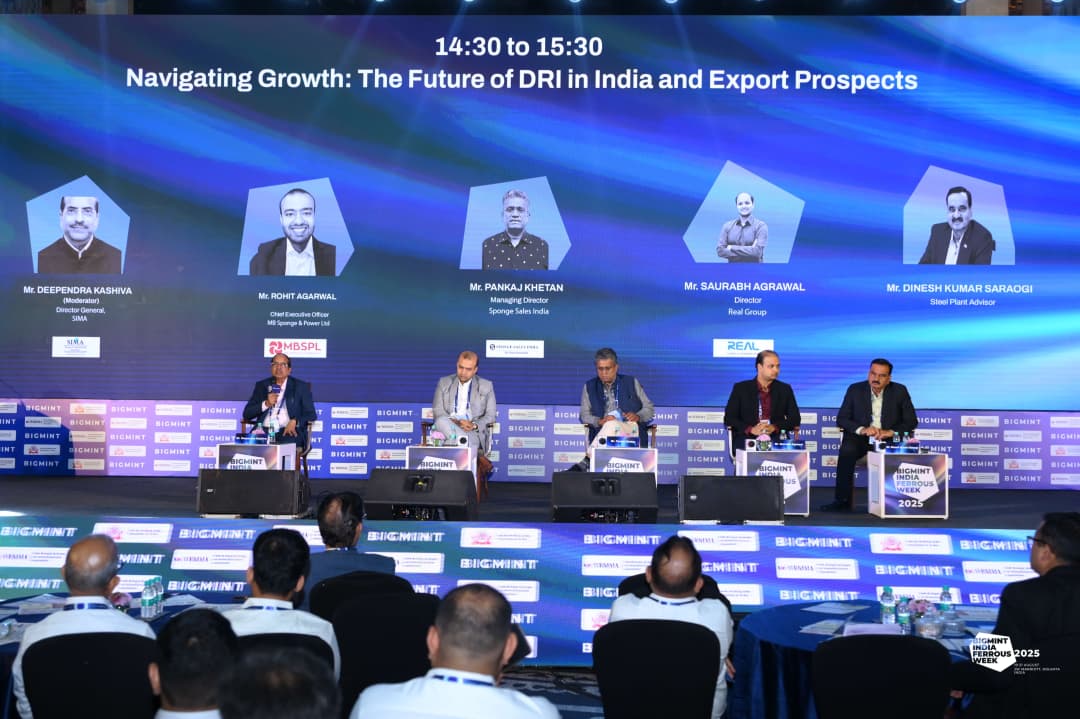
India’s direct reduced iron (DRI) industry is charting a transformative path as the country’s steel sector aspires to become a global green manufacturing powerhouse. At the BigMint India Ferrous Week 2025, industry leaders came together to discuss drivers for growth, challenges, regional dynamics, export potential and industry voices from the frontline of DRI production and marketing in India.
1. Key drivers behind India’s projected DRI production growth (FY’25-30)
- Steel demand growth: India’s crude steel output is expected to grow rapidly, pushing DRI production from 55 million tonnes (mnt) in FY’25 to 67 mnt by FY’30. This trajectory is closely linked to expanding domestic consumption in infrastructure, automotive, and defense sectors, as well as rising per-capita steel usage.
- De-carbonisation, policy incentives: With the onset of the carbon credit trading scheme (from April 2026) and strong regulatory push, producers are catalysing investments in low-carbon DRI. Carbon reduction goals (targeting a 30% reduction) are directly influencing plant technology choices, operational strategies, and raw material sourcing.
- Resource availability: Panelists asserted India’s scrap availability is inadequate to meet the steel ministry’s 2030 and 2047 production targets. DRI, particularly from iron ore and coal/pellets, remains essential — the “backbone” of the sector — as alternatives such as scrap cannot bridge the supply gap.
- Government support: Ongoing environmental clearances, the promotion of new capacity, and incentives tied to CO2 reduction reinforce the centrality of DRI in the national growth blueprint.
2. Factors fueling increased adoption of DRI in India
- Evolution of production routes: Electric furnaces (EFs), especially in the east, are increasing DRI usage in their metallic mix from 37% in FY’25 to an expected 41% by FY’30; induction furnaces and blast oxygen furnaces are also seeing incremental DRI integration.
- Rise of pellet-based DRI: The shift towards pellet-based DRI (PDRI) is crucial due to its higher quality, uniformity, and energy efficiency, which are critical for premium steel grades. The growth in domestic pellet supply and energy savings from charging PDRI has further strengthened its adoption.
- Technology advancements: Waste heat recovery (WHR), gas-based DRI plants, and plants designed for future hydrogen use are redefining the sector, especially in the west and south.
- Resource, supply chain responses: As raw material price volatility (e.g., iron ore exports versus domestic requirements) presents risks, producers are diversifying sources, including select DRI imports and exploring deeper integration along the iron and coal value chains.
- Policy, market adaptation: Producers are adjusting to regulatory and market signals, such as CO2 benchmarking (2.15-2.45t CO2/t CDRI) and the expectation of further reductions for value chain competitiveness; government incentive schemes (e.g., INR 1,000/t for CO2 reduction) also help justify projects for gas conversion and WHR.
- Plant segmentation: The sector comprises many small units (<50,000 t), mid-sized plants (50,000-150,000 t), and large players (>150,000 t). Large plants are positioned to convert to gas if supplied collectively and if capex is competitive; small plants face more acute adaptation and funding challenges.
3. The export potential of Indian DRI
- Exports rise at 80% CAGR: Exports have grown from 0.9 mnt in FY’20 to over 2 mnt in FY’25 (80% CAGR). Key destinations — Nepal, Bangladesh, Bhutan — are being joined by newer markets, as Indian producers become strategic, not just surplus exporters.
- Two-way trade emerges: While India is the world’s top DRI producer, leading integrated steelmakers have also begun to import select cleaner forms of DRI, signaling growing integration into global supply chains
- Exports becoming more strategic: As panelists highlighted, exports no longer reflect surplus; instead, they are a calculated lever to boost competitiveness, regional supply chains, and support for decarbonisation.
- Quality requirements to shape shipment volumes: Export performance will hinge on product quality and ability to meet global decarbonisation standards. The industry recognizes the need for process innovation, resource efficiency, and continuous reduction in carbon footprint to remain globally relevant.
4. Regional production, consumption trends
- East India – scale hub: About 65% of India’s DRI capacity is in the east (Odisha, Chhattisgarh, Jharkhand) due to proximity to iron ore deposits and established coal logistics. This region focuses on scale and capacity expansion, leveraging brownfield and greenfield project momentum.
- West and south – centres of innovation: Gas-based DRIs (Hazira, Odisha, Dolvi, and Vijayanagar) lead the migration towards hydrogen-ready technologies and international collaborations. These plants unlock efficiency and prepare for the eventual transition to cleaner energy inputs
- North India – resource constraints, adaptations: Northern India lacks domestic raw materials and faces unique obstacles. Scrap logistics, frequent GST compliance challenges, and environmental standards are prompting many induction furnace users to increase their DRI (especially PDRI) adoption in charge mixes — from 10% just a few years ago to 30% today. To further reduce operational risks, firms are incorporating solar power to offset part of their carbon load, though battery storage remains a constraint for night operations.
- Cluster-based transition: Panelists discussed cluster-based supply of reducing gas (including emerging coal gasification technologies) as a critical enabler for plants unable to invest in their own captive gas or hydrogen sources. This approach is central to making gas-based DRI viable for mid-sized and even small units.
5. Key takeaways from session
- Growth imperative: DRI production is projected to rise 22%+ by FY’30, with robust demand, policy incentives, and limited scrap alternatives keeping the process vital for India’s steel industry.
- Quality, efficiency: Pellet-based DRI, gas-based units, and technological upgrades (beneficiation, WHR, hydrogen-readiness) are essential for meeting new steel demand and carbon standards.
- Export focus: Indian producers are increasingly using exports as a strategic lever, even as select imports support domestic innovation and advanced steelmaking.
- Regional strategies: Regional production and consumption dynamics require tailored strategies — scale in the east, innovation in west/south, and adaptation in the north, with policy and industry collaboration central to success.
- Policy action needed: Structural interventions — especially to support mid-tier plant upgrades, promote beneficiation, incentivise low-carbon tech, and facilitate cluster-level gas supply — are crucial for achieving both growth and decarbonisation.
Conclusion
DRI has to be at the center stage of national steel growth. No other route can bridge the gap with limited scrap available, and government support for new DRI units validates its priority.
Leave a Reply