- Japan’s EAF share to rise from 25% to 45% by 2030
- India’s demand to climb 50% to over 60 mnt by 2030
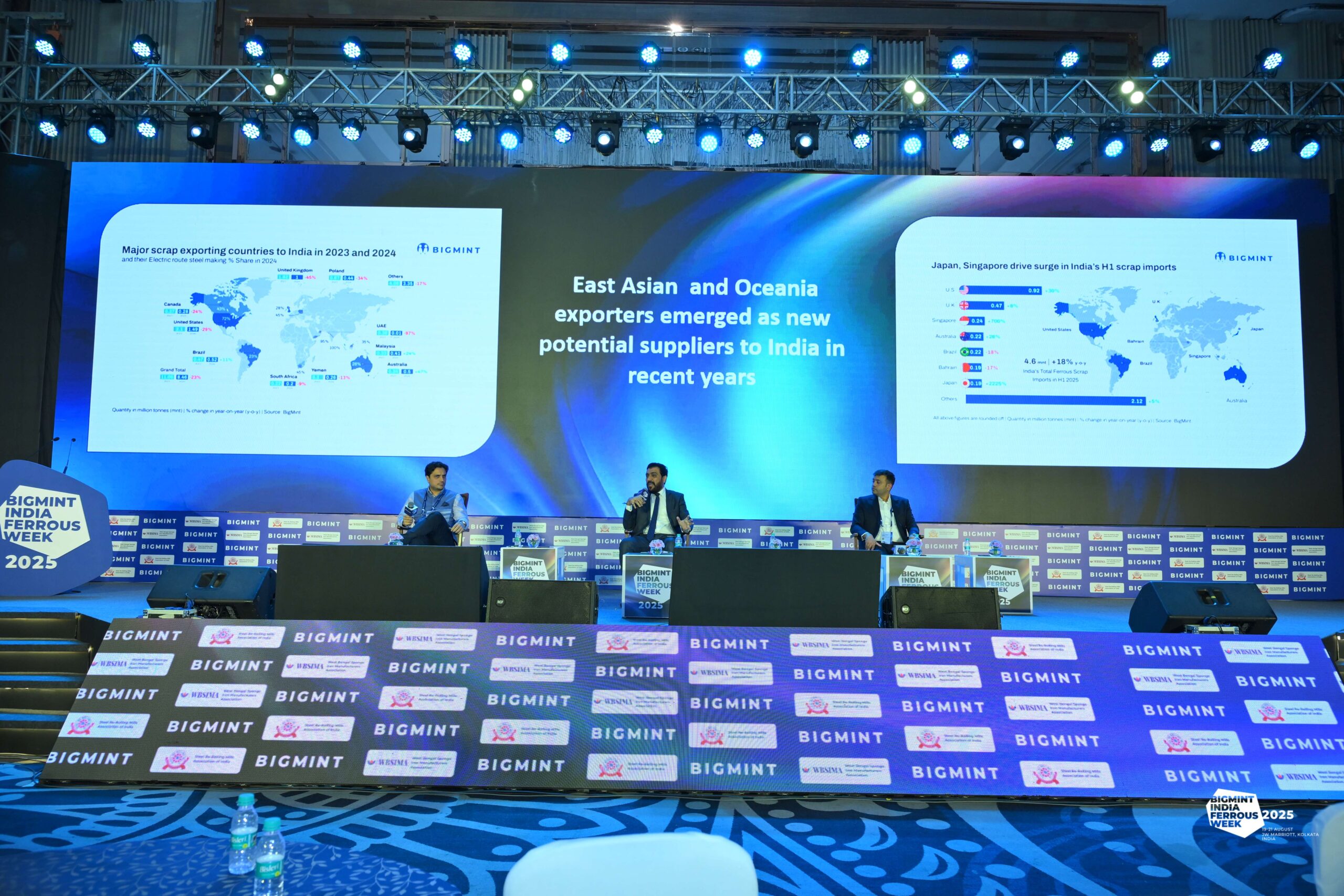
At the BigMint India Ferrous Week 2025, industry leaders came together to deliberate on the evolving dynamics of the global scrap market amid geopolitical shifts.
In the session on “Imported scrap under strain: How global trade and policy shifts are reshaping the new reality of scrap sourcing”, Zain Nathani, Managing Director of Nathani Industrial Services Pvt. Ltd., set the context by referring to BigMint’s projections on India’s scrap demand-supply scenario by 2030, highlighting a likely shortfall of nearly 15 million tonnes. He noted that while India has come across Japan as a short-term supplier, the country must actively diversify its sourcing beyond the US and Europe to mitigate risks of global market volatility.
Ashish Thakkar, Vice President, JFE Shoji India Pvt. Ltd., further cautioned during his presentation that Japan’s rising EAF capacity will significantly limit its scrap outflow in the coming years. He noted that while Japan has recently emerged as a major exporter, this window may narrow considerably by 2030, reducing India and other East Asian scrap consumers’ access to Japanese scrap supplies.
Key takeaways
India’s ferrous scrap demand to rise 48% by 2030, imports to continue
India’s ferrous scrap demand is set to climb nearly 48% over the next five years, rising from 41.9 million tonnes (mnt) in fiscal year 2025 to 61.8 mnt by 2030, driven by growth in electric steelmaking and higher demand for long steel products, industry participants said at the BigMint India Ferrous Week 2025.

“Steelmakers are also turning to hot briquetted iron (HBI) and domestic direct reduced iron (DRI), balancing these inputs with scrap usage to meet green steel targets,” Govind Goyal, Kalika Steel (a panellist), said.
Japan-India scrap trade: Key trends shaping 2025-30
The steel and scrap industries are entering a period of transformation as sustainability goals and new production technologies reshape global material flows. One of the most notable shifts is the evolving trade of steel scrap from Japan to India — a partnership set to gain momentum over the next five years.
Accelerating change in Japanese steelmaking
During his presentation, Thakkar emphasised Japan’s steel sector, long anchored by blast furnace — basic oxygen furnace (BF–BOF) routes, is rapidly pivoting toward electric arc furnaces (EAFs).
In FY’24-25, the country produced 83 mnt of crude steel, with about 25% from EAFs. This share is expected to rise to 45% by 2029-2030, driven by major investments in new EAF capacity and the gradual retirement of older blast furnaces.
The shift is fuelled by both economic and climate imperatives. Japan has pledged carbon neutrality by 2050 and a 46% reduction in emissions by 2030. Achieving these targets will demand cleaner energy, such as green hydrogen, advanced recycling technologies, and greater reliance on scrap feedstock.
With more scrap consumed domestically, Japan’s export capacity may tighten in the years ahead.
Shifting export dynamics, India’s rising demand
Traditionally, Japan’s scrap exports have been concentrated in East Asia — supplying Korea, Vietnam, and Taiwan — while India played a smaller role. That dynamic is now changing. In 2024, Japan exported around 200,000 tonnes (t) of scrap to India; by 2025, volumes are projected to more than double to over 400,000 t. This surge reflects India’s expanding steel production and Japan’s strategy to diversify export markets.

India’s infrastructure push, manufacturing growth, and increasing EAF capacity are driving strong scrap demand. Backed by advanced logistics and financial solutions, Japanese suppliers are positioning themselves as dependable partners for Indian mills seeking secure and high-quality supplies.
Looking ahead: sustainability and strategic partnerships
Japan’s EAF transition underscores how climate policy is reshaping global raw material flows. As its domestic scrap consumption rises, export volumes could eventually level off — making early partnerships and efficient supply chains even more critical for buyers like India.
Financial innovations and logistics support will further strengthen this corridor. Ultimately, the Japan — India scrap trade reflects the wider transformation of the steel industry — where sustainability targets, technological change, and strategic collaboration define the path forward.
Industry experts stressed the need for investment in advanced scrap collection, enhanced processing, and greater domestic recycling capacity to meet the government’s target of using 35-40% scrap in steelmaking by 2030, and as global trade flows shift, India’s steel sector faces a critical balancing act between policy, sustainability, and sourcing strategies.
Despite growing consumption, domestic scrap generation is projected to reach only 46.7 mnt by 2030, leaving a shortfall of 13-15 mnt and underscoring India’s reliance on imports.
Leave a Reply