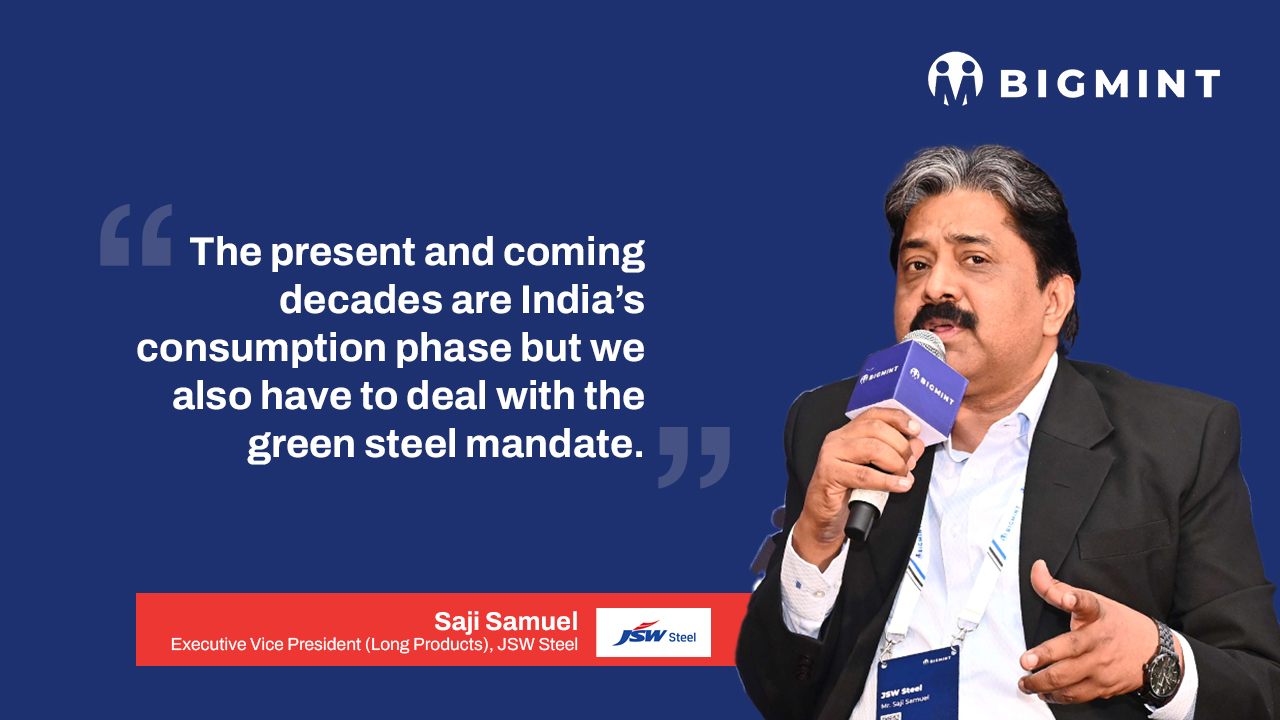
In an exclusive interview with BigMint, Saji Samuel, EVP (Long Products), JSW Steel, talks about India’s steel export prospects in a changing world, the impact of CBAM and high tariffs, the need for a mechanism to restrict steel dumping and China’s aggressive pricing strategies. Excerpts
India’s steel exports are declining every year. With stricter regulations in place, will exports to the EU trickle down even further in the years to come?
With the CBAM regulation, Europe intends to shift to green steel imports. Indian mills have started to witness substantial domestic consumption only in the last 15-20 years. The present and coming decades are India’s consumption phase but we also have to deal with the green steel mandate and requirements both domestically and for exports.
The investments in BOF technology are quite high and typically are for 40-45 years. So, the mills will have to produce steel with lower emissions within the restrictions of the present technologies. They are also investing in lower CO2-intensive production. However, green steel is majorly about the change in technologies that will take some time to happen.
The investments the steel majors have made in latest and advanced BOF technologies are with an eye on increasing consumption. Now, suddenly the world has changed to green steel and it is very confusing for the Indian economy as we have just started taking baby steps in consumption.
I believe the EU’s demand for green steel has to be fulfilled first and that, too, at a cost which is not too high. Their requirements of specific grades and quality overall will also keep Indian mills in the fray. So, despite safeguards, they will provide Indian suppliers with a window of opportunity to come up with green steel for exports to the EU.

Will the integrated mills, the major exporters of steel, run parallel low-emissions production processes for low-CO2 steel exports to the EU in the coming years?
As per the government, our export vision is 20 million tonnes (mnt). With enabling policy such as PLI, the Indian mills today are in a position to deliver world-class steel products and newer downstream products such as CRGO and many types of alloy steels. Going forward, this will propel our export ambition, although we are not dependent on exports as a country.
Our advantage in terms of costs, which is far lower than the global average, is already a major advantage in the export market. Of course, India stands out in the China + One world.
But super aggressive pricing by China is affecting India’s export prospects in key markets such as the Middle East and Vietnam?
That is true. Of course, China’s pricing strategies are questionable. Not only steel but in all kinds of products they have a very different pricing mechanism. It’s difficult to understand that delta between raw materials and finished steel prices that they can come up with. I think only when you know the value chain as a customer that you are able to see that they are pushing the products instead of depending on cost + pricing.
But the basic fact is that they have a production capacity which is almost 60% higher than any other country. And so, it means that you have to live with this pain. Tariff restrictions are rising across the world. Unless there is a tollgate or a mechanism to stop China from dumping steel, it will very difficult to restrict huge exports by that country.
The government has come up with a tariff to restrict dumping of steel which is positive. The demand for steel in India and the viability of investments in the sector are dependent on this.
Going forward, high tariffs are also going to hit the end consumers of steel. In the US, for example, sharp reduction in imports due to tariffs will see surge in steel prices that will affect consumers. Today there is too much noise around tariffs but the dust will eventually settle. Consumers of steel will need assurance of quality coupled with reasonable pricing and tariffs will create further inflation.
Therefore, after the present disruptive tariff-induced phase of uncertainty gets over, ultimately conditions will be created which will be lenient and conducive for Indian steel exporters.
Leave a Reply