- New refineries in Indonesia begin deliveries
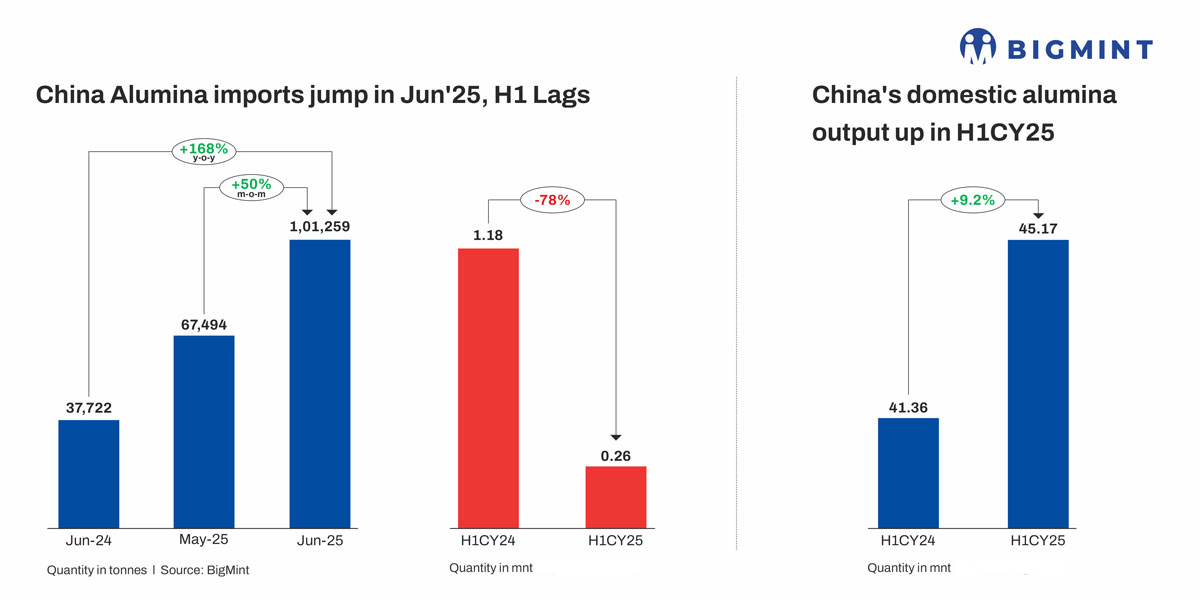
- H1 imports drop 78% on poor import margins
China’s alumina imports surged in June 2025, fuelled by a sharp rise in shipments from Indonesia as new refinery projects began to deliver into the market. Customs data showed that alumina imports from Indonesia jumped from just 267 t in May to nearly 63,000 t in June, marking the start of bulk shipments from newly operational plants such as Hangzhou Jinjiang’s PT Borneo Alumindo Prima.
As a result, China’s total alumina imports in June rose 50% m-o-m reaching 101,259 t from 67,494 t and 168% y-o-y. However, overall imports for the first half of 2025 were still down 78% settling at 0.26 mnt from 1.18 mnt in the same period last year due to previously poor import margins and limited arbitrage opportunities.
The increased Indonesian flow comes as multiple refinery projects in the country ramp up. Besides Borneo Alumindo, Shandong Nanshan’s Bintan Alumina Phase III and PT Borneo Alumina Indonesia’s Mempawah refinery have also begun production, with output expected to stabilise or rise further in Q3. These projects are together contributing up to 3 million tonnes (mnt) per year of additional alumina capacity to the global market.
Additionally, China’s alumina exports rose 9% y-o-y in June but fell 18% from May levels. Still, total H1 2025 exports surged 66% y-o-y, backed by domestic oversupply, as Chinese alumina production rose 7.8% y-o-y to 7.75 mnt in June. Cumulative H1 output reached 45.2 mnt, up 9.3% on-year.
Domestic prices declined under this supply pressure and weak seasonal aluminium demand, falling from RMB 3,250/t at end-May to RMB 3,100/t by end-June. While June’s import spike hints at potential arbitrage opportunities, actual transaction volumes remain limited. Market participants say Q3 dynamics will depend on how much Indonesian alumina becomes available on the spot market, and how Chinese producers and traders respond to shifting price signals.
Leave a Reply