- Turkish market quiet yet firm
- Pakistan lifts bids for restocking
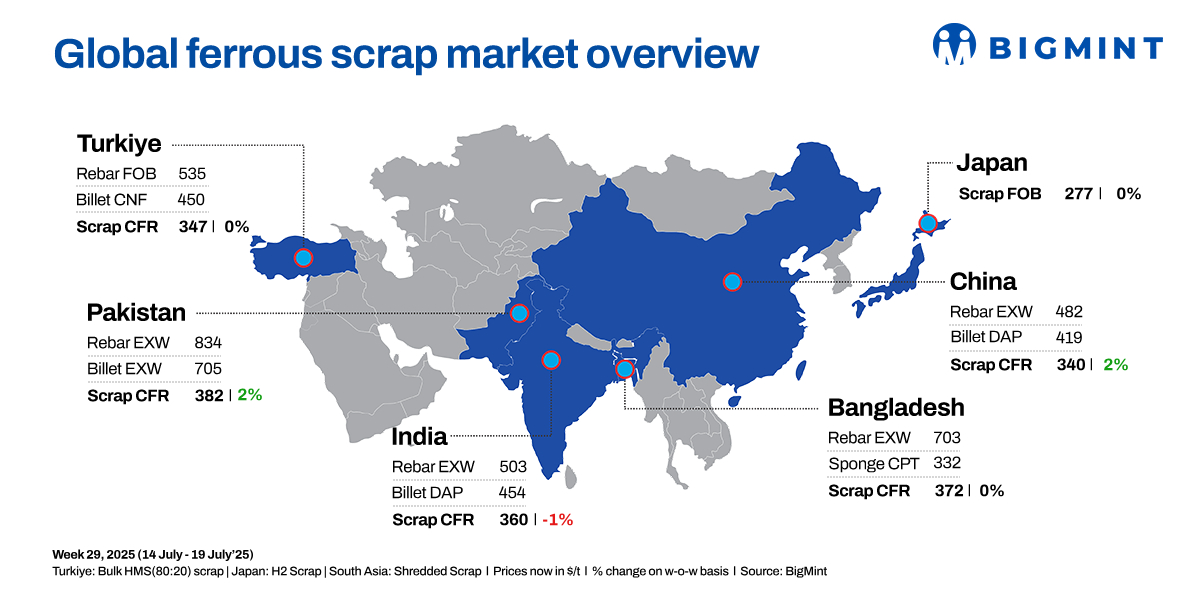
Global ferrous scrap prices stayed mostly mixed this week amid weak steel demand, monsoon disruptions, and holiday-related slowdowns. While Turkish and Bangladeshi prices remained flat, Pakistan saw slight gains, and Japan recorded a marginal uptick on yen weakness.
Turkiye: The Turkish deep-sea ferrous scrap market remained stable throughout the week, with US-origin HMS 80:20 prices holding steady at around $347/t CFR. Mills stayed largely inactive, citing weak domestic rebar demand, national holiday and unclear near-term price direction. Early in the week, tradable levels ranged from $340-348/t CFR, but mill resistance kept overall trade volumes low.
Suppliers, on the other hand, held firm at their offer levels, supported by expectations of lower scrap generation in Europe during the summer holidays.
Limited trades were reported at $347/t CFR, aligning with last week’s levels. Despite sluggish demand, sellers maintained a firm stance on prices, banking on supply constraints from European yards preparing for 20-25 day closures.
India: India’s imported scrap market stayed weak this week amid poor steel demand, monsoon disruptions, and buyer caution. HMS 80:20 offers hovered at $325-330/t CFR, Market activity was muted as mills avoided new bookings, citing poor finished steel demand and unclear tradable levels.
Mills shifted to sponge iron which saw 50-60% higher intake and domestic scrap due to cost advantages, reducing reliance on imports. Sellers held shredded offers close to $365-370/t CFR, but buyers stayed firm at lower levels. Only limited deals were heard, with UK/Europe shredded assessed at $360/t CFR Nhava Sheva, down 1% w-o-w.
Around 5,000-6,000 t of imported scrap was booked into India this week, mostly HMS 80:20 at $330-345/t CFR. The rest included MS Turning, HMS-LMS bundle mix, and HMS 1.
Pakistan: Pakistan’s imported ferrous scrap market remained sluggish throughout the week with UK/Europe shredded scrap prices averaged $382/t CFR this week, up 2% from $376/t the previous week. Frequent rain and a lack of government push in infrastructure continued to suppress activity. Mills stayed on the sidelines, cautious about overstocking due to ongoing currency instability and soft steel sales.
UK/Europe shredded scrap offers stood at $380-385/t CFR Qasim, with trades reported at $378-382/t. UAE shredded was higher at $395-400/t amid stronger restocking demand.
Bangladesh: Bangladesh’s imported ferrous scrap market remained subdued throughout the week with UK/Europe-origin shredded prices were assessed at $372/t CFR Chattogram, unchanged from the previous week, with mills showing limited interest due to muted construction activity and slow rebar demand amid monsoon-related disruptions. Buyers stayed cautious, avoiding bulk purchases and preferring small-volume bookings.
UK and EU shredded scrap offers hovered at $375-376/t CFR Chattogram, while buyers targeted $370-372/t. Some Dhaka-based mills were willing to pay up to $378/t, but trades stayed limited.
Japan: Japan’s H2 scrap export prices rose slightly by JPY 150/t ($1/t) to JPY 41,250/t ($277/t) FOB Tokyo Bay, supported by a weaker yen. However, domestic and overseas demand stayed muted due to summer production cuts and global uncertainty. Despite currency-led margin support, trade activity remained limited as Japanese suppliers held offers firm.
Malaysia: The Malaysia Steel Association (MSA) backed MACC’s Ops Metal crackdown on steel scrap export duty evasion, citing MYR 950 million in tax losses over six years. MSA warned that illegal exports are hurting local supply, raising costs, and undermining Malaysia’s green steel goals.
China: China’s Shagang Steel raised scrap purchase prices by RMB 50/t ($7/t) on 14 Jul’25, bringing HMS (6-10 mm) to RMB 2,440/t ($340/t), including 13% VAT. Prices have now returned to levels last seen at the beginning of 2025.
Vietnam: Vietnam’s scrap demand remained weak amid sluggish rebar sales and sufficient inventories. Northern mills paused fresh bookings, citing poor downstream demand. Purchases may resume by end-July, with expectations of recovery post-monsoon as construction activity improves.
South Korea: South Korea’s steel scrap inventories rose to 916,000 t in mid-July, up 6% w-o-w and 28% m-o-m-the highest since late April. The build-up was driven by lower consumption, production cuts, and pre-summer stocking by large EAF mills, which are now expected to adopt a cautious buying approach.

Leave a Reply