- Domestic construction demand recovers slowly
- Baosteel, Formosa Ha Tinh keep HRC prices stable
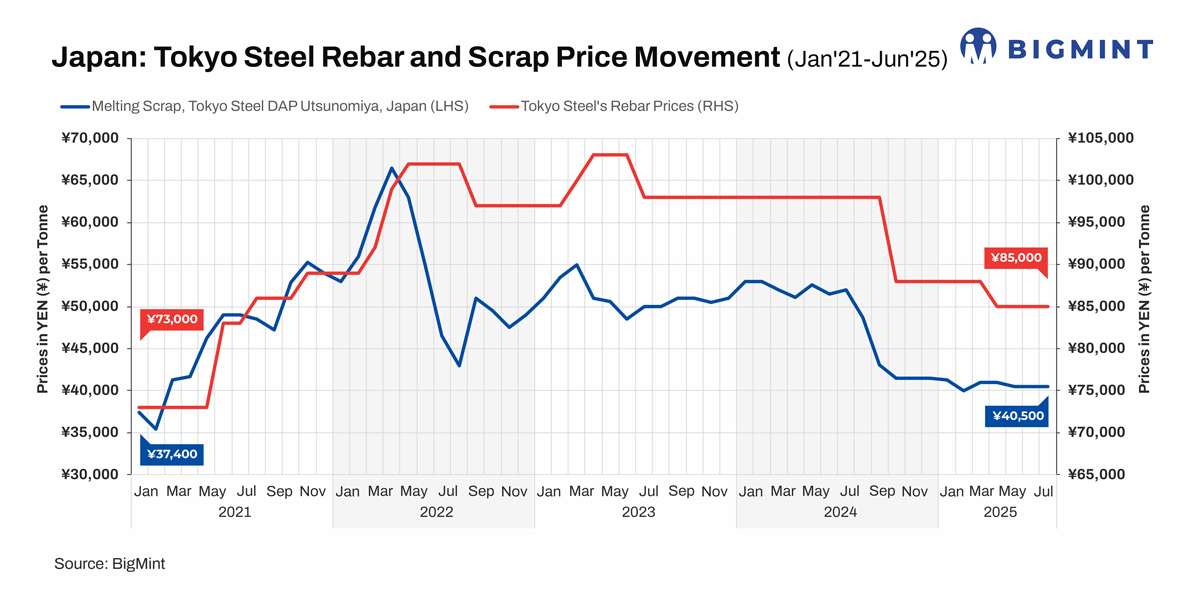
Tokyo Steel, Japan’s leading electric arc furnace (EAF) steel manufacturer, has kept prices of hot-rolled coils (HRCs) (1.7-22 mm) stable m-o-m for July 2025 sales, the fourth consecutive month of stability. Moreover, the company kept prices of rebars and H-beams unchanged.
Revised prices are as follows:
- HRCs (1.7-22 mm): JPY 89,000/tonne (t) ($617/t)
- Rebars (D13~25): JPY 85,000/t ($589/t)
- H-beams (100-300 mm): JPY 112,000/t ($776/t)
Factors influencing Tokyo Steel’s pricing
1. Domestic trade gradually gains momentum: Japan’s domestic steel market for building materials is currently experiencing a downturn, largely influenced by global economic shifts and volatility in steel-related markets. This has led to some manufacturers cancelling or postponing significant investment projects. Despite this, there has been an improvement in demand from construction companies, particularly for projects such as logistics and manufacturing facilities.
Steel procurement, which had slowed, is now beginning to rebound. With a stable supply and demand balance expected, there is optimism for an early recovery in the steel market.
2. Key global mills keep HRC prices flat m-o-m: Chinese steel giant Baosteel rolled over HRC prices for July 2025 sales, marking the fourth consecutive month of stability, according to BigMint’s sources. Vietnamese steel major Formosa Ha Tinh (FHS) has kept HRC prices flat for July 2025 sales. Following this revision, prices (SAE1006, skin-passed) hovered at $508-518/t CIF Ho Chi Minh City (HCMC).
3. H2 scrap export offers rise: Japan’s H2 scrap export market saw a modest uptick this week, driven by a weaker yen and a rise in volume for the June Kanto tender, even as global demand remained sluggish. Japan’s H2 scrap offers increased by JPY 735/t ($5/t) w-o-w to JPY 41,335/t ($288/t) FOB Tokyo Bay, as per BigMint’s assessment.
Outlook
The short-term outlook for Japan’s domestic steel demand shows mixed trends, with the construction of logistics facilities and data centres boosting demand for building materials. Restrained supply from steelmakers may improve the supply-demand imbalance, supporting price stability and potential market recovery.
Leave a Reply