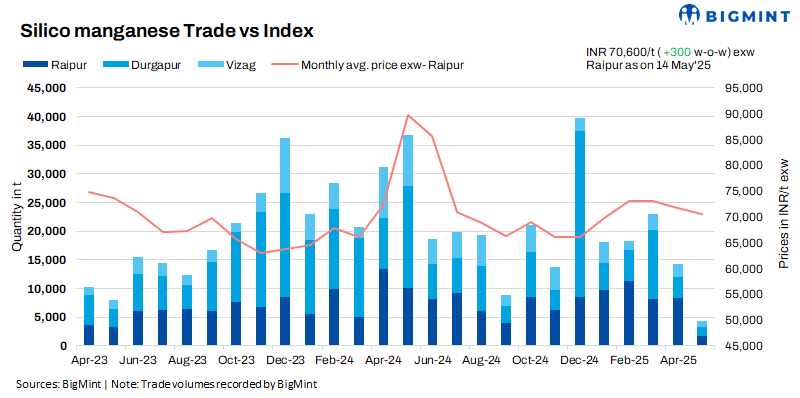
- Smelters refrain from price cuts after suffering losses
- Limited export demand might further pressure tags
Domestic silico manganese prices registered a slight uptick w-o-w despite subdued demand from steel mills. Some smelters ceased offering discounts, which helped support prices. While raw material prices declined, they did not have any impact on production costs.
According to BigMint’s latest assessment, prices of the 60-14 grade increased marginally by INR 250/tonne (t) ($3/t) w-o-w, to INR 69,900-70,500/t ($819-825/t). Many sellers adopted a strategic approach, opting not to provide further discounts in order to minimise losses and stabilise their margins.
Deal concluded (as per BigMint)

Market review
Smelters resist price cuts amid financial strain: Smelters showed little interest in offering material at discounted prices domestically, despite a subdued market. Current prices were just enough to cover production costs, which are above INR 70,000/t in key regions, resulting in losses for many producers. Consequently, smelters were hesitant to reduce prices further despite challenging market conditions.
A key smelter from Raipur informed BigMint that the current asking rates were much below the levels that would allow producers to secure profits. If the export market resumes, it could support prices. Otherwise, tags are expected to fall below INR 68,000/t exw in the near term.
Steel prices edge down w-o-w: Domestic steel prices experienced a slight drop w-o-w. BigMint’s daily steel billet index closed at INR 40,800/t ($388/t) exw-Raipur on 14 May 2025, reflecting a slight decrease of INR 200/t ($85/t) w-o-w. As prices were largely stable, there was no significant impact on silico manganese prices. However, demand from steel mills remained subdued.
Outlook
In the short term, domestic silico manganese prices are likely to remain range-bound as smelters strategically maintain their offers without providing discounts. A recovery in pricing will also depend on the export momentum; limited demand in the seaborne market might negatively impact prices. Producers may need to adjust their strategies to navigate these challenging market conditions.
Leave a Reply