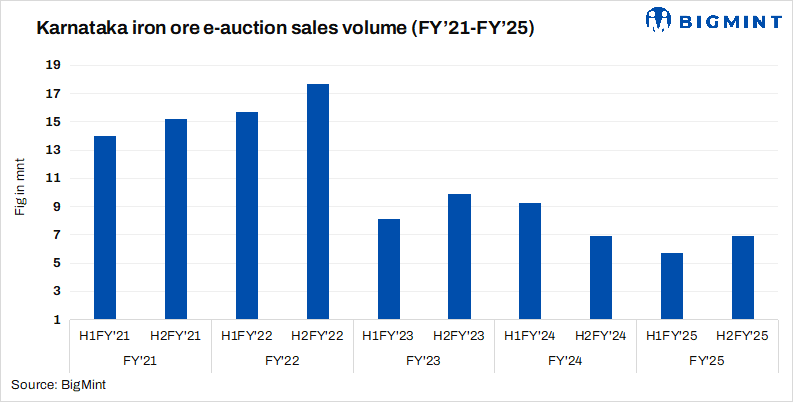
- NMDC’s LTA contracts impact total offered volumes in auctions
- Logistical problems, strikes, extended monsoon, MRT bill affect sales
Iron ore e-auction sales volumes in Karnataka dropped significantly by around 22% y-o-y to 12.66 million tonnes (mnt) in FY’25 against 16.15 mnt in FY’24, data maintained with BigMint shows. Meanwhile, e-auction sales volumes totalled 1.01 mnt in March, marking another 23% m-o-m decline from 1.31 mnt in February.
The decline in volumes has been attributed to several factors, including NMDC’s long-term agreement (LTA), union agitation by NMDC workers, frequent transport disruptions, an extended monsoon season last year, and the late-year announcement of the Mineral Rights and Mineral Bearing Land Tax Bill (MRT, still pending), sources informed BigMint.

NMDC tops the chart but volumes drop
- National Mineral Development Corporation (NMDC), India’s largest iron ore miner, sold around 9.11 mnt from Karnataka via auctions in FY’25, a y-o-y fall of 19% against 11.2 mnt in FY’24. Although the miner emerged as the leading auctioneer during the review period, it witnessed a sharp decline in e-auction sales volumes. This drop was primarily due to reduced offerings and a large number of auctions went unresponded toward the end of CY’24.
- Karnataka State Minerals Corporation Limited (KSMCL) emerged as the second-leading miner, selling around 1.43 mnt of iron ore in FY’25, a sharp fall of 51% y-o-y compared to 2.9 mnt in FY’24. The miner’s attempt to incorporate the MRT into its e-auction price structure led to a lack of bidder interest, resulting in the majority of auctions failing to attract any bids.
- Sandur Manganese and Iron Ores (SMIORE) reported auction sales of 1.21 mnt in FY’25, largely stable from 1.2 mnt sold in FY’24.
- Vedanta sold 0.65 mnt of iron ore in FY’25, a sharp 63% increase y-o-y as compared to 0.4 mnt in FY’24.
Why Karnataka iron ore e-auction sales dropped in FY’25?
- NMDC’s Long-Term Agreements (LTA): NMDC adopted a strategy of signing LTA for iron ore sales from its Donimalai mines in Karnataka in December 2023. These LTAs involved contracts with Karnataka-based players, where 80% of the iron ore was sold directly under the agreements, and only 20% was auctioned. This approach, although aimed at stabilising sales volumes and providing price certainty through direct sales while still utilising auctions for price discovery, impacted the offered volumes from the respective mines.
- NMDC’s union agitation: In May 2024, NMDC workers staged protests demanding wage revisions, which disrupted operations across multiple units and impacted rake dispatches. Additionally, a work-to-rule protest in March 2025 resulted in a 30-40% drop in daily iron ore production at NMDC’s Kirandul, Bacheli, and Donimalai mining complexes, according to an official press release on the company’s BSE handle.
- Bid-offer disparities: During the review period, BigMint noted a decline in auction volumes, driven by the exit of certain miners from the market and the limited offerings from those who remained. Furthermore, a few miners set prices significantly out of line with prevailing market rates, resulting in a notable bid-offer disparity. As a consequence, a substantial volume of material remained unsold.
- Frequent transportation strikes: A series of strikes by lorry drivers hindered iron ore dispatches and created logistical challenges. As a result, with growing concerns over supply chain stability, miners reduced the volumes on offer.
- Extended monsoons & logistical difficulties: The region experienced an extended monsoon with continuous rainfall, resulting in flooded mines and hampering efficient mining operations in the last financial year. Workers struggled to operate under these conditions, and the persistent weather delays slowed down the extraction process, ultimately reducing overall output. Additionally, the prolonged rains created logistical challenges that further impacted production.
- MRT bill announcement: The Karnataka government’s new tax policy, introduced toward the end of last year, has created uncertainty within the mining sector. The policy imposes a tax of INR 1/t on mineral-bearing areas in auctioned leases, along with an additional INR 100/t specifically for iron ore-producing regions. For non-auctioned mines, the tax is set at three times the royalty rate. While intended to enhance state revenue, the policy has significantly increased operational costs for both miners and steel producers. Consequently, auction activity slowed toward the year-end, as miners awaited greater clarity and buyers held off on purchases pending further details. In a recent development from early April 2025, regional sources reported that the Governor has forwarded the bill to the President after reviewing the required reports from the state government. An official statement on the matter is expected within the next six to seven months.
E-auction prices rise y-o-y in FY’25
The yearly weighted average e-auction prices of iron ore fines (Fe 60%) stood at INR 3,571/t ($41/t) and lumps (10-40 mm, Fe 63%) at INR 4,579/t ($53/t), an increase of INR 429/t ($5/t) and INR 163/t ($2/t), respectively. Prices are on ex-mines basis, excluding royalty, DMF, and NMET. Despite a y-o-y decline in e-auction sales volumes during the year under review, prices rose compared to the previous year. This increase was driven by concerns over the supply of high-grade materials, which led to premium bids in auctions.

However, on a monthly basis, prices of fines and lumps showed mixed trends as fines prices remained stable while lumps prices decreased by around INR 100/t ($1/t) in March 2025.
Outlook
The proposed MRT is expected to significantly affect Karnataka’s mining and steel industries. According to industry sources, demand for steelmaking raw materials in the region is likely to remain subdued. Stakeholders express concerns that the bill could increase mining costs, destabilize the market, and undermine the sector’s overall competitiveness. However, bill is still pending with the authority. Notably, Karnataka stands as India’s 2nd-largest iron ore-producing state, with volumes at 46 mnt in FY’25.
Leave a Reply